Folk
Folk Trio Stage Plot Template for Small Venue Gigs
A folk trio stage plot template with acoustic guitar, banjo and upright bass, three vocal mics for harmony, and a wedge per player for your next small room gig.
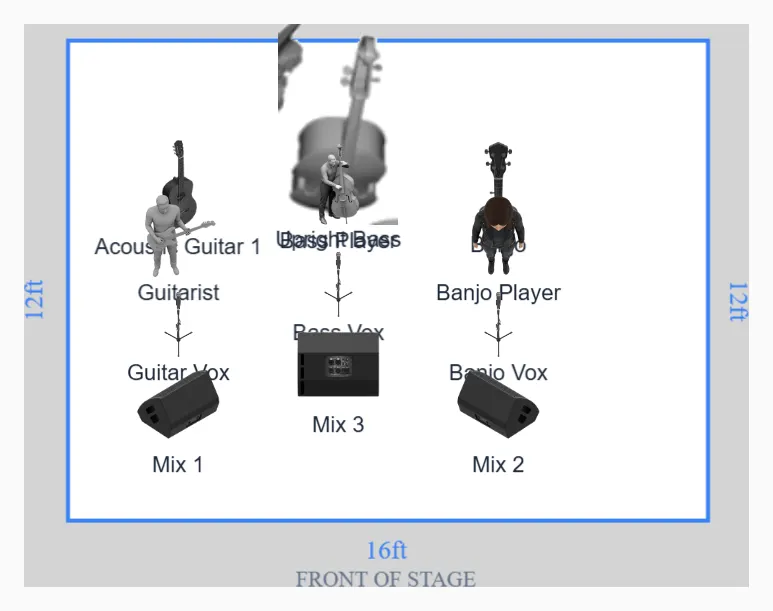
The upright bass decision comes before everything else
This trio lives on a 16 by 12 foot deck, which is a small stage for an instrument the size of a double bass. The upright sits upstage centre at 8 feet across and 2 and a half feet from the back wall, with the bass player standing just downstage of it. That leaves the front half of the deck for the other two.
How that bass gets into the PA is the single most consequential line on your input list. There are three realistic answers and only one of them survives a small room.
A piezo pickup under the bridge foot, or a wing mounted transducer, is the default for a reason. It has no acoustic feedback path, it rejects the banjo 4 feet away completely, and it takes compression without complaint. It also sounds like a pickup, which is to say slightly plasticky in the low mids, and players who care about tone hate it. A large diaphragm condenser aimed at the f hole from 8 inches sounds enormously better and it is the wrong choice on a 16 foot stage, because at 8 inches from a bass you are also 4 feet from a banjo, and the banjo will be louder in that mic than in its own. The third option is both, blended, which is genuinely good and costs you a second channel plus a phase relationship somebody has to check. Say which one you are bringing in the advance, because the engineer's answer changes depending on the room. There is more on how those choices behave live in the microphone selection guide.
A banjo runs 10 dB hotter than the guitar beside it
The banjo sits at stage right, 12 feet across, and the acoustic guitar at stage left, 4 feet across. Eight feet apart, which is as much separation as this stage can offer.
They are not equal sources. A banjo head is a drum, and a hard driven five string peaks around 100 dB SPL at a foot. A flatpicked dreadnought sits closer to 88. That 10 to 12 dB gap means the two channels never take the same gain, never take the same compression, and never sit at the same fader. If the banjo goes through a pickup, it also has a much hotter output than the guitar pickup, which stacks another 6 dB on top at the preamp.
The consequence on this plot is not front of house. It is the wedges. The guitarist asking for more of themselves is really asking to be heard over a banjo, and the fix is almost always less banjo in that wedge rather than more guitar. Ask for it that way.
Three vocal mics on a stage 12 feet deep
Each player sings into their own tripod boom. The guitar and banjo mics sit at 7 and a half feet downstage, the bass mic a foot upstage of those because the player is standing behind a large instrument and cannot come forward.
Eight feet of separation between the outer two mics gives you roughly 24 dB of rejection against a singer 6 inches off their own grille. The bass vocal is the weak link at 4 feet from each neighbour, which is around 18 dB, and it is also the mic most likely to be pointed at the neck of an upright. Angle it slightly away from the instrument rather than straight down the centre line, and accept that this channel will always have bass bleed in it. High pass it at 100 Hz and stop fighting.
Wedge levels when nothing on stage is loud
Three wedges, one per player, sitting 2 and a half feet from the front edge for the outer two and a foot upstage for the bass wedge. The reason for that offset is that the bass mic is already upstage, and putting its wedge in line with the others would put a box 5 feet from a capsule with nothing between them.
Total stage volume on this plot is maybe 82 to 88 dBA. That is quiet, and quiet is harder, not easier. A vocal mic on a soft folk singer wants 45 to 55 dB of preamp gain against maybe 20 dB for a snare, and every one of those extra decibels amplifies your own wedge along with your voice. A folk trio hits feedback at a wedge level a rock band would consider silent. Build the mixes sparse: vocal first, the instrument you cannot hear acoustically second, and nothing else unless somebody asks. The general request order is in the monitor mix guide.
If the room is smaller than the plot
Coffeehouses and brewery corners routinely offer less than 16 by 12. Before you agree to anything, get real numbers from the venue using the stage dimensions guide, because an upright bass needs about 3 feet of depth on its own and a player behind it.
- Swap the banjo for a mandolin or dobro. Same channel, quieter source, and you can move the two flanking positions a foot closer.
- Only two singers. Drop the third mic. Two open capsules on a small stage is a meaningfully quieter night.
- No wedges at all. In a genuinely small listening room, three people standing 8 feet apart can work off the room. Try it at line check.