Jazz
Jazz Trio Stage Plot Template for Club and Lounge Gigs
A jazz trio stage plot template with piano, upright bass and a compact mic kit, plus a wedge per player, ready for any club, lounge or restaurant booking.
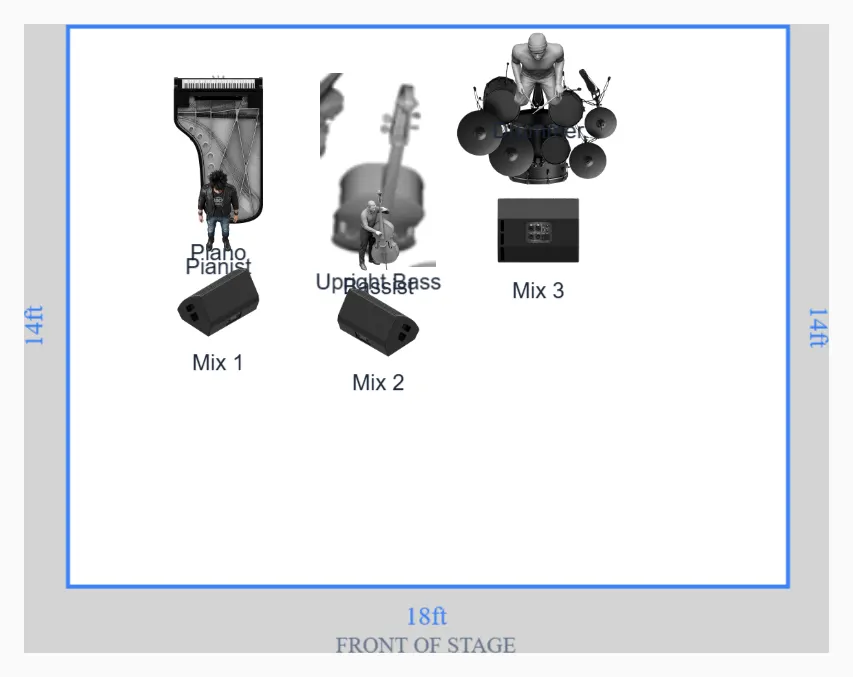
Three players and not one vocal channel
This is the only plot in the library with no vocal on it anywhere. That single absence changes every decision downstream. There is no handheld to ring out, no lead source to build the monitor mixes around, and no reason for the PA to do much beyond filling the back third of the room. If you take one thing from this template, take that.
The footprint is small on purpose. An 18 by 14 foot area holds a grand piano at stage left with the pianist seated behind it, an upright bass at centre about 9 feet across, and a four piece kit at stage right. All three players sit within about 2 feet of the same upstage line and roughly 4 feet apart from each other. That proximity is the design. They can hear one another acoustically, which means the console is solving a much smaller problem than it would on a wider stage.
Reinforcement is a different job than amplification
Most rooms that book a trio own a PA sized for a rock band and an engineer whose instinct is to make everything present. Resist that. The inputs on this plot exist to lift the ensemble over the room noise, not to become the sound of the ensemble.
A practical test: stand at the back wall during soundcheck and ask whether the drummer's ride cymbal is arriving off the stage or out of the boxes. If it is coming off the stage, the balance is right and the PA is only carrying the piano and the bass, which are the two sources that genuinely lose to a full room. If the ride is arriving from the mains, the overheads are several dB too loud and the mix will fight the room all night.
Input count lands between four and eight. Piano is a pair inside the lid. Bass is one channel from a pickup or a small diaphragm mic near the bridge, and it is worth naming which one you bring rather than leaving it to whatever is in the venue's box. Drums run anywhere from a single overhead to kick, snare and a pair, depending on the room. That range matters more than the exact number, so state your preference in the advance instead of discovering it at line check. Pickup versus mic on an upright is a real tonal decision, and the mic selection guide covers the trade honestly.
Brushes set the dynamic floor, and the gain follows
A trio that plays brushes for half the set has a quiet floor that a rock gain structure will destroy. Set the drum gain to the brushes, not the sticks, then leave headroom for the two or three tunes where the drummer opens up. Staged the other way around, the ballads are inaudible and somebody spends 40 minutes riding a fader to fix it.
The same logic applies to the piano lid. On the short stick with a pair inside, you get a controlled, slightly boxy sound that sits well against an upright. Fully open, you get a beautiful instrument and considerably more drum spill in the piano channels. On a stage this size, short stick is the safer default.
Three wedges, and one of them may be unnecessary
The plot places a wedge for each player, all within a few feet of their position. That is a fair starting point, but on an 18 foot stage it is often more than the band needs. Try running the piano wedge and the bass wedge only, and ask the drummer whether the wedge at the kit is doing anything. Many drummers in this format say no. Every wedge you leave switched off is more gain before feedback in the piano mics, which are the most open channels on the stage.
Ask for bass in the piano mix and piano in the bass mix. Almost nobody in a trio needs more of themselves. The case for building sends around what a player cannot hear rather than what they play is in the monitor mix guide.
What to change before you send it
- Venue supplies the piano. Confirm whether it is a grand, an upright, or a digital instrument. Each is a different mic plan and a different channel count.
- Bass amp on stage. If the bassist brings a combo, that is a second bass source and it raises the stage volume floor. Put it on the plot.
- Guest singer for two tunes. Add the mic and the stand now. A vocal added at 9pm is a channel nobody gain staged.
- Dinner set then a concert set. Say so. The two want different levels and the engineer would rather know before the room fills. Walk the rest of it through with the soundcheck guide.