Orchestral
Small Orchestra Stage Plot Template with Curved Rows
Build a small chamber orchestra stage plot with elevated cello desks, curved violin and viola rows, double basses, conductor and four section microphones.
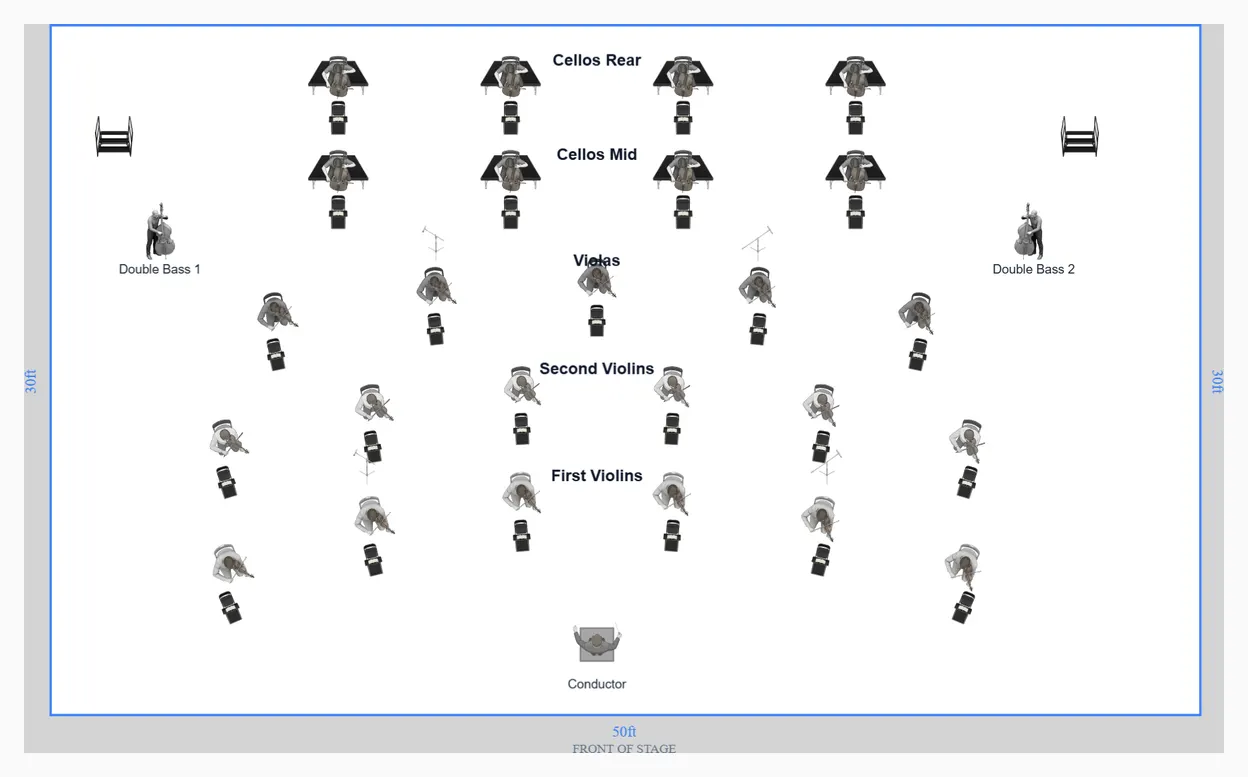
Four microphones for an entire string orchestra
The whole technical argument of this template is that a 50 by 30 foot stage full of strings needs four inputs, not forty. Two spaced pairs cover the section as a section. There are no spot mics, no DIs, and no wedges anywhere on the plot, which makes it the simplest patch in the orchestral category and the one where microphone placement carries almost all of the risk.
The seating runs up the centre line. Two rows of seated cellists sit furthest upstage at 4 and a half and 8 and a half feet in, violas at 13 feet, second violins at 17 and a half, and first violins at 22 feet. The conductor stands at 28 and a half feet, six and a half feet downstage of the front desk, on a podium at the front edge. The two double basses sit out at the wings, one at stage left and one at stage right, 11 feet upstage and roughly 19 feet either side of the centre line.
Two pairs, nine and a half feet of depth between them
The rear pair sits at 11 and a half feet upstage, 14 feet apart, covering the cellos and violas. The front pair sits at 21 feet, 20 feet apart, covering both violin rows. That spacing is not arbitrary. A wider pair over the front rows takes in a wider row without pulling the outside players off axis, and a narrower pair over the rear rows keeps the cellos from drifting hard into one side of the stereo image.
The nine and a half foot depth between the two pairs is the number that will cost you the most if you ignore it. Sound covers roughly 1.1 feet per millisecond, so a cello reaches the rear left condenser about 8 milliseconds before it reaches the front pair. Sum those two open pairs at unity and you get comb filtering in the low mids that reads as a hollow, phasey string tone nobody can EQ away. Two fixes work. Either delay the rear pair by roughly 8 milliseconds to time align it to the front pair, or run the rear pair 6 to 8 dB under the front pair and treat it as fill rather than as a second main. Most engineers do both.
Height and angle matter as much as spacing. Hang or stand each pair 10 to 12 feet above the deck, angled down at the second row behind it, not at the front row. Aim at the front row and you get one desk of players louder than the section they are part of. The mic selection guide covers pattern choice, and on a plot with no close mics at all, cardioid versus subcardioid is a decision with real consequences for how much hall you capture.
There are no monitors on this stage, and that is correct
Not a single wedge appears on this plot. That is deliberate, and it is the biggest structural difference between an orchestral page and a band page. A string orchestra balances itself acoustically by listening across the rows and watching the stick. Putting a floor wedge into that environment does two things, both bad: it adds a source the players did not expect and cannot balance against, and it dumps energy straight into four open condensers that are already running high gain to pick up a section 20 feet away.
If a soloist or a vocalist joins for one movement, they get a wedge, and it lives downstage of the conductor pointing away from the main pairs. The section still gets nothing.
Sightlines and the practical stuff around them
Every desk on this plot has a music stand about 18 inches in front of it, and every stand is a potential sightline blocker to the podium. Stand height is a musical decision that the orchestra will make, but it is worth confirming that the two cello rows on risers can still see over the stands of the row in front once everyone is seated.
The three step stairs sit at 4 and 46 feet across, outside the seating lanes at both wings, so players enter without crossing the centre aisle or stepping over a mic stand base. Confirm riser height with the venue before you commit to this layout at all, because a 16 inch riser and an 8 inch riser change where those pairs need to hang. The stage dimensions guide covers what to ask a venue for. If you are building your own version from scratch, start with how to make a stage plot and add spot mics only where the score actually demands them.