Stageplot Pro /
Jazz Trio Stage Plot for a Small Room: What Fits and Goes
Plan a jazz trio stage plot for a small room: fit upright bass, compact kit and piano on a tiny deck, and decide what stays off when there is no real PA.
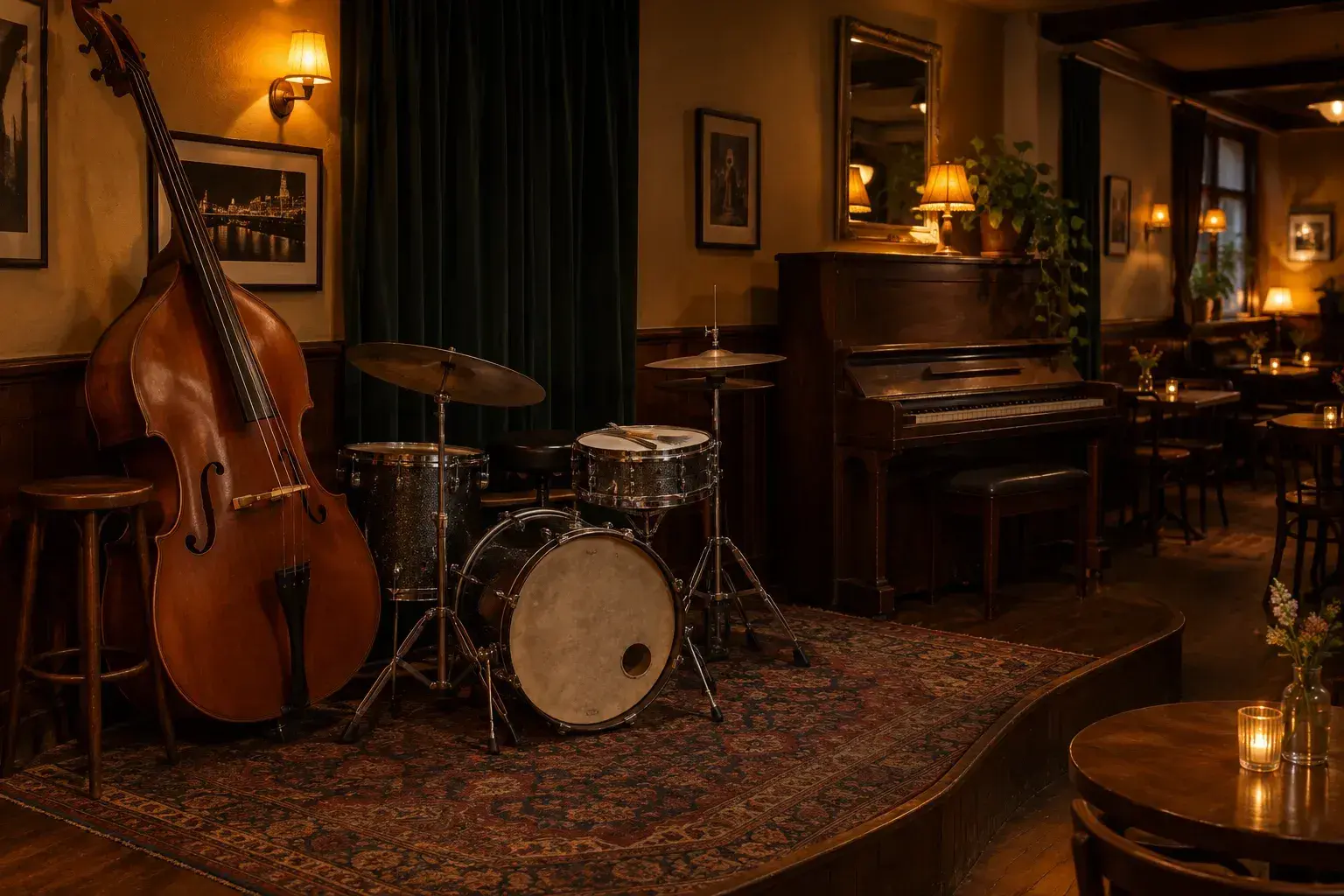
Most listening rooms and restaurants that book jazz have a stage that is really a raised corner: eight feet wide if you are lucky, a step high, with a window or a service door right behind the drummer. You are expected to fit an upright bass, a piano or keyboard, and a drum kit into that space, and to sound good without a house PA worth the name. This post walks through how to plan that gig on paper before you drive there.
How big a stage do three jazz players actually need?
A jazz trio can work on roughly 10 by 8 feet, and many rooms give you less. Allow about 4 feet of width for the piano, 3 for the bassist, and 4 for a compact kit, then accept that everyone will sit closer than they would at rehearsal.
Real measurements beat guesses. Ask the booker for the usable deck, not the room, and note anything that eats floor: a support column, a step edge, a speaker the house owns, a radiator. The stage dimensions guide covers how to turn those numbers into a plot that matches the footprint. For this format, measure three things before you commit to a layout:
- Usable width and depth of the deck, side to side and front to back
- Distance from the back wall to the nearest obstruction behind the drums
- The path from the load-in door to the stage, since an upright in a hard case does not turn corners easily
If the deck is under 8 feet deep, the drummer may need to sit partly on the floor level, and that decision belongs on the plot, not in a panicked conversation at 6:30 pm.
Where do the piano, bass, and drums go on a tiny stage?
Put the piano on the side where the lid can open toward the room, the bass beside the pianist's right hand, and the drums at the back. That layout keeps the bassist and drummer within arm's reach, which matters more than anything else in a trio.
Here is the reasoning behind each choice:
- Piano: an upright or a stage piano against the side wall frees the center. If the venue owns a baby grand, ask which way the tail points and whether the lid stick is allowed, because that decides how the room's acoustic balance will behave.
- Bass: the player stands or sits on a stool near the hi-hat, so the bassist can hear the ride cymbal and see the drummer's hands. Leave room for the neck to swing without hitting a mic stand.
- Drums: a compact bop kit with an 18 or 20 inch bass drum, one rack tom, one floor tom, a snare, and a ride and hi-hat only. A single crash is optional. Brushes and a felt beater are often the deciding factors for whether the room invites you back.
Draw the trio facing each other in a loose triangle rather than in a line facing the audience. A line is the default on most layouts you will find, so start from the jazz trio template and adjust the angles to suit the deck you actually have, keeping a small gap between the bass and the front edge for the bow arm.
What should you leave off the plot when there is no real PA?
Leave off anything whose only job is to fix a sound problem the room does not have. A trio at conversation volume does not need monitor wedges, a drum mic forest, a subwoofer, or an elaborate input list.
Think of the plot as a statement of what the room must provide and what you bring. If the venue has two small powered speakers on stands and a six channel mixer, the plot should say so, and say which of your sources go through it. Typical omissions include:
- Monitor wedges, since the band hears the room and each other
- Kick and tom microphones, because a small kit in a small room is already loud enough
- Direct boxes for the piano if it is acoustic
- Any in-ear system or stage snake, which would take more floor space than the instruments themselves
What stays is deliberately short: a note that the band is acoustic, a power request for any electronic keyboard, and the phone number of the person who will actually be there on the night. A plot that is half empty reads as confident, not careless.
Which instruments need a microphone or a direct box?
Only the upright bass reliably needs help, and even then many rooms do fine without it. If the house gives you a speaker, take the bass through a clip-on pickup and a small preamp, with a vocal mic reserved for announcements.
Gear that suits this setup is modest. A preamp with a direct output such as a Fishman Platinum Stage EQ, or a compact unit like the Grace Design Felix, handles an under-saddle or bridge pickup cleanly. A single small-diaphragm condenser on the piano, placed over the open lid, is enough if the room has speakers at all. The drummer needs nothing.
If you carry a stage piano rather than relying on the house instrument, give it a stereo pair of cables and note it as two outputs, because a mono sum folds the width of a good patch down to nothing. Whatever you amplify, label it clearly on the plot so a server with a mixer manual can set it up in five minutes.
How do you set levels when you are the sound engineer?
Set them by walking the room, not by looking at a meter. Start with the drums at the level you will play, bring the bass up to meet them, and then place the piano so that the whole trio blends from the back table.
A workable order for a ten minute check:
- Play a quiet swing groove and walk to the farthest seat. If you cannot hear the bass line there, raise the bass first.
- Ask the staff to stand at the bar and listen while you play your loudest tune.
- Place a small speaker so it points across the room rather than at the first table.
- Take a short break, then recheck with the room half full, because bodies absorb the low end.
Sound from the stage hits the front tables first, so a trio often wins by turning down rather than up. Brushes, a drummer who stays under the ride, and a pianist who treats the lid as a volume control are cheaper than any gear you can buy.
What information belongs on the plot you send ahead?
Send a one page diagram with each position labeled, the stage size you planned for, and a short list of what you carry and what you ask the venue to supply. Keep it visual, and keep the text to the facts a manager can act on.
Include a few details that most trios forget:
- A seat or stool for the bassist and a heightened drum throne
- Two power outlets within reach of the piano position
- Clear permission to place a floor mat or small rug under the kit
- Where you load in, and how long you need to load out between sets
Edit the dimensions to match your deck once the venue confirms them. If a venue later sends a smaller measurement, export a second, compact version and keep both on your phone.
How do you handle a room that surprises you on the night?
Keep a fallback arrangement in your head and tell the band before you arrive. Typically that means swapping bass and piano sides, moving the drummer forward a foot, or playing the first set unamplified and adjusting after you hear the room.
Surprises tend to repeat: a piano with a sticky pedal, a stage that is a set of risers rather than a fixed platform, or a manager who wants a speaker on your side of the stage for the bartender. Treat each as an agreed change rather than a problem. A trio that adapts without drama gets rebooked, and rebooking is the real aim of every plot you draw.
Frequently asked questions
- Do I need a PA for a jazz trio in a restaurant?
- Usually not. A piano, an upright bass, and a kit played with brushes or light sticks fill a small dining room acoustically. If you want the bass lifted, one small powered speaker and a clip-on pickup are enough, and anything more can stay in the car.
- How much stage space does a jazz trio need?
- Plan for about 10 by 8 feet for comfort, and be ready to work in 8 by 6 if the room insists. Measure the usable deck, not the room, and note obstructions like columns, steps, and radiators before you finalize positions.
- Where should the drummer sit in a small jazz room?
- Toward the back or a rear corner, with the ride cymbal angled so the bassist can hear it and see the drummer's hands. Keep the kit compact, with an 18 or 20 inch bass drum, and put a rug under it to stop creep.
- Should I send a stage plot to a small venue?
- Yes. A one page diagram with positions, stage size, power needs, and a short list of what you bring and what the venue supplies saves time on load-in and shows the booker you are organized.