Worship
Full Worship Band Stage Plot Template for Church Teams
A seven piece worship band stage plot template with dual guitars, keys and two vocal mics laid out, so your production team can advance a full service fast.
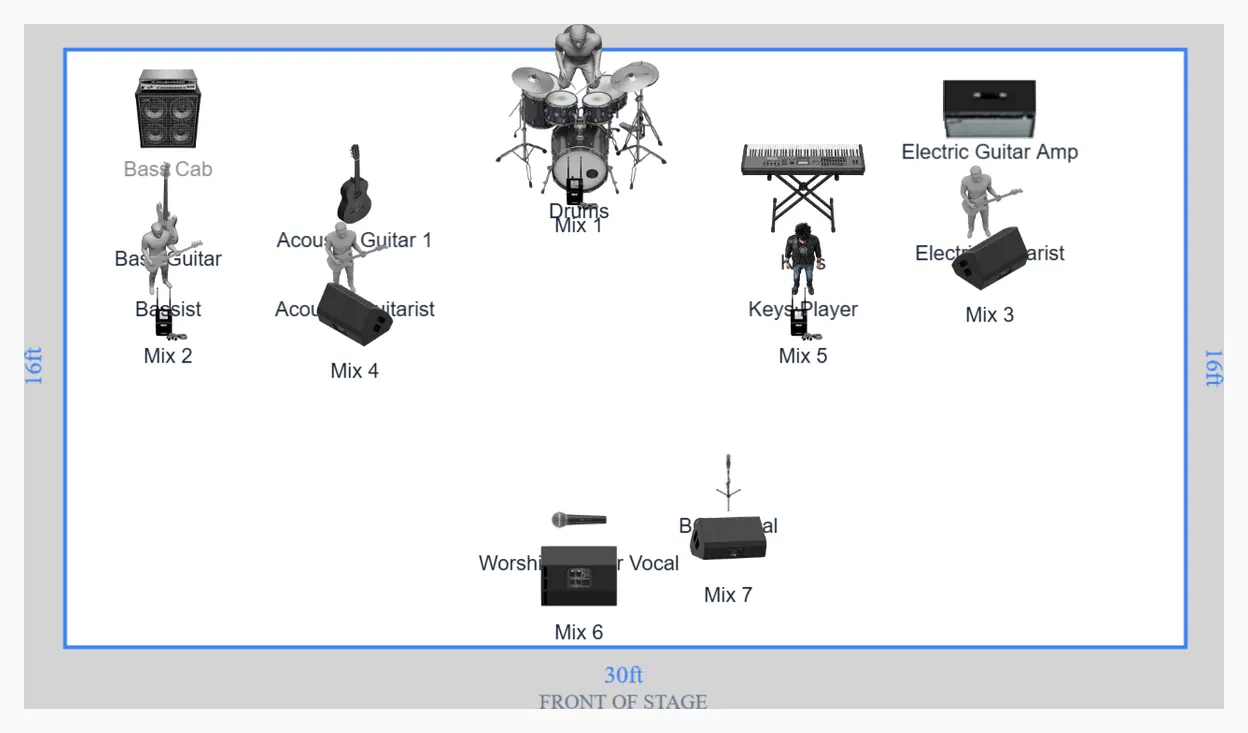
Three players on ears, four on wedges, one platform
The interesting line on this plot is invisible in the room. Drums, bass and keys each have an in ear pack. The electric guitar, the acoustic guitar, the worship leader and the backing vocalist all have floor wedges. Seven monitor mixes, split into two different worlds on a platform only 30 feet wide and 16 feet deep.
Most teams end up here by accident, buying two or three IEM rigs and running out of budget. It is worth arriving on purpose instead, because the split maps cleanly onto who has to be locked to a timing reference and who does not.
The click decides who has to be on ears
If your team runs a click and multitrack playback, and most seven piece contemporary worship bands do, the click is the reason for the whole arrangement. A click in a floor wedge bleeds into every open microphone inside fifteen feet, and on a 16 foot deep platform that means all of them. The congregation hears a faint ticking under the quiet moment in the bridge, and the only real fix is to stop putting it in a wedge.
So the three players who need the click are on ears: the drummer, who is driving it, the bassist, who is locked to the drummer, and the keys player, who on most teams is also running the playback rig. The two guitarists and the two vocalists get tracks in their wedges but never click. Write that split into the plot in words, because an engineer who has not run tracks before will default to copying one mix everywhere.
That also means the two worlds want structurally different mixes. An IEM mix wants the whole band, the click, and a little ambience so the player does not feel sealed off from a room full of people. A wedge mix wants the lead vocal first, the player's own instrument second, and almost nothing else. Copying an IEM mix into a wedge is how you end up with a stage that howls. The distinction is unpacked in the wedges versus in ear monitors guide.
The acoustic guitar is the channel that starts the arguments
The acoustic sits at the 9 foot mark stage left, and it is the one channel on this plot with no obvious right answer.
A pickup straight to a DI is one channel, needs no stand, and never feeds back, but it sounds like a pickup. A preamp pedal with an XLR out sounds better and may want phantom down the line, so say which. A condenser in front of the soundhole sounds best and is a bad idea on a platform this shallow with four wedges open. On a 30 by 16 foot stage, the DI wins almost every week.
Say in the advance whether the acoustic arrives as a quarter inch jack needing a box or an XLR from a pedal, and whether that pedal is running on a battery or expecting the desk to feed it. A preamp that dies in the second song is nearly always a battery nobody checked. The phantom power guide covers what is safe to send down which line.
Sixteen channels and a shallow platform
The count runs four to nine for the five piece kit depending on how far you go with tom mics, one bass DI, one on the Fender combo at stage right, one acoustic, a stereo pair from keys, the leader on a wireless handheld at centre and the backing vocal on a boom stand beside them.
Sixteen feet of depth is the real constraint. The kit is at two feet, the players are at four to six, and the vocalists are at twelve to thirteen. That leaves under four feet between a live vocal capsule and the leader wedge at 14.5 feet. Aim that wedge deliberately off axis from the capsule and you buy back several dB before it rings, which matters more here than any graphic EQ.
When a guest band walks into your hybrid rig
The hybrid split is great for a resident team and confusing for a visiting one. A guest band that runs everyone on ears will not want your four wedges, and a guest band on all wedges will need three more mixes than you have set up.
Send this plot out with the booking, not the week of, and ask one question back: are you on ears, on wedges, or split, and do you carry packs. That question belongs in a standing document rather than an email thread. The tech rider guide explains how to write one your church can reuse for every guest artist for the next five years.