Acoustic
Acoustic Duo Stage Plot Template for Small Venue Gigs
A ready to use acoustic duo stage plot template with vocal mics, guitar inputs, and monitor placement so you can prep your next small venue gig in minutes.
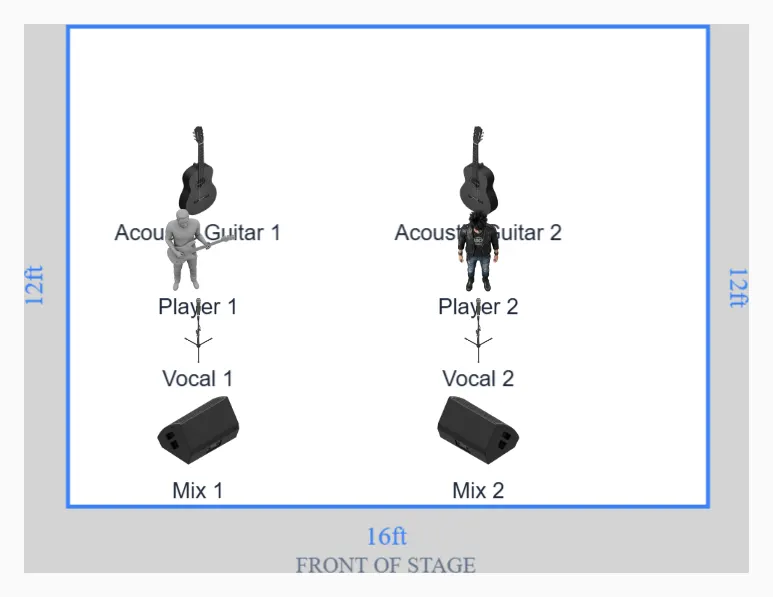
Two of everything, seven feet apart
A duo is the first setup where symmetry starts doing real work for you. This template lays out a 16 by 12 foot deck as two mirrored halves. Stage left holds the first acoustic guitar with the player standing behind it, and stage right holds the second guitar with the second performer in the same relationship. The two positions sit 7 feet apart on centre, which is the number worth defending when a venue tries to squeeze you onto a 10 foot corner.
Each performer sings into an SM58 on a tripod boom placed 2 feet downstage of where they stand, and each has their own floor wedge another 2 and a half feet further out, about a foot and a half in from the front edge. Eight objects, four of which are inputs. That is the whole document, and it reads in about five seconds.
Four channels, two mixes, and the arithmetic that follows
Two guitars and two vocals gives the engineer four inputs. It is a small number that hides one genuinely consequential decision, which is how each guitar arrives at the stagebox.
If both players run pickups into a passive box, that is two DI channels and the venue supplies both boxes. If one player runs an XLR straight out of a preamp pedal and the other hands over a quarter inch jack, say so, because those are two different lines with two different gain structures and the engineer will set them up wrong if the plot implies they are the same. It is worth understanding what a DI box is actually doing to the signal before you argue about it at load in.
The alternative is a small diaphragm condenser on each guitar. It sounds better in a listening room and it is a bad idea almost everywhere else. Two open instrument mics 7 feet apart, plus two open vocal mics, plus two wedges pointed back at all four of them, is four feedback paths on a stage where the loudest source is a strummed dreadnought. A pickup has no feedback path at all, which is why duos playing bars almost always go direct.
Two wedges is not a luxury on a 16 foot stage
The most common note we get on this template is that one wedge would be cheaper. It is, and it is worse, for a reason that is just geometry.
With a wedge in front of each player, the box is roughly 2 and a half feet from that performer's ears. Move to a single shared wedge at centre and the distance becomes about 4 and a half feet on the diagonal. Doubling the distance from a source costs you 6 dB, so a shared box has to be run 4 to 5 dB hotter to deliver the same level to each singer, and every one of those decibels lands in two live vocal capsules instead of being aimed usefully. Two quiet wedges beat one loud one, and on a duo the difference is audible within one song.
The second reason is that a shared wedge means a shared mix. In a duo those two mixes are rarely the same. The person singing lead wants their own voice on top. The person singing the harmony line above it usually wants more of the lead vocal than of themselves, because a harmony is tuned against something. Give that to one aux and you are asking two people to agree about pitch reference, which they will not.
If you would rather cut the wedges entirely, the tradeoffs are laid out in the wedges versus in ear monitors comparison. A duo is one of the few band sizes where a two pack IEM system is genuinely affordable.
Quiet stages need more gain, not less
Acoustic acts assume they are easy on the engineer because they are quiet. The opposite is true at the preamp. A snare hitting a mic puts 120 dB SPL into the capsule and needs about 20 dB of gain. A softly sung verse at 6 inches might put 90 dB into the same mic and need 45 to 50 dB. That extra 25 dB of gain applies equally to everything the mic hears, including your own wedge, so a duo sits much closer to the ringing point than a rock band ever does.
The practical answer is to sing close. Two inches off the grille instead of six buys you around 10 dB of level for free, and that 10 dB is 10 dB of headroom you did not have to ask for.
When the duo is not symmetric
- One player sings, one does not. Delete a vocal mic and a wedge. Three channels, one mix, and the plot gets simpler rather than emptier.
- A stomp box, cajon, or shaker. That is a fifth channel and it belongs on the plot, because a percussion source changes the whole gain conversation.
- Backing tracks from a phone. A stereo pair on top of your four, and it needs a power drop and a spare cable nobody planned for.
- Restaurant gig with no engineer. Set both wedges low and leave them there. Nobody is riding the desk when the room fills.
Rename the four channels to match your rig, export the PDF, and paste it into an advance email a few days out. A duo that sends paperwork gets treated like a band.