Bluegrass
Bluegrass Five Piece Stage Plot Template for Live Gigs
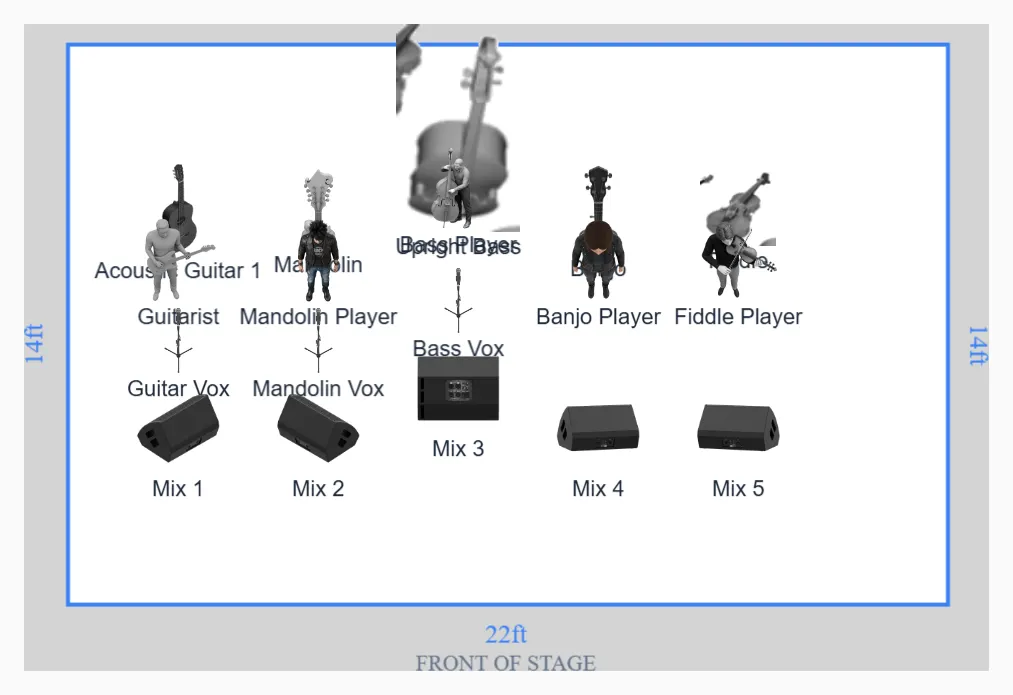
A bluegrass five piece stage plot template with guitar, mandolin, banjo, fiddle and upright bass, shared vocal mics and a wedge per picker for the whole band.
One condenser or eight channels: decide before you load in
Bluegrass is the only genre on this site where the traditional answer and the modern answer are both correct, and picking the wrong one costs you the show. The traditional answer is a single large diaphragm condenser at centre with the band choreographing around it, stepping in for solos and back for rhythm. The modern answer is what this template draws: every instrument on its own line, every picker on their own wedge.
The single mic wins in a listening room, a theatre, a radio session, or a festival with a competent engineer and a band that has actually rehearsed the choreography. It sounds like the record because it is one acoustic image rather than five stitched together, and the band mixes itself in real time by moving. It requires stage volume near zero, which in practice means wedges almost off or none at all.
The multi mic plot wins everywhere else: bars, breweries, wedding and corporate work, outdoor stages with wind, any room where the audience talks, and any festival slot with a 15 minute changeover and a shared console. It also wins any time the band has a fill in player who has not learned where to stand. If you carry both, say which one you are running in the advance rather than deciding on the day.
Five pickers across 22 feet
The layout puts the upright bass upstage centre at 11 feet, 2 and a half feet off the back wall, with the other four in a line 4 and a half feet from the back. Guitar at 4 feet, mandolin at 7 and a half, banjo at 14 and a half, fiddle at 18. Three vocal mics, at the guitar, mandolin and bass positions, sit a little over 3 feet downstage of the players.
Note the spacing is not even. Guitar to mandolin is 3 and a half feet, banjo to fiddle is the same, but the middle of the stage is open. That gap is where a soloist steps forward, and it is also what keeps the two loudest instruments in the band away from the two quietest.
The banjo and the fiddle are 15 dB apart
This is the number that makes bluegrass hard. A hard driven five string banjo peaks near 100 dB SPL at a foot. A fiddle played into a close mic sits around 88, and the same fiddle played quietly under a vocal is closer to 80. Mandolin lands between them at roughly 90 with a much sharper transient.
Practically, that means five instrument channels that share nothing. The banjo takes low gain and usually a limiter. The fiddle takes high gain and a slow attack so the bow noise does not get squashed into the note. Set them from the same starting point and the banjo will be clipping while the fiddle is inaudible. Ask the engineer for a proper instrument by instrument line check rather than a group pass, which is exactly the situation the soundcheck guide is written for.
The dynamic spread also explains why gain before feedback is worse here than on a louder stage. The quiet sources need 45 to 55 dB of preamp gain, and every one of those decibels applies to the wedge bleeding into that same mic. A bluegrass band rings at a wedge level a rock band would call off.
Three vocal mics, five people, everybody moves
Only three positions get a vocal mic, which is how most working bands run it. The guitar and mandolin mics carry the lead and the tenor, and the bass mic picks up the baritone or bass part. Banjo and fiddle sing into a neighbour's mic by stepping over, which is the part engineers never see coming.
Put it in your notes. If your banjo player crosses 6 feet to share the mandolin mic on the choruses, that mic needs more gain than a single singer would justify, and the wedge under it needs to be running low enough that a second body in front of it does not start a ring. Failing to flag stage movement is one of the more common stage plot mistakes and it costs a band real level.
Five wedges on a stage with no drummer
Every picker gets a wedge, positioned about 4 feet from the front edge except the bass, whose box sits a foot upstage in line with the player. Five mixes on a 22 foot stage is a lot of aux sends for an acoustic band, and it is justified here only because the instruments are so unequal. The fiddle player needs banjo turned down. The banjo player needs to hear the fiddle at all. Those are opposite mixes and they cannot share a send.
Keep every wedge sparse: yourself, the bass for time, and whatever you cannot hear acoustically. On a festival bill where you are getting a shared console and no line check, plan a reduced version of this in advance rather than improvising, and read the festival stage plot guide for how much of your monitor request is likely to survive.