Planning
Stage Plots for Festival Sets and Fast Changeovers
How to build a stage plot for a festival slot, where a stage manager who has never met you has minutes to read it, patch it, and move on to the next act.
By Stageplot Pro Editorial Team Updated
The reader is different, so the plot has to be different
A club engineer books your gig, gets your paperwork, and probably talks to you on the phone. A festival stage manager gets a folder of thirty stage plots for the day and reads yours for maybe ten seconds before moving on to the next act. Your plot needs to be readable at a glance: clear stage orientation, obvious input numbering, and nothing that requires a phone call to decode.
Design for a changeover clock, not for detail
Festival changeovers run anywhere from 15 to 30 minutes depending on the size of the event, and that clock covers moving gear on and off, patching, line check, and a monitor pass. A stage plot with 24 inputs and six monitor mixes is a liability on that clock even if it is accurate to your real show. Build a festival version of your plot that matches what you can actually patch and check in the time you are given, and save the full version for club dates where you control the clock. Our soundcheck guide breaks down realistic timing for both scenarios.
Shared backline changes your plot
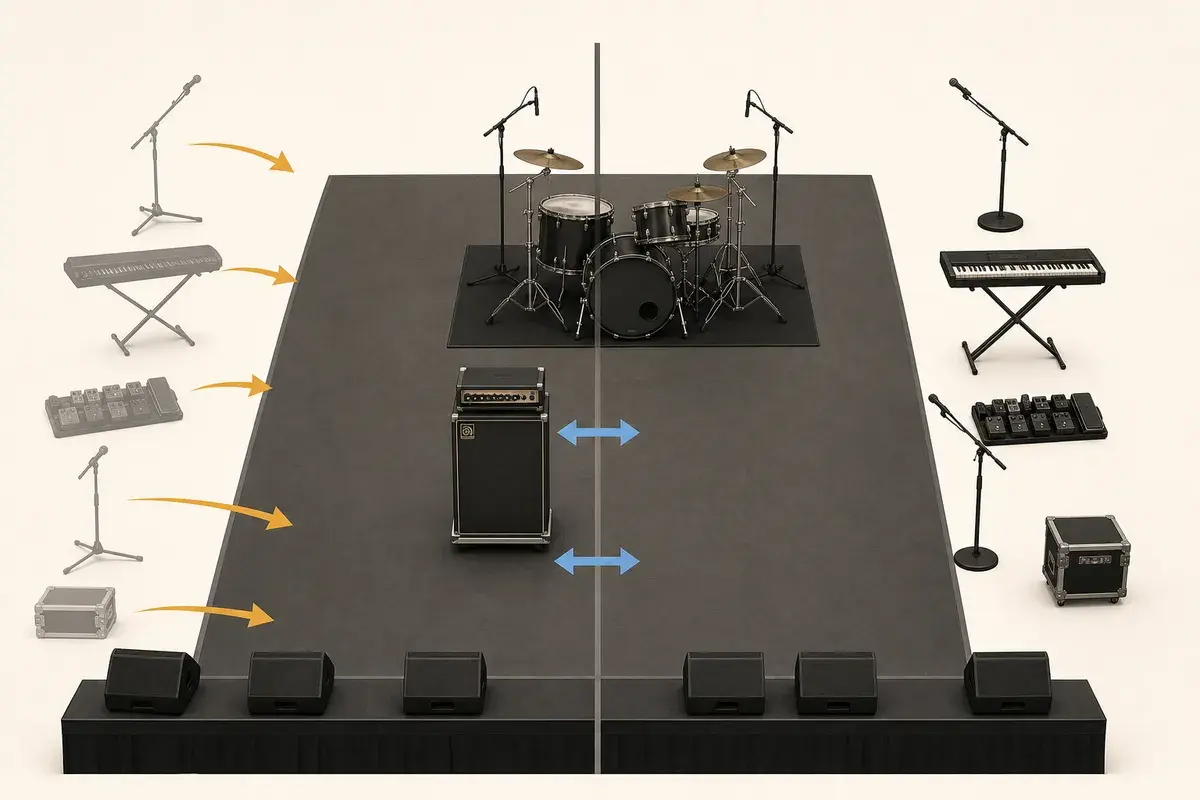
Most festivals run a shared kit, shared bass rig, and sometimes shared guitar amps between acts to keep changeovers fast. If you are playing on house backline, your stage plot should say so clearly, house kit, house bass amp, so the stage manager knows what is already in place and what your band is actually bringing. Bands that draw a full kit and full backline on a festival plot when they are actually using house gear cause real confusion during a fast changeover.
What belongs on a festival advance versus the full stage plot
A festival advance usually wants three things: your stage plot, your input list, and a short note on anything unusual, tracks, click, in-ear packs, extra risers. Keep the plot itself focused on placement and inputs. Save detailed monitor notes and channel-by-channel processing requests for a tech rider, which the festival's monitor engineer will read separately if they read it at all before you arrive. Our tech rider guide covers what belongs in that document instead of on the plot itself.
Drawing to scale still matters
Even under time pressure, keep your festival plot to scale relative to the actual stage footprint you were told you have. A plot drawn for a wide club stage does not translate cleanly to a narrower festival stage shared with side-fills and monitor world. Our stage dimensions guide covers how to check your actual footage before you finalize placements.
Mic count for a changeover
Fewer mics, faster changeover. A full eight-mic drum kit that takes ten minutes to patch and ring out is the wrong call on a 20 minute changeover. Our drum mic guide covers the minimal kit that still sounds full without eating your whole changeover window on cabling alone.
Label for someone who has never heard of your band
A club engineer might already know your lineup from a previous show. A festival stage manager almost never does. Label every position in plain terms, lead vocal, drums, bass, not nicknames or inside references that only make sense to your band. The same goes for input numbering, number left to right or in patch order consistently across your whole plot so nobody has to reverse-engineer your logic while a changeover clock runs.
Weather and outdoor stage realities
Outdoor festival stages introduce variables a club stage does not have: wind affecting mic stands and loose cables, direct sun on gear that usually lives indoors, and sometimes a covered stage roof that changes rigging options for overhead mics. If your set includes anything wind sensitive, an acoustic instrument with an open-backed condenser mic, mention it on your advance paperwork so the stage manager can plan mic choice or windscreens ahead of time rather than improvising with whatever is on hand.
Build in time for the unexpected
Even a well-planned festival changeover can slip because of the act before you, a broken cable, or a stage manager juggling three problems at once. Plan your own setup so the parts you control, your mic count, your input list, your labeling, are not the reason for a delay. A band that is ready the moment the stage is clear gets goodwill from the crew that a band scrambling to find a cable does not, and that goodwill matters the next time you are booked at the same festival.
Templates that scale to festival lineups
If your festival lineup is bigger than your normal club setup, horns sitting in for the tour, an extra vocalist, start from a template close to your actual headcount rather than modifying a two-piece plot into something it was never built for. A ska six piece template or a funk band with horns template both show how larger festival-style lineups lay out cleanly with numbered inputs. Build it in the Stageplot Pro editor, export it, and send it to the festival production office ahead of their deadline, not the morning of the show. Our blog post on festival season prep covers the rest of the advance checklist beyond the stage plot itself.
Keep a club version and a festival version
Once you have built a leaner festival plot, keep both versions on hand rather than overwriting your regular club plot every festival season. Your club shows still benefit from the fuller mic count and monitor detail your usual room can support, while your festival plot stays ready to send the moment a new slot gets confirmed, without you rebuilding it from scratch every time a festival advance deadline comes around.