Choir
Choir with Piano Stage Plot Template for Worship Services
A choir with piano stage plot template with a stereo piano feed, overhead choir mics and a soloist mic, plus wedges, ready for your next worship service.
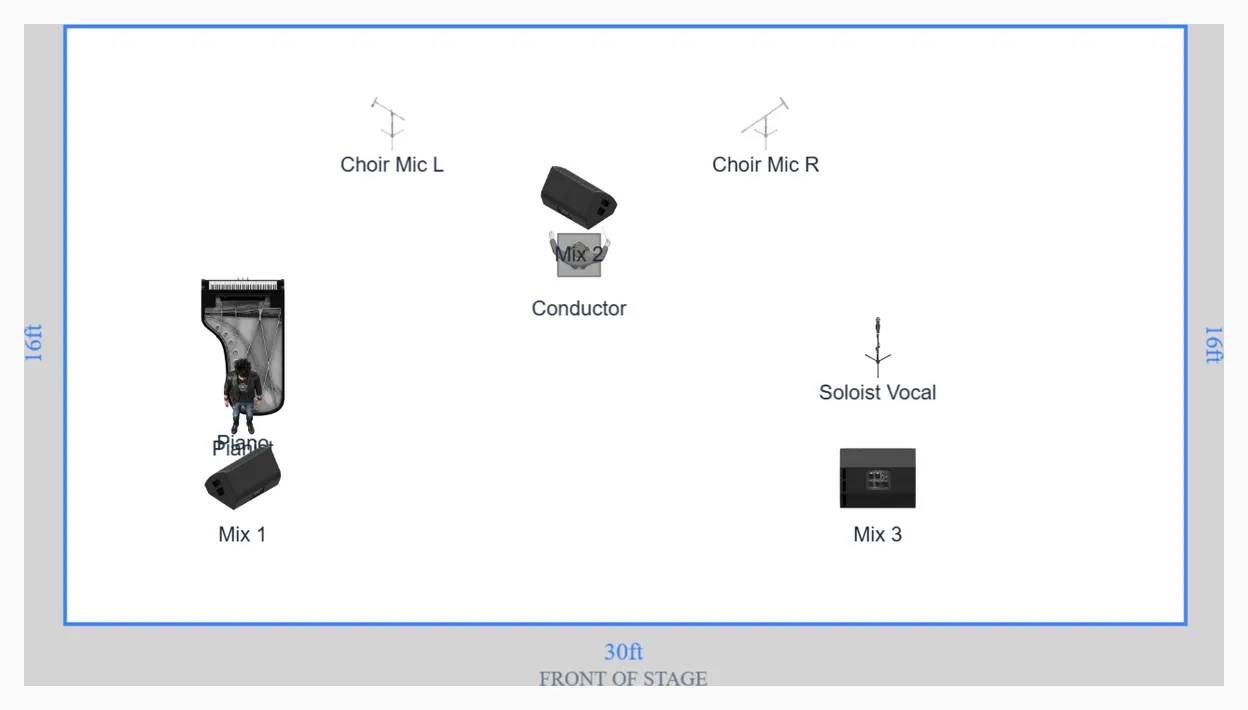
Two microphones for the entire choir
A choir pair is the least forgiving mic setup in this whole library. There is no close mic to fall back on, no fader that isolates the alto section, and every mistake in placement shows up as a permanent tonal problem rather than something you fix in the mix. On a 30 by 16 foot stage the plot gives you a left condenser at 10 feet across and a right condenser at 20 feet, both 3 feet from the upstage edge, and asks them to cover a riser section of anywhere from twenty to sixty voices.
Get three numbers right and the pair works. Get them wrong and you spend the service chasing feedback while the tenors are inaudible.
Height, angle, and what 10 feet of spacing actually demands
The pair is 10 feet apart. The 3 to 1 rule says that for two mics to sum without audible comb filtering, the distance between them should be at least three times the distance from each mic to its source. Ten feet of spacing therefore wants each mic within roughly three feet of the nearest singers it is covering. That is much closer than most churches hang them.
Practical placement that satisfies it: mount each mic 2 to 3 feet in front of the front row and about 3 feet above the head height of the back row, angled down at the back row rather than at the front. Aiming at the back row is the part people skip, and it is the part that does the balancing. The back row is furthest away and arrives quietest, so putting it on axis and letting the front row sit slightly off axis evens out a section that is 8 or 10 feet deep.
If your riser is wider than about 20 feet, do not simply spread the pair further. A wider pair on the same distance produces a hole in the middle where the middle of the choir goes vague. Either move the pair closer to the front row, or accept a third mic and space all three evenly. Both condensers need 48 volts from the console, so confirm the desk is actually supplying it before Sunday morning rather than during the first hymn. The phantom power guide covers what to check and what not to hot patch.
The piano is seven feet from the left choir mic
The grand piano sits at 6 feet across and 9 feet upstage with the pianist behind it. Run the geometry and the piano lid is a little over 7 feet from the left choir condenser. That has two consequences worth planning around.
First, the piano is genuinely loud in the left choir mic, so your stereo image is already lopsided before you touch a pan control. Second, the piano arrives twice, once in its own stereo feed and once, slightly later, in the choir pair. Those two correlated signals comb filter against each other in the low mids. The fix is not EQ. The fix is to keep the piano channels a few dB lower than instinct suggests and let the choir pair carry some of the piano, or to close the lid to the short stick, which cuts what escapes toward the choir mics considerably.
The choir wedge is the most dangerous object on the plot
Three wedges appear here, and two of them are placed correctly. The wedge at the piano sits downstage of the pianist, well away from the condensers. The soloist wedge sits three and a half feet downstage of the soloist mic at 23 feet across, which puts it squarely in the rear null of a cardioid capsule aimed back at the singer. That is textbook and it is the reason the soloist mic can run hot.
The choir wedge is the problem. It sits at centre, 2 feet downstage of the pair and about 5 feet from each condenser, firing back toward the risers. Two open, high gain condensers with a monitor five feet away is the classic choir feedback geometry, and it is the reason so many services run the choir mics 6 dB quieter than they should.
Try running the plot without it. The piano is already close, the conductor stands three and a half feet in front of the choir, and a choir standing on risers in a room with any reflective surface hears the accompaniment perfectly well. If the choir genuinely cannot hear, feed that wedge piano and soloist only, never the choir pair itself, and keep it under the level where the conductor has to raise their voice. The general logic of building a send from what a performer cannot hear is in the monitor mix guide.
Five channels total, two of which are the whole show. Send the plot to the tech team ahead of the rehearsal, and check it against the common stage plot mistakes before you do.