Rock
Classic Rock Cover Band Stage Plot Template for Bar Gigs
A classic rock cover band stage plot template with guitar, bass, drums, a Hammond and Leslie, and a frontman singer, ready for a full night of bar band covers.
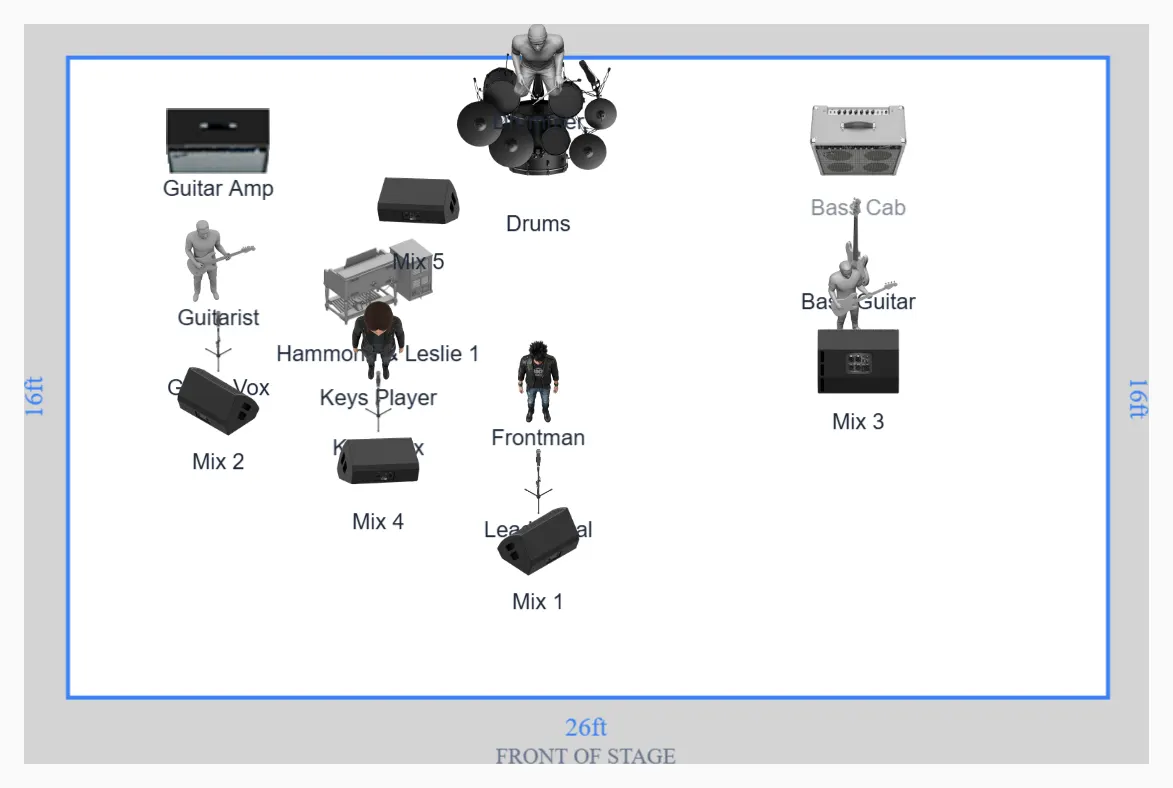
The Leslie is the reason this plot needs a page of notes
Four of the five positions on this template are ordinary. Drums, a guitar amp, a bass rig and a frontman are things every bar engineer has patched a thousand times. The Hammond and Leslie at x9 y6 is not ordinary, and it is the single item most likely to blow up your load in if nobody warned the venue it was coming.
A rotary cabinet is a speaker with moving parts inside it. It has an upper horn that spins and a lower rotor that turns more slowly, and the whole sound of the instrument is those two things moving at different speeds. You cannot DI it. There is no line out that captures what the audience is supposed to hear. It has to be miked, and how many mics you use is a real budget decision on a small console.
Three mics, two mics, or one, and what each costs you
- Three mics. A pair on the top rotor, roughly a foot back and about 90 degrees apart, plus one dynamic on the lower rotor vent. This is the full version. Stereo swirl up top, real weight underneath. Three channels.
- Two mics. One on top, one on the bottom. You lose the stereo movement and keep the tonal split. Two channels, and honestly fine in a bar.
- One mic. A single dynamic aimed at the upper rotor. You get the wobble, you lose the low end, and the organ sits thin under a loud guitar.
On a 16 channel desk with drums, bass, guitar and three vocals already spoken for, the two mic version is usually the honest answer. What matters is that you say which one you want in the advance, because the difference between one channel and three changes the channel order and patch plan before anyone unloads a van. Write it into your input list as its own named entry rather than burying it under the word "keys".
One more thing that never fits on a drawing. The Leslie needs its own power and it takes time to spin up and slow down. Do not put it on the same drop as the console. Ground hum through a rotary cabinet is loud and unglamorous.
Twenty six feet wide is a bar stage, and it is full
The footprint is 26 by 16 feet. The four piece kit sits centre at x13 y2, the Fender style guitar amp is at x5, and the blonde Bassman style bass cab is at x21. That gives you 16 feet between the guitar rig and the bass rig, which is comfortable, and it leaves the Leslie sitting between the guitar amp and the drums where it will hear both of them whether it wants to or not.
Sixteen feet of depth is the tighter constraint. The lead vocal at y11 is only five feet from the front edge, and the lead wedge at y12.5 sits almost on the lip. Check the numbers you are actually being given before you commit to this layout, because "26 by 16" on a booking email and 26 by 16 of usable deck are frequently different measurements. The stage dimensions guide covers what to ask.
Three vocals, five wedges, and a mix each
Vocals sit on tripod boom stands at the lead position, the guitar position and the keys position. Three open mics on a stage this small is a lot of bleed, and the fix is aim rather than volume. Every wedge on the plot should be angled so no capsule looks straight into a monitor.
Five wedges means five sends. The guitarist and bassist need vocals and kick, not more of themselves, because their own cabinets are three feet away. The keys player needs the Leslie, which sounds obvious until you remember it is behind them and pointed the wrong way. The drum wedge at x10 y4 is usually bass and lead vocal and nothing else.
Set to set consistency is what makes a cover band easy to mix
You will play four hours of material across three or four sets, and the instrumentation does not change. That is a gift to an engineer if you use it. Keep the same channel order every night, name the Leslie mics the same way every night, and ask for the console scene to be saved. A band that arrives with an identical patch every show gets a better mix by the second set because nobody is rebuilding anything.
- No Hammond that night. A clonewheel through a stereo DI is two channels and no mics. Say so, it changes the whole patch.
- Second guitar sitting in. Add the amp and the channel on the plot, not in conversation at 8pm.
- House PA with no engineer. Set the guitar amp volume you plan to use for the last set, not the first one.