DJ
DJ with Live Percussion Stage Plot Template for Gigs
A DJ with live percussion stage plot template with a booth, controller and a mic'd percussion rig laid out, so you can advance a lounge or cocktail set fast.
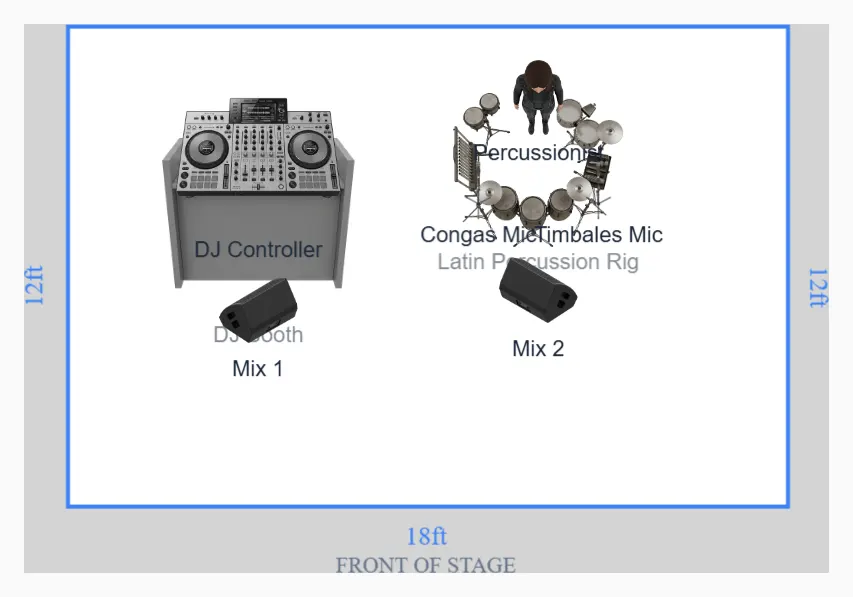
Seven feet between a controller and a set of congas
The distance is the whole story on this plot. The DJ booth sits at 6 feet across and 5 feet back on an 18 by 12 stage. The latin percussion rig sits at 13 feet across with the player behind it at 13 by 2.2. Centre to centre that is 7 feet, which is close enough that everything the percussionist plays reaches the booth, and everything in the booth wedge reaches the percussion mics.
That is not a flaw in the layout. It is what makes the act work, because the two performers have to see each other's hands. It does mean this plot has to be advanced as a bleed problem rather than as a five channel input list.
Five channels, and one of them is a compromise
- Program left and right. Two channels from the DJ controller, and they are stereo.
- Congas. One SM58 on a tripod boom at 11.5 by 4.5, on the booth side of the rig.
- Timbales. A second mic on the far side at 14.5 by 4.5.
- Talkback, if you use one. Not on this template. Add it if the DJ speaks.
Two mics on a semicircle rig is the working compromise, not the ideal. A full latin setup deserves four or five: congas from above, timbales with the bell covered, bongos, and something on the shaker hand. Two mics gets you a usable version of all of it as long as everyone understands the mics are covering zones rather than individual drums. The live mic selection guide walks through what a dynamic on a boom actually captures at 8 inches versus 18 inches, which is the difference between a conga and a room.
The booth wedge is aimed straight at your percussion mics
Look at where the boxes land. The booth wedge is at 6 by 7.5 and the percussion wedge is at 13 by 7, both downstage of the performers and firing back upstage. The congas mic at 11.5 by 4.5 sits between them, roughly 3 feet from one and 6 feet from the other, pointed down the throat of both.
That geometry sets a hard ceiling on how much gain the percussion mics can take before they turn into open mics on the program feed. In practice you get less than you expect, and pushing for more produces a low mid honk rather than a clean ring, so it is easy to miss until it is ugly. Three things help:
- High pass the percussion mics at 120 to 150 Hz. Almost nothing you want from a conga or a timbale lives below that, and almost everything the booth wedge is leaking does.
- Rotate the boxes off axis. A wedge turned 15 degrees away from a mic buys real gain for no money.
- Keep the percussionist's wedge mostly program. They do not need their own drums back. They are standing right behind them.
Somebody has to be the clock, and it is not the drummer
The DJ is playing to a grid. The percussionist is playing to their ears. When those two disagree the percussionist always loses, because the audience hears the track as the reference. Say that out loud in rehearsal rather than discovering it at 11pm.
Practically that means the percussion wedge needs the program feed clean, loud enough to lock to, and with low end intact. A conga player following a track on a wedge with no kick information will drift, and drift on a cocktail set sounds like sloppy playing rather than a monitoring failure. Ask for kick and hat specifically in that mix. The general logic for building a send around what a player is following is in the monitor mix guide.
Check it in the right order or the gains are fiction
Program first, alone, at show level. Then set the percussion mics against it. Doing it the other way round gives you mic gains that were set in a silent room and will ring the moment the music comes up.
Ask for two minutes of both together before you release the stage, and have the percussionist play their loudest thing, which is almost always a timbale rim rather than a conga. Most rigs on this plot get checked at a polite dynamic and then hit 10 dB harder in the set. The soundcheck guide covers how to structure that when you only get 15 minutes.
Where this act gets booked, and what changes each time
- Cocktail hour. Program at conversation level, percussion largely acoustic, mics barely up. In a room under 100 people you may not need them.
- Pool deck or patio. Bring your own booth wedge if you can. Outdoor stages eat low end and the percussionist over plays to compensate.
- Late club slot. Now the mics are working hard and the bleed ceiling is real. This is where the high pass earns its keep.
- No engineer on the desk. Common on this act. Set the mic gains conservatively, park them, and let the DJ ride program level instead.