Rock
Four Piece Rock Band Stage Plot Template for Live Gigs
A four piece rock band stage plot template with drums, guitar, bass and vocals, plus a wedge for every player, so you can advance your next club gig in minutes.
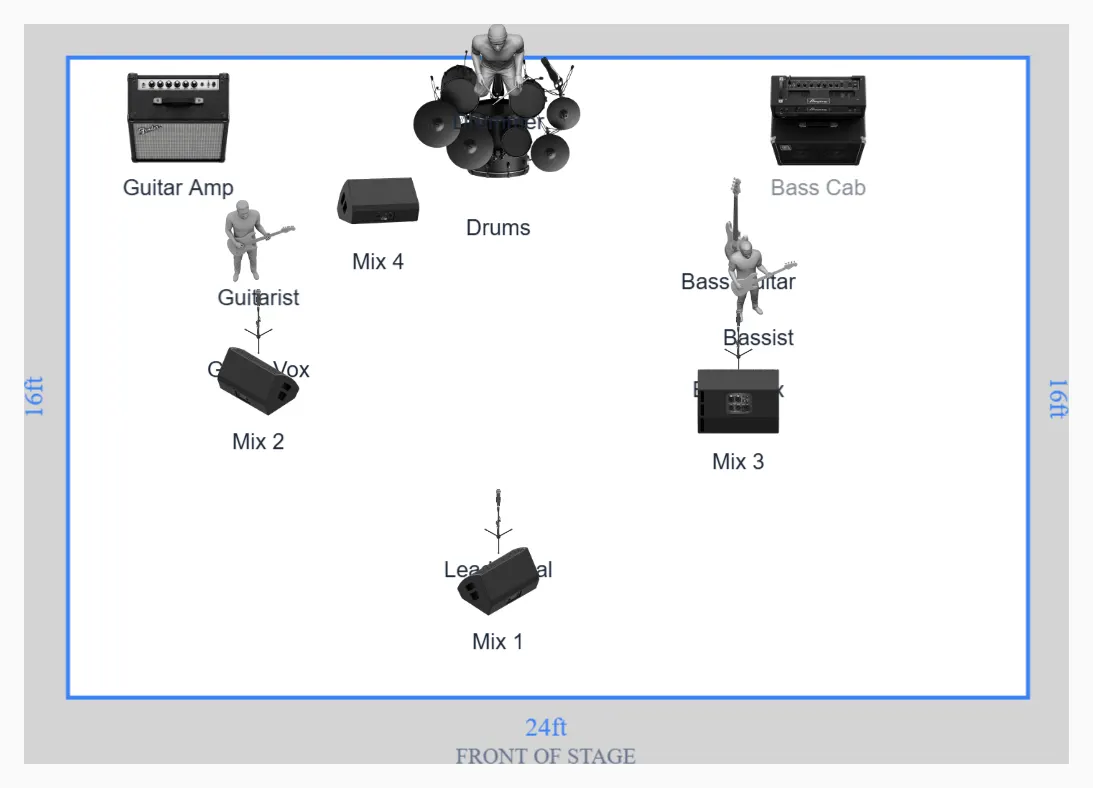
A rock plot with no amplifiers on it
Look at this layout and the first thing you should notice is what is missing. There is no guitar cab, no bass rig, no half stack against the back wall. All three string players are on digital rigs: the bassist, the rhythm guitarist and the lead guitarist each have a digital FX board at their feet, and every one of those boards leaves the stage as a line rather than as air moving in the room. That single fact drives everything else on the page, and it is the reason this template exists as a separate plot instead of a variation on a backline one.
The geometry is a 40 by 30 foot stage, which is main stage or theatre sized. The four piece kit is upstage centre at 20 feet across and 5.5 feet deep, with the drummer behind it. The three front line players spread wide across the downstage half: bass at 8.5 feet in, rhythm guitar at 20, lead guitar at 31.5. On a silent stage you can afford that spread, because nobody is trying to stay inside the throw of their own cab.
What silent stage actually buys you, and what it costs
The upside is genuine and large. With no cabs, the only real acoustic source on stage is the drum kit, so front of house gets clean isolated guitar and bass signals with nothing bleeding into the vocal mics. Gain before feedback goes up. The mix you hear in the room at soundcheck is close to the mix the audience gets when it fills, because there is no backline volume changing as the room absorbs more sound. On a big stage like this one, that also means the first ten rows are not being hit by a guitar amp that front of house cannot control.
The cost is that the players lose the thing they were monitoring with. A guitarist standing in front of a cab hears themselves whether the engineer helps or not. On this plot, if the guitar is not in a wedge, it does not exist. Every one of those three signals has to be built back into a monitor mix from scratch, and the person who suffers most is the lead guitarist at 31.5 feet across, who is 23 feet from the bassist and has no vocal mic to keep them anchored.
Three direct feeds, and the questions nobody asks in advance
Each of the three boards has a decision inside it that changes the patch:
- Mono or stereo out. A modeller with stereo delay and reverb wants two channels, not one. Three stereo rigs is six inputs instead of three, and that is a real difference on a 16 channel desk.
- Line level or instrument level. Most modellers put out a hot line level signal. Say so, because a line output into an instrument input pads badly.
- XLR direct out or quarter inch into a box. If it is a jack, the venue has to supply three DIs, and it is worth knowing what a DI is doing to that signal before you argue about it.
- Ground lift. Silent stages hum more often than amp stages, because everything shares one path to the console. Ask for lifted grounds early.
Honest channel math for this plot: 4 to 8 for the kit, 3 to 6 for the direct rigs depending on the stereo answer, and 2 vocals. That is 9 to 16 inputs. The spread is wide enough that an engineer genuinely cannot guess it, which is why the advance email matters more here than on a plot where they can see three cabs and count.
Two vocals only, and where the wedges go
The bassist has a backing vocal mic at stage left and the rhythm guitarist takes lead vocal at centre, 24 feet downstage. The lead guitarist does not sing. That is only two open mics on a 40 foot stage, which combined with the silent backline is about as clean a source as a rock band ever hands an engineer.
Four wedges cover the band: one each for the bass, rhythm and lead guitar positions across the front, and a fourth at 15.5 feet in aimed back at the drummer. Build those mixes deliberately. The lead guitar wedge is the one to get right first, because that player has no vocal, no cab and no neighbour within ten feet. If your band is already committed to modellers, the logical next step is ears rather than more wedges, and the tradeoff is laid out in wedges versus in ear monitors.
- Smaller stage. The layout collapses to 24 feet wide with no other changes, because nothing here needs clearance for a cab.
- One player still wants an amp. Draw it, and warn the engineer, because one loud cab on a silent stage is more disruptive than four.