Funk
Funk Band with Horns Stage Plot Template for Live Gigs
A funk band stage plot template with a full horn section, rhythm section and lead vocal laid out, so you can advance a tight, groove heavy gig in minutes.
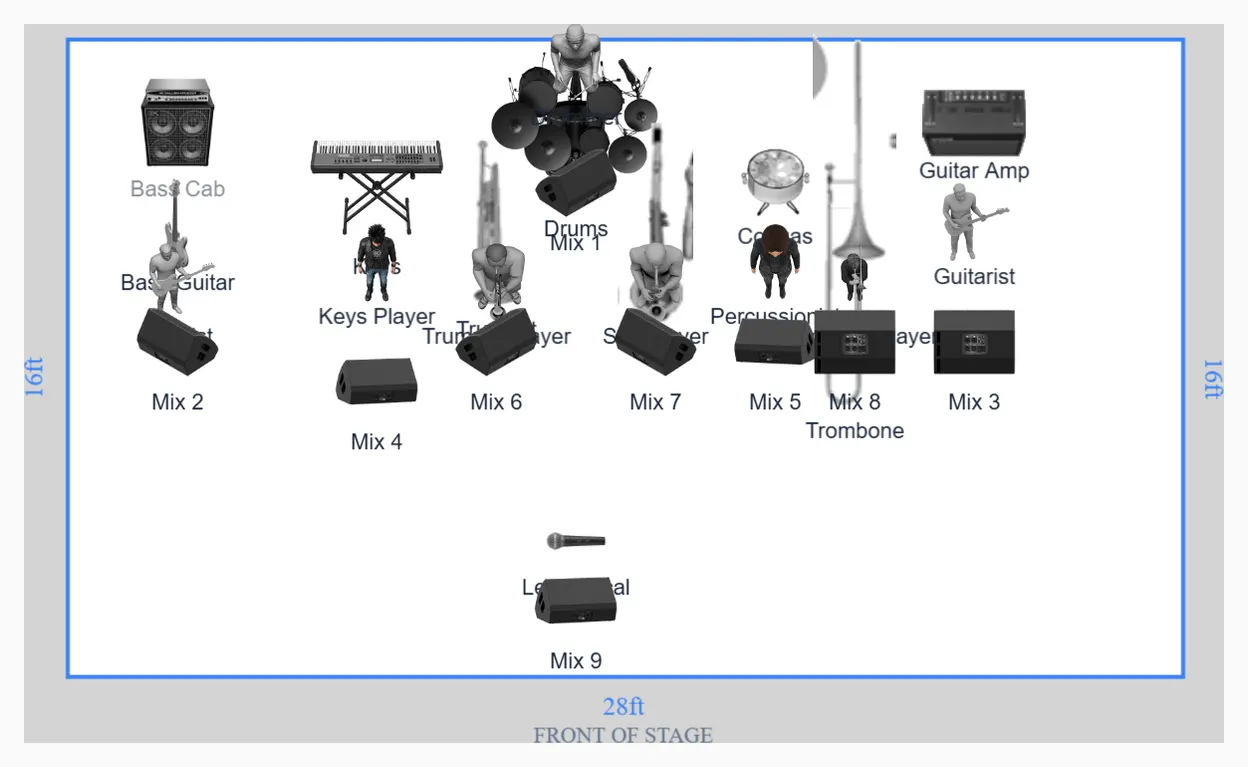
Nine wedges on a stage twenty eight feet wide
The interesting problem on this plot is arithmetic, not taste. The stage is 28 feet wide and 16 feet deep, there are eight players on it, and there are nine floor wedges drawn. Six of those sit in one row about eight feet back from the front edge, which works out to a speaker every three feet across the middle of the stage, every one of them firing back upstage into three open horn mics.
That is a lot of monitor world for a footprint this size. It is also what a funk band usually asks for, because the style depends on eight people locking to the same kick and the same bass note, and nobody locks to something they cannot hear. So the template does not cut wedges. It just means aim and level matter more here than they would on a 40 foot stage, and it means the engineer should know the count before they arrive and find the amp rack two mixes short. If this band is playing anything bigger than a club, this is the plot that makes the argument for putting the horn row and the singer on in ears and leaving wedges to the rhythm section. The tradeoffs are laid out in the wedges versus in ears comparison.
One vocal channel, and no safety net
There is exactly one vocal on this plot: a wireless handheld at centre, three feet off the front edge, with its own wedge on the downstage lip in front of it. No backing vocals, no talkback, no spare. Every word the audience hears arrives through one capsule that is moving around a stage covered in monitors.
Two consequences follow. That channel needs headroom the others do not, so ring it out early and keep the compressor conservative rather than crushing it to sit over a horn section. And if your horn players sing backgrounds on two songs, that is not something you sort out at the gig. It is two or three more channels, three more stands and a different monitor plan. Put it on the plot or accept that it will not happen.
The guitar amp and the trombone are five feet apart
Look at the stage right side. The Vox style combo sits at x24 against the upstage line, and the trombone position stands at x21, five feet downstage of it. The horn player is standing in that amp's throw, and a clean funk guitar part and a trombone want a lot of the same midrange.
There are two fixes and only one of them is free. Free: tilt the combo back so it fires at the guitarist's ears instead of across the stage into the horn row, and take two clicks off it. Not free: shift the horn line stage left so the trombone sits inboard of the amp rather than in front of it. On 28 feet of width there is not much room to do that, which is precisely why it is worth settling in the advance instead of during the first tune.
Congas, and how many channels they really are
The congas sit at x19, roughly four feet upstage of the trombone, with the percussionist behind them. Ask how many drums are actually coming. A pair is usually one condenser between the two heads aimed down at the gap. A quinto, conga and tumba is three drums and either two mics or three. If the percussionist also carries a cowbell, a shaker and a jam block, budget a fourth line for the small stuff, because those toys are what the arrangement actually turns on and they are never loud enough acoustically.
Reading the channel count straight off the picture
- Kit. The four piece at centre is five to seven channels, depending on whether you take a hat mic and a pair of overheads.
- Bass. One line. The 4x10 cab is backline only and does not earn a second channel.
- Guitar. One mic on the combo.
- Keys. A single board at x9. Confirm whether it needs a mono line or a stereo pair before you budget for it.
- Congas. One to four, per the paragraph above.
- Horns. Three, on stand mics rather than clip ons.
- Vocal. One.
That lands somewhere between 13 and 18 channels, which fits a 16 or a 24 channel console depending on how honest the band is about the drum kit. Number the list in the order the engineer will patch it rather than the order the band thinks in, and the channel order guide covers the convention most desks expect to see.
One last thing before you commit to nine mixes: confirm the deck really is 28 by 16. Club stages advertised at that size are routinely smaller once the drum riser and the house DJ table are on them, and the stage dimensions guide lists what to ask a venue for so you find out by email rather than at load in.