World
Indian Fusion 8-Piece Stage Plot Template with IEMs
Plan an Indian fusion stage with tabla, dhol, violin, bass, guitar, stereo keys, full drums, lead vocal, stagebox and five individual wireless IEM mixes.
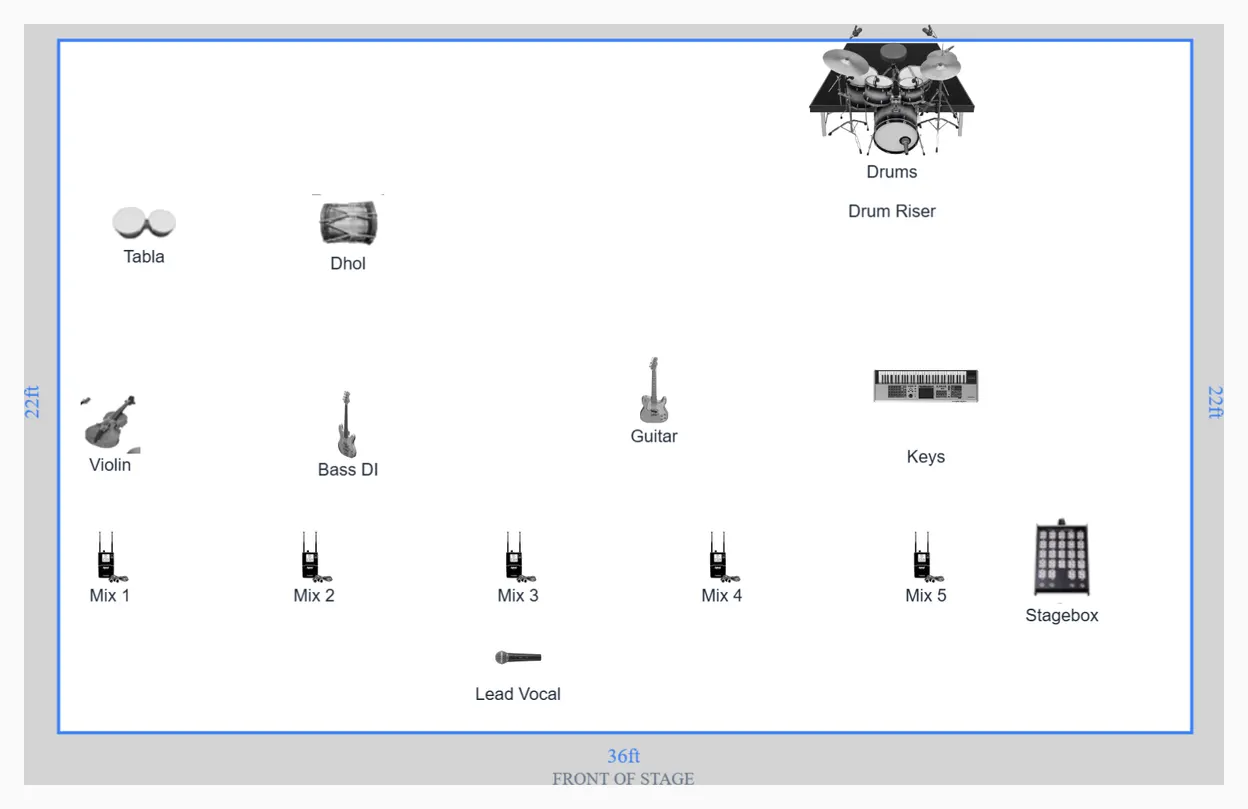
Two hand drums with thirty decibels between them
The stage left half of this 36 by 22 foot plot holds the two instruments that make or break the mix. Tabla at x7, dhol at x13, six feet apart on the same upstage line. They are both hand drums and that is where the similarity ends. The tabla is one of the quietest amplified instruments that will ever appear on your stage. The dhol is louder than the snare drum. Micing them the same way, or worse, sharing a mic between them, produces a mix where one of them is inaudible and the other is clipping.
Six feet of separation is not much when the level difference is that large. Whatever mic is on the tabla will hear the dhol clearly, so the practical rule is simple: whenever the dhol plays, the tabla channels come down. Not muted, down. That is a fader move somebody has to know is coming, which means it belongs in the advance notes, not in the engineer's reflexes.
Micing tabla like the detailed instrument it is
Tabla is two drums played by one person and it wants two channels, not one. The dayan is the small wooden drum under the right hand, and almost everything interesting about it lives between 1 and 8 kHz in the ring off the syahi. A small diaphragm condenser six to ten inches above the head, angled in from the rim rather than pointed straight down at the centre, gets the pitch and the articulation without the thud.
The bayan is the large metal bass drum under the left hand, and its whole character comes from the heel of the palm sliding on the head to bend the pitch. Point a mic at the centre of that head and you capture the boom and lose the bend. Aim it in from the rim on the side away from the player's hand, and use either a second condenser or a dynamic if the stage is loud.
Two channels, and if you use condensers, both need phantom power from the console. Confirm the box and the desk can supply it on those inputs before the day, because a dead tabla channel at line check is a fifteen minute problem. The phantom power guide covers what to check.
The dhol is a completely different job
The dhol is a barrel drum worn on a strap and played with two sticks on both heads at once. It is loud, the transients are fast, and the player moves. Every instinct that served you on the tabla is wrong here.
Use dynamics, not condensers. Pad the input before you set the gain. One mic on the bass head and one on the treble head is ideal, but one dynamic on the bass side with the treble head bleeding in is a perfectly good single channel answer if the box is tight. The bigger question is whether the player stays put. Dhol players traditionally do not. If yours moves out front, a stand mic is decoration and you need a clip on mic on the shell instead. Ask, and put the answer on the plot.
Twenty two feet is doing you a favour
The drum riser with the mic'd five piece kit sits at x29, which is twenty two feet from the tabla at x7. That is the single most helpful number on this drawing. A fully mic'd kit is the loudest open source on the stage and the tabla is the quietest, and putting them at opposite ends buys back most of the bleed you would otherwise be fighting.
Do not undo it. If somebody suggests tightening the stage to leave room for a banner or a video wall, move the guitar at x22 or the stereo keys at x30 before you move the tabla. Keys are on a DI and do not care where they stand. The tabla cares enormously.
Speaking of which, a stereo keyboard is two channels, not one, and both of them need to arrive as a matched pair. The stereo keyboard DI guide covers why a single mono line off a board playing stereo patches sounds wrong in a way nobody can point at.
Eighteen channels, one box, no monitors drawn
Count it: kit 7 to 9, tabla 2, dhol 1 to 2, violin 1 on a pickup and a DI, bass 1, guitar 1, stereo keys 2, one wireless vocal. That is 16 to 19 channels into a 32 channel stagebox at x34, which is comfortable. Spend the surplus on the second dhol mic and separate tabla channels rather than economising there.
What the plot does not show is a single monitor position. Eight players need at least five mixes and the tabla player needs one badly, because a performer who cannot hear a quiet instrument plays it harder and ruins the tone. Add the positions before you export, and use the monitor mix guide to decide what goes in each one.