Rock
Indie Rock Four Piece Stage Plot Template for Club Gigs
An indie rock four piece stage plot template with guitar, bass, drums and stereo keys, built around a singing guitarist, ready for your next club show fast.
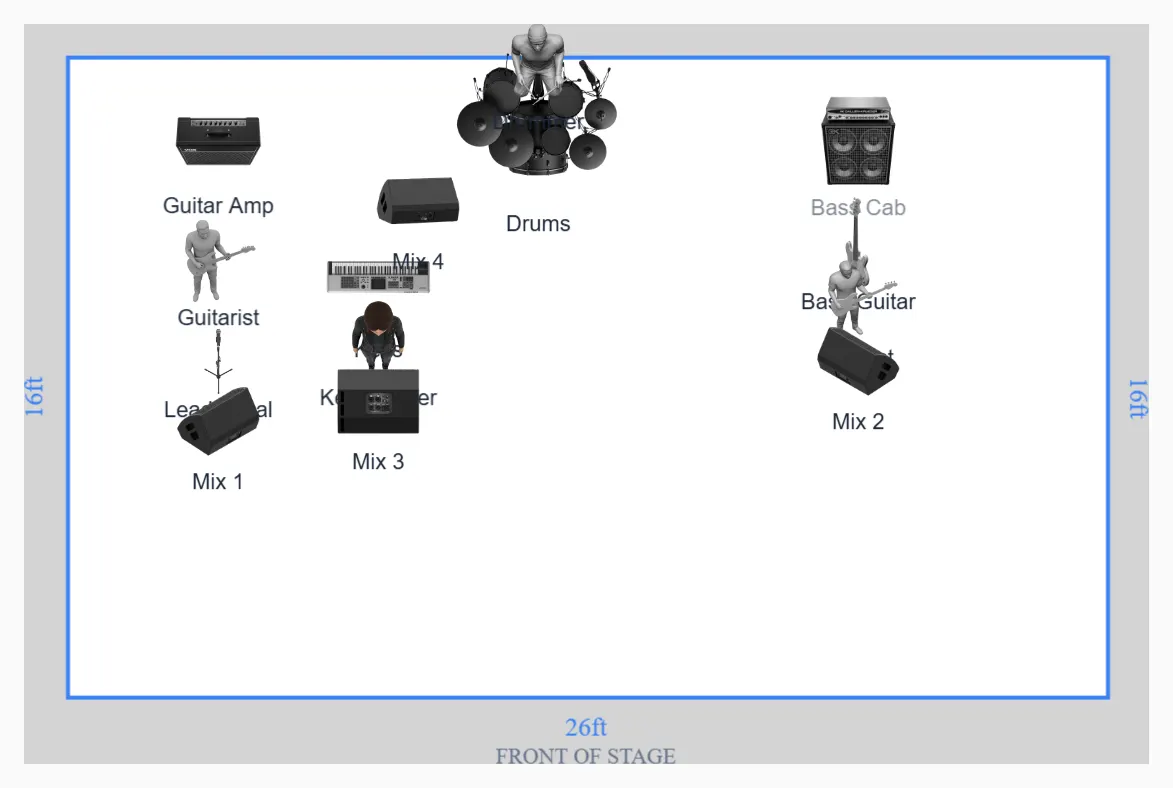
Four people and exactly one microphone
There is one vocal mic on this entire plot, at stage left, in front of the guitarist. Nobody else sings. That is unusual enough on a rock stage that it is worth saying out loud in the advance, because an engineer looking at a four piece will reflexively expect two or three vocals and will set aside channels and mic stands you do not need.
It also means one thing goes badly wrong if you get it wrong. There is no second voice covering a missed line and no other open mic on stage picking up a usable version of that vocal. The whole vocal presence of the band lives on one capsule, so it should get the best handheld the venue owns and the most careful wedge in the building. Everything else on this stage is recoverable. That is not.
Put the singer's mic on a short boom rather than a straight stand. A guitarist who sings works close to the neck of the instrument, and a straight stand puts the shaft exactly where the headstock wants to be.
Stereo keys is two channels, and one real decision
The stereo keyboard at 9 feet across is the only piece on the plot that is not self explanatory. Stereo means two console inputs, two DIs and two lines from that position, not one. Bands routinely write "keys" on a plot, get one channel, and then spend soundcheck explaining why the pad sounds narrow.
Then decide whether you actually want stereo. In a small club with the PA covering a 40 foot wide room, a stereo keyboard image collapses to mono for almost everyone standing off centre anyway, and a wide stereo patch can leave the left hand quieter on one side of the room than the other. If your sounds are piano and pad, take stereo. If they are mono synth leads and organ, take one channel and give the engineer back an input. The full argument is in the stereo keyboard DI guide, and the broader case for how stereo inputs behave live is worth reading before you commit to a stereo rig at club level.
A combo amp is the quietest good decision here
The guitarist runs a combo amp rather than a stack, at 5 feet across and 2.5 feet deep. On a 26 foot stage in front of a keys rig and one vocal mic, that is exactly right. A combo aimed slightly inward gives the engineer a controllable source, keeps the low mids off the drum overheads, and does not bury a keyboard that has no acoustic presence at all to defend itself with.
The 4x10 bass cab is the counterweight at 21 feet across, marked backline only, with the channel coming off the bass guitar on a DI. Sixteen feet between the guitar combo and the bass rig is good separation for a stage this size.
Twenty six by sixteen feet fills up faster than it reads
Stage depth is 16 feet, and the useful part is less than that. The four piece kit is at 2 feet deep, the amps at 2.5, and the keys rig sits at 6 feet deep in the middle of the stage at 9 feet across. That places the keys player between the guitarist and the drum kit rather than off to one side, which is good for eye contact and bad for traffic. There is roughly four feet of walkway between the keys player and the kit, and that is the only route from stage left to stage right behind the front line.
Two practical consequences. Cable runs to the keys position have to come from upstage or they become a trip hazard across the walkway. And if the venue's actual deck is narrower than 26 feet, the keys rig is the thing that has to move first, usually toward stage left and closer to the guitarist. Before you commit to this layout, get the real numbers from the venue using the stage dimensions guide rather than trusting a photo.
Channel count, and four wedges
Add it up: 4 to 8 for the kit depending on the mic package, 1 guitar combo, 1 bass DI, 2 for stereo keys, 1 vocal. That is 9 to 12 inputs. Small for a four piece, entirely because there is only one vocal.
Four wedges cover the band. The singer's is the hard one and it should get vocal first and very little else. The keys wedge is the one most often built wrong: keys players usually want vocal and drums in it more than they want their own keyboard, since they are already sitting behind a full range rig of their own. Ask before you assume.