Karaoke
Live Band Karaoke Stage Plot Template for Event Production
A production-ready karaoke plot with a live rhythm section, four band vocalists, four guest mics, confidence screens, playback stems and 12 monitor mixes.
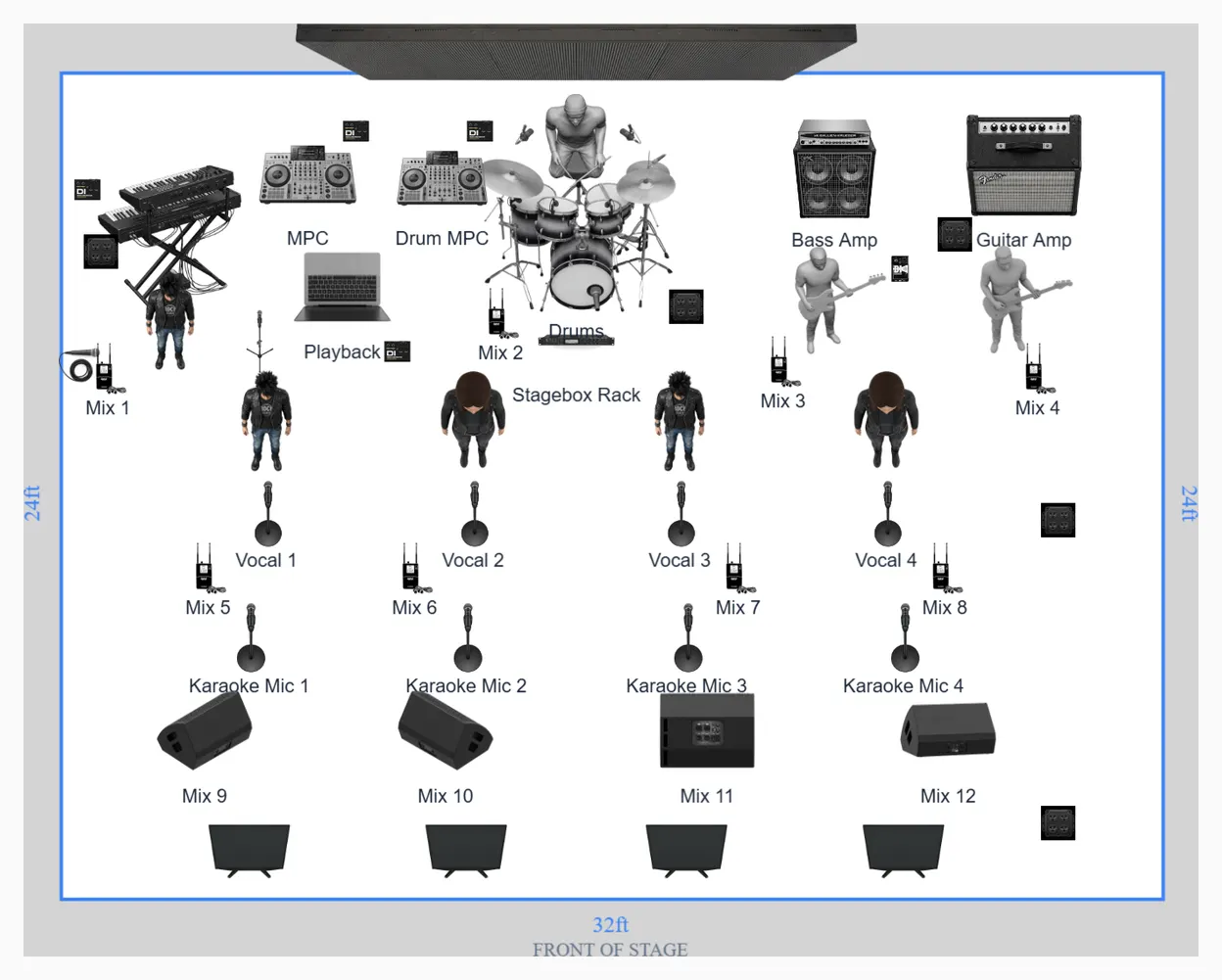
The four most important mics belong to people you have never met
Every other plot in this library assumes the person holding the microphone has done it before. This one does not. Four guest karaoke mics sit at the 16.8 foot line, and over the course of a night forty different people will hold them, most of them having never used a handheld in their lives. Half will cup the grille. Some will point it at their chin. One will drop it.
That single fact drives the whole 32 by 24 foot layout, and it is why this reads as an event production document rather than a band plot. Everything downstage of the 14 foot line exists to make an untrained singer succeed in under ten seconds.
Guest wedges are not band wedges
The four guest wedges sit at the 19.5 foot line, roughly two and a half feet downstage of the guest mics and aimed straight back at the singer. That placement is deliberate and it is the opposite of what you would do for a touring vocalist. A guest needs their own voice loud, immediate and close, because they have no technique to fall back on and no idea how far to lean in. Build those four mixes as vocal first, band underneath, and nothing else. Do not put reverb tails in the wedge. It makes people sing flat.
Meanwhile the house band and the four resident vocalists are all on in ear packs, eight of them, which keeps the stage quiet enough that four open guest wedges are survivable at all. Twelve mixes total. That is more than the mix bus count on a lot of house consoles, so confirm it before you confirm the booking.
The talkback mic is how the show gets driven
There is a coiled cable SM58 at the far stage left edge next to the keyboard rig. It is a talkback mic and it is the single cheapest piece of insurance on this plot. It goes to the monitor world and to the band's ears, never to the house. The bandleader uses it to tell the drummer the guest is going to start early, to call a key change, and to warn the engineer that mic three is dead. Give it a latching mute the leader can hit without looking. Label it TALKBACK on the plot in capitals so nobody patches it to the mains.
Confidence screens live at the downstage edge on purpose
Four lyric screens sit at the 23 foot line, one per guest position, at the very front of the deck. They face upstage back at the singers. That means a guest looks straight ahead at the audience while reading, instead of turning to a wall of text behind the band, which is the single most common lyric display mistake at this kind of event. The LED wall upstage centre is for the room, not for the singer.
Put the screen feed in the advance as a video item with its own operator and its own power. Lyric timing is a live job. Nobody in audio is going to run it while also riding four guest vocals.
Four stereo DIs, one laptop, and no room for a dropout
The playback world here is dense. A laptop and three controllers feed four separate stereo DIs, plus a mono DI on the bass, and five quad power drops are marked at keys, drums, backline, vocals and the downstage screen line. The full input list runs to around 40 channels.
Two rules. Everything that comes off a computer gets its own stereo pair with its own labelled DI, never a summed mono feed, because you will need to mute one source without killing the rest mid song. And the playback rig gets a dedicated circuit that no lighting fixture touches. How to name and order those stems is covered in the playback rig input list and the stereo inputs guide.
Hygiene, spares, and the twenty second changeover
Four guest mics means four RF channels on top of five band vocal channels and eight IEM transmitters. In a hotel ballroom that already has a DJ and a house speech system, you are coordinating close to 20 frequencies. Scan once, coordinate once, and carry two spare clear frequencies.
Then the unglamorous part. Guest mics get handled by dozens of strangers, so carry alcohol wipes and at least two spare capsules, and swap out anything that gets dropped rather than hoping. Brief the engineer that guest changes happen in about twenty seconds, which is not enough time to re ring a wedge. Set those four channels conservatively at the start of the night and leave them. Agree that plan up front, the way the working with sound engineers guide suggests, and the show runs itself.