Pop
Pop Band with Tracks Stage Plot Template for Live Shows
A pop band stage plot template with drums, bass, guitar, keys and a stereo tracks rig mapped out, so you can advance a click driven live show in minutes.
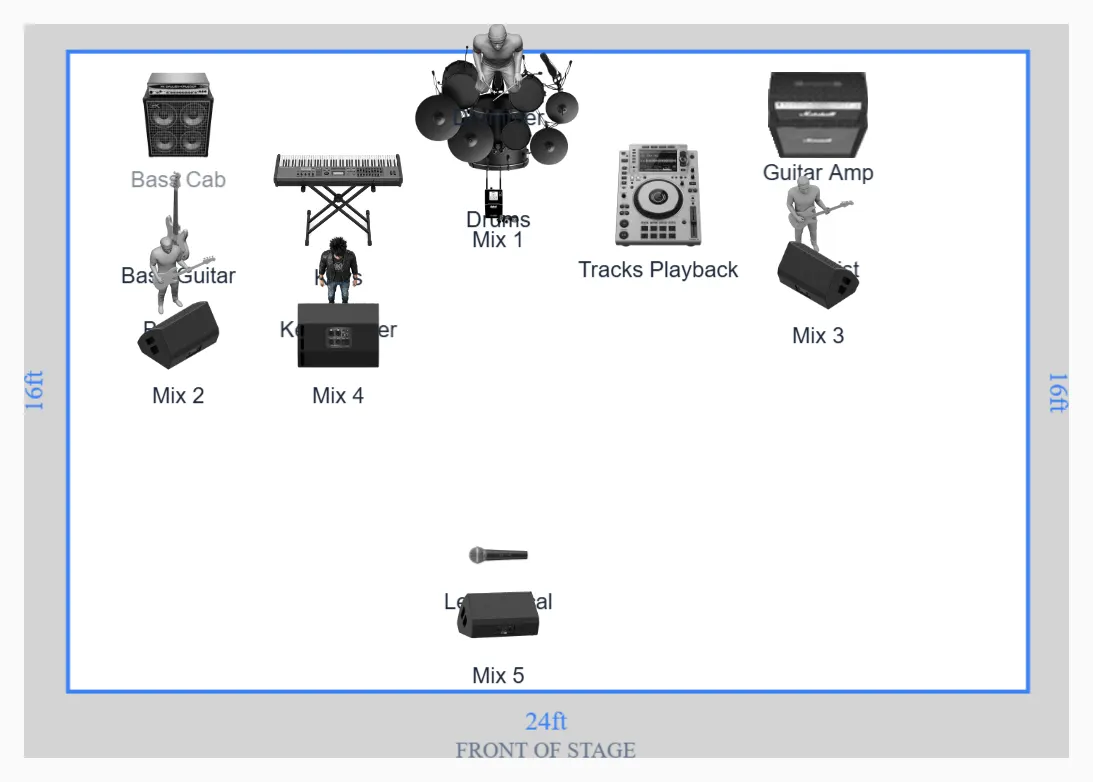
The playback rig is the sixth member of this band
Five people stand on this 24 by 16 stage and the most important thing on it is a box. The tracks player sits at 16 feet across and 4 feet back, in reach of the keys player and in the drummer's sight line, and everything else on the plot is arranged around the fact that this show runs to a grid.
The rest is a conventional pop layout. A four piece kit centre upstage at 12 by 2, a bass cab at 4 by 2 with the player downstage of it at 4 by 6, a Marshall style guitar amp at 20 by 2, single keys at 8 by 4, and a wireless handheld for the lead singer at 12 by 13, well downstage of everybody.
Somebody owns playback and their name goes on the plot
The most common failure on a tracks gig is that nobody was actually in charge of the playback rig. The keys player assumed the MD had it. The MD assumed front of house had it. Front of house assumed it was a band problem.
Write the name on the plot. That person starts the track, stops the track, handles the count in, and is the one who calls a hold when a song needs to wait. On this layout it is almost certainly the keys player at 8 by 4, since the rig sits 8 feet to their side at 16 by 4. If the operator is somebody else, move the box on the plot to where that person actually stands.
The channel count includes lines the band always forgets
- Tracks left and right. Two channels to front of house, stereo, and the loudest and most consistent thing in the mix.
- Click. A separate output that must never reach the house. Drummer only.
- Cue or guide, if you use one. A third output carrying counts and reminders. Also monitors only.
That is up to four outputs from a rig most bands describe on a plot as a laptop. Put them on the input list explicitly, with the click and cue lines flagged as monitor only in writing, because an engineer patching all four to the house by default will put a cowbell in the mains during song two. The playback rig input list shows how to lay those lines out so the intent cannot be misread.
Order matters too. Put tracks at the end of the input list, after drums, bass, guitar, keys and vocals, rather than dropping them into the middle. Standard channel order is what lets an engineer find things without reading, and a playback pair parked mid band breaks it.
Click goes to exactly one person, and that person is on ears
The IEM pack at 12 by 4 is the only pair of ears on this stage, and that is deliberate. The drummer is the only player who genuinely needs the click, and a click in a wedge is a click in every open microphone within 15 feet of it.
Everybody else follows the drummer, which is what they were doing before there were tracks, so it asks nothing new of the band and only one person has to be rigged. Two things to request. First, the click sits clearly above the tracks in that mix rather than buried under them. Second, the drummer gets the lead vocal, because on a tracks show the singer is the one most likely to drift and the drummer is the only person who can push or pull to meet them.
What you do in the thirty seconds after playback stops
It will happen eventually. Plan for the half minute afterwards.
- Agree an abort signal. One visible gesture from the drummer or the MD meaning the band plays the song out live. Rehearse it once.
- Know which songs survive without tracks. Usually the ones where playback carries a pad rather than the drums and the hook.
- Know which do not. Those get cut rather than attempted, and you decide that in advance, not at 10pm.
- Carry a second source. A phone loaded with the set and a cable to the same input is twenty dollars of insurance on a show worth thousands.
Four wedges arranged around one pair of ears
Bass at 4 by 7.5, keys at 8 by 7.5, guitar at 20 by 6, lead vocal at 12 by 14.5. Four wedge mixes plus the drummer's ears is five sends, which is more than a small venue console with six auxes wants to hand over.
If you have to combine, combine bass and keys. They sit 4 feet apart at the same depth and want a similar blend of tracks, kick and their own instrument. Never combine the lead vocal mix with anything. Every wedge on this stage should carry the tracks, because tracks are the reference the whole band is playing against, and a player who cannot hear them is guessing.
Send the plot with a short advance listing five channels of band, up to four of playback, five monitor mixes and two power drops. The band advance email template has the skeleton, and a tracks act gets more out of it than most, because there is simply more to get wrong before you arrive.