Rock
Power Trio Stage Plot Template for Guitar, Bass and Drums
A power trio stage plot template built for guitar, bass and drums, with the bassist on lead vocal, ready to advance a loud, stripped-down three piece show fast.
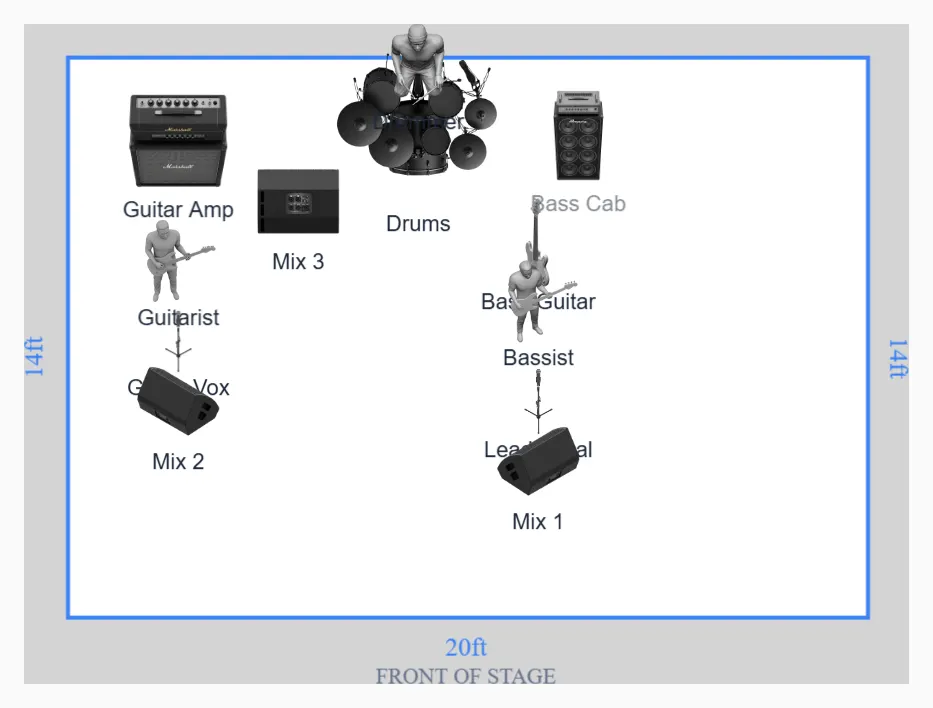
Three players and no harmonic safety net
A power trio has no second guitar holding the chord, no keys filling the middle, and no third voice covering a flat note. When the guitarist leaves the rhythm part to play a line, the harmony goes with them. Bands solve that by playing louder, and playing louder on a small stage is exactly how a trio ends up with a muddy front of house mix and a wedge that rings on the second song.
This template lays the band out on a 20 by 14 foot deck, which is the honest size of most club stages that book three piece rock. The four piece kit sits dead centre at the upstage wall with the drummer behind it. The guitar stack is upstage left at 4 feet in, the 8x10 bass cab is upstage right at 14 feet in, and the two of them are about ten feet apart with the kit in the gap. That spacing is the only acoustic separation you get, so do not close it up to make room for a merch table.
The guitar tone is carrying the entire midrange
On a five piece, the engineer can pull 3 dB out of one guitar and the arrangement survives. Here, that same cut leaves a hole between the bass and the vocal that nothing fills. The practical consequence is that your amp setting is a front of house decision, not just a stage decision, and it needs to be a setting you can live with all night rather than the one that sounded best alone in a rehearsal room.
Two specifics worth agreeing on before doors. First, mic position: a dynamic tight on the cone gives the engineer a bright, aggressive signal that sits forward, while moving the mic two inches toward the edge of the speaker takes the fizz off without touching your amp. Second, the boost. Most trio guitarists step on a solo boost that adds 4 to 6 dB, which on a quiet stage is fine and on a loud stage is the difference between a mix and a wall. Tell the engineer the boost exists and roughly how much it is, and they will ride it rather than fight it. That conversation is the short version of working with sound engineers.
Bass cab as backline, bass guitar as the channel
The cab on this plot is marked as backline only. The channel comes off the bass guitar through a DI, because an 8x10 pushed hard in a 20 foot room is already loud enough in the first ten rows that miking it adds phase problems more than it adds tone. If your sound depends on the cab, ask for a mic on it as a second channel and let the engineer blend, rather than replacing the DI with a mic.
Two vocals, three wedges, one real problem
The bassist sings lead from stage right at 13 feet in, with the guitarist on a backing vocal mic at stage left. Three wedges cover it: one for the lead vocal position, one for the guitarist, and one at 7 feet in aimed back at the drummer.
The hard mix is the lead vocal wedge, because it lives four feet from an 8x10 and about ten feet from a guitar stack, and it has to deliver a voice over both. Do not solve that with level. Solve it by asking for vocal first and almost nothing else in that wedge, and by aiming it up at the singer's ears rather than square into the mic capsule. A trio that plays the same rooms every week should seriously price out in ear monitors for the two singers, because the argument in wedges versus in ear monitors tips much earlier for a loud three piece than it does for a quiet six piece.
Ten channels, and what to say in the advance
Count it out loud so the engineer can plan: 4 to 6 for the kit depending on whether you get overheads, 1 for the guitar cab, 1 for the bass DI, and 2 vocals. That is 8 to 10 inputs and 3 monitor sends. Any console in any club can do it, which means your advance is short and there is no excuse for not sending one. If you have never written the input side of it, the input list guide covers the format engineers actually want.
- Guitarist sings lead instead. Swap the vocal positions on the plot. Do not leave the mic named for the wrong person.
- Second guitar amp for wet and dry. That is a second channel and a second power drop, and it belongs on the plot before you arrive.
- Backing tracks or a click. Add a stereo pair and put the drummer on ears, because a click in a wedge is a click in every mic on stage.