Acoustic
Solo Piano Vocalist Stage Plot Template for Live Gigs
A solo piano vocalist stage plot template with a stereo grand piano feed, one vocal mic and a wedge, ready for your next lounge or listening room gig.
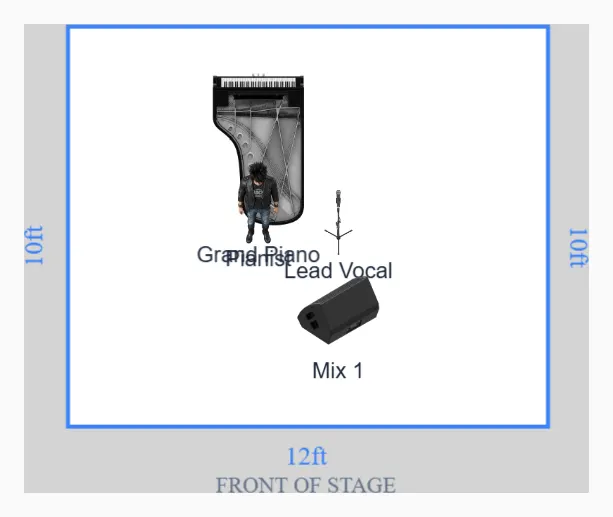
A 12 by 10 foot deck with a grand piano on it
Four objects on the plot and every one of them is load bearing. The grand sits at centre, 3 and a half feet from the back wall, with the player on the bench just downstage of it, a vocal mic on a tripod boom at 8 feet across and slightly downstage of the bench, and a single wedge 2 and a half feet from the front edge.
Draw it to scale and the constraint becomes obvious. A 6 foot baby grand is about 5 feet wide at the keyboard and 6 feet long, so the instrument alone occupies roughly a quarter of a 120 square foot deck, and the bench plus the player's working space takes several more. There is no room to move anything once the piano lands, which is exactly why the plot needs to exist. Send it to the venue and let them figure out the piano position before your load in rather than during it. If you have never sent one, the what is a stage plot explainer covers what the venue is actually reading it for.
Full stick, half stick, or short stick
This is the argument you will have at every gig with a real piano, so decide where you stand.
Full stick is what a piano is designed for. The lid opens fully, the soundboard radiates into the room, the instrument sounds like itself, and if you are miking inside it you get the best result by a wide margin. It is also a 5 foot reflective panel angled directly at whatever is on the other side of it, which on a stage this small is your own wedge and your own vocal mic.
Half stick trades maybe 3 to 5 dB of projection for a much more controllable stage. On a 12 by 10 foot deck with one vocal mic 2 feet from the rim, half stick is usually the right call and full stick is usually vanity.
Short stick or lid fully down is the lounge answer. It kills the acoustic instrument and forces you into boundary mics taped under the lid, which sound closed in but which will let you sing loudly 18 inches from the rim without starting a feedback loop. Take it when the room is small, live, and busy.
Whichever you choose, say it in the advance, because it determines the mic plan. A pair of small diaphragm condensers 8 inches above the strings and about a foot back from the hammers, one over the bass strings and one over the treble, is standard for full or half stick. Boundary mics on the lid underside are for short stick.
Two channels, or three, and which one you ask for
The piano is a stereo pair, so two channels, plus one vocal. Three inputs, and the stereo pair is the part venues get wrong. Ask for two channels panned hard and linked, not a summed mono line, because the low to high spread across the keyboard is most of what makes a solo piano set sound like a full arrangement in an empty room. Mono it and you have a keyboard sound. The reasoning behind keeping keyboard and piano sources in stereo is in the stereo inputs guide.
If you are on a house instrument with a fitted pickup system rather than mics, say so, and say whether it needs power. Those systems vary enormously and the engineer's approach changes completely.
Singing across an instrument louder than you are
Your vocal mic is roughly 2 feet from an open piano rim. A grand on full stick under close mics is producing 95 to 100 dB SPL at the mic position when you play hard. A singer at 4 inches produces about the same. So the two sources are comparable in level, which means the vocal channel is going to hear a lot of piano no matter what you do.
Two things help. Get closer, because 2 inches instead of 6 buys about 10 dB of vocal against a piano that has not moved. And point the microphone's rear null at the loudest part of the instrument rather than aiming it in whatever direction the stand happens to fall. A cardioid rejects 15 to 20 dB directly behind it, and that rejection is free.
One wedge, and the piano is in the way
A solo pianist singing is one of the harder monitor problems on this site, for a reason that has nothing to do with the mix. You are seated behind a large body, often side on to the room, and the house speakers are 20 or more feet away. Sound covers about a foot per millisecond, so what reaches you from the PA arrives roughly 20 milliseconds late and smeared by the room. Singing to that is genuinely difficult.
The single wedge sits downstage and to your side rather than directly in front of the mic, which keeps it off the capsule's hot axis and out of the lid's reflection path. Ask for vocal only in it. You can hear the piano acoustically from the bench better than any monitor will reproduce it, and every decibel of piano in that wedge is a decibel of gain you lose on the voice.
Before you send the file, run the stage plot checklist.