Classical
String Quartet Stage Plot Template for Weddings and Events
A string quartet stage plot template with two violins, viola and cello mic'd for front of house, arranged for a classical ceremony, reception or private event.
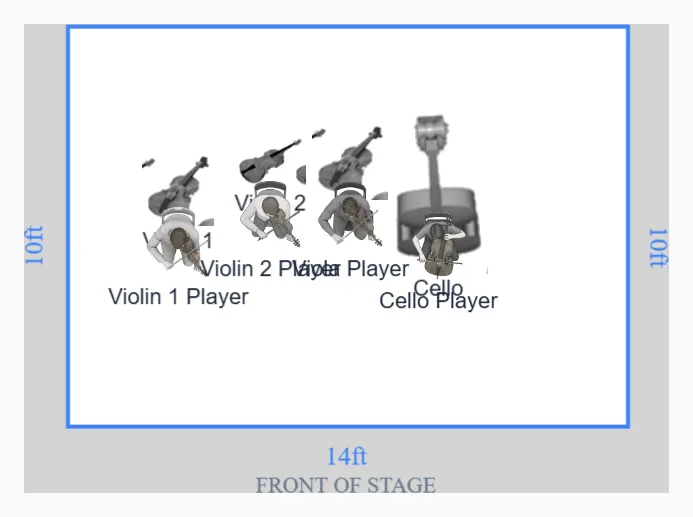
Eight objects, 14 by 10 feet, and not one cable
This is the smallest and quietest plot in the library, and it is worth studying precisely because there is so little on it. Four instruments, four seated players, a footprint of 14 by 10 feet, no monitors, no vocal, no backline and no power. The quartet occupies a shallow arc between the 4 and 10.5 foot marks laterally and only about two feet of depth.
That arc is not decoration. Violin one sits at the outside stage left position, violin two and the viola tuck in half a foot upstage, and the cellist sits at the outside stage right position facing back across the group. Everyone is inside seven feet of everyone else. A quartet balances itself by ear, and the moment you spread that arc past about ten feet across, the ensemble starts chasing each other and the tempo suffers. If a planner asks you to open the arc for a photograph, that is a real musical cost, not a preference.
Spot mics or a single pair
The plot ships with no microphones on it at all, which is the honest starting point, because the right answer depends entirely on the room and nobody should assume it a week out.
A single stereo pair on one tall stand, six to eight feet in front of the group and about seven feet up, is two channels, one stand, one power free position and a sound that already blends like a quartet because the players did the balancing themselves. For a garden ceremony of 120 guests or a cocktail hour in a hotel foyer, this is almost always the better choice.
Four spot mics, either small diaphragm condensers on short booms or clip ons at the bridge, give you four channels, four times the gain before feedback, and independent control of the cello when it disappears under the violins. That control is what you need in a 600 seat ballroom with a live PA and a DJ rig already in the room. It also gives you four stands to place inside a two foot deep arc, phase relationships between mics three feet apart, and phantom power on all four channels.
Pick one, write it on the plot, and send an input list that matches. Two channels and four channels are different conversations with a venue.
Chairs and stands are the real technical rider
The thing that actually goes wrong at a quartet booking is never audio. It is furniture.
- Four armless chairs of the same height, roughly 18 inches at the seat, flat and firm. Not upholstered lounge chairs, not banquet chairs with arms, not stools. A cellist cannot play in a chair with arms and a violinist cannot play sunk into a soft cushion.
- Four music stands, black, and four stand lights if any part of the booking runs after dusk. Confirm who supplies them. Venues say yes and then produce two.
- A hard, level surface. The cello endpin needs something to bite. On grass or carpet you need an endpin board or a stop, and the quartet should carry their own rather than trusting the site.
- Shade or cover outdoors. Direct sun on an instrument for 40 minutes is a real risk to the instrument, and wind takes sheet music off a stand at about the speed you would expect.
Put all of it on the plot as production items. A stage plot is only partly an audio document, as the what is a stage plot guide explains, and for an acoustic ensemble it is mostly a load in list.
Ceremony and cocktail hour are two different jobs
The same four players do two unrelated gigs in one afternoon and the plot should say which one it is describing.
A ceremony needs cues. The quartet has to see the officiant and the aisle, and someone has to tell them when the doors open. That is a sightline requirement, not an audio one, and it is why the arc faces where it does. A cocktail hour needs the opposite: the quartet is background, the position is whatever corner is free, and reinforcement is often unnecessary entirely.
Ask which segments need reinforcement rather than defaulting to all of them. A quartet playing acoustically to 80 people in a stone chapel needs no PA and sounds better without one.
Power for essentially nothing
The ensemble itself draws zero. If you add mics, the power belongs at the mix position, not on the deck. The only cable that might reach these four chairs is one 15 amp circuit for stand lights. Say so explicitly, because a venue that hears the word band will send an electrician you do not need. Run through the gear checklist before you leave and the whole booking fits in two cars.