Worship
Worship Five Piece Stage Plot Template for Church Teams
A five piece worship band stage plot template with drums, bass, guitar and keys mapped out, so your church tech team can advance service setup in minutes.
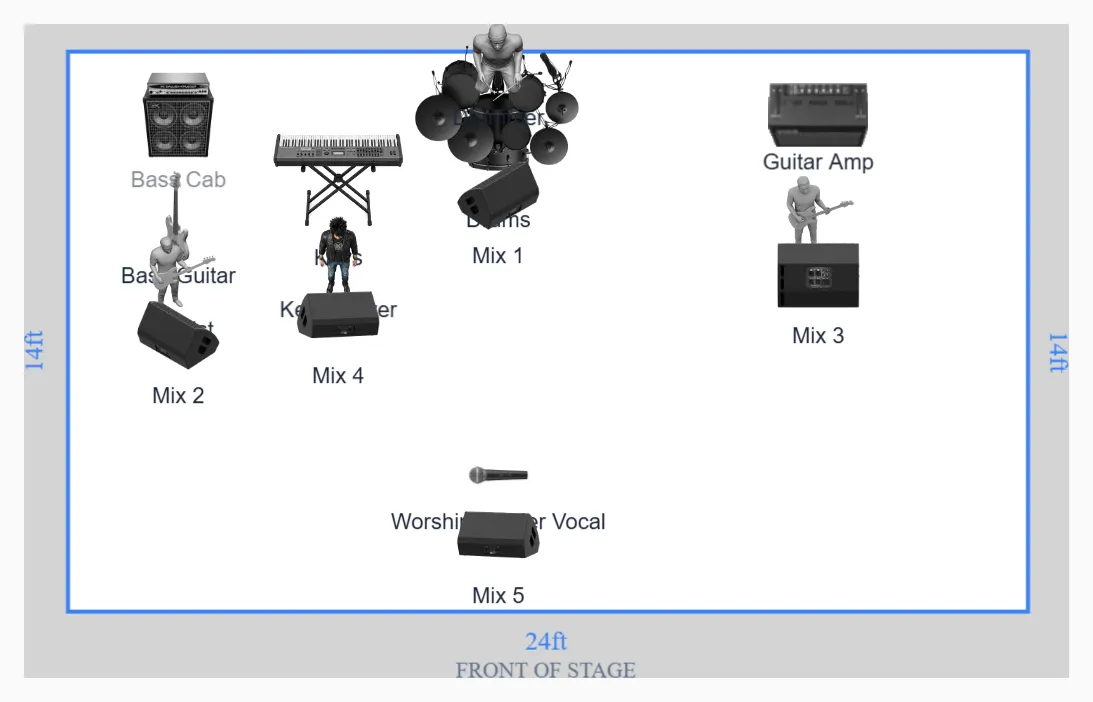
A 24 by 14 foot platform is the entire constraint
This is a small stage. Twenty four feet across and fourteen deep is a typical church platform, and once the pulpit, the communion table and a projection screen are accounted for, the band is working with less than that. Every decision on this plot follows from the footprint rather than from the music.
The four piece kit sits dead centre two feet from the back wall. Bass is at the 4 foot mark stage left with a 4x10 cab behind the player, keys sits just inside it at 8 feet, and the guitar rig works the 20 foot mark stage right. The worship leader stands at centre on a wireless handheld, three feet off the front edge, with a wedge in front of them. Five wedges, one per person, which is the right call at this size because nobody on this platform is more than 16 feet from anybody else.
Build the console scene once and recall it every week
The thing that actually kills a church tech team is not the mix. It is rebuilding the same mix fifty two times a year with a different volunteer at the desk each Sunday.
A five piece worship band with a fixed platform is the single best candidate for scene recall there is. Get the plot right once, patch the same channels to the same numbers every week, save the scene by name, and the Sunday morning job goes from a 40 minute rebuild to a 10 minute check. Number the channels in a fixed order and never renumber them, even when the drummer is away, because a volunteer who has memorised channel 12 as the leader vocal should be right in January and in November. The live sound channel order guide gives a numbering convention worth adopting wholesale.
Label the wedges by position, not by person. Bass wedge, keys wedge, guitar wedge. The bass player changes weekly. The bass position does not.
Sanctuaries were built for voices, not for a drum kit
The acoustics problem in a church is almost never a console problem. A sanctuary built for congregational singing has hard reflective surfaces and a reverb time somewhere between 1.5 and 2.5 seconds, which flatters a hundred people singing together and destroys a snare drum. The kit rings for a full second after every hit and no amount of gating fixes what the room is doing past the microphone.
Three things that actually help, in order of how much they cost:
- Move the kit off the back wall. The plot has it at two feet. Pulling it to three or four feet forward measurably reduces the slap off a hard rear surface.
- Put a rug under it. Free, instant, and it kills the floor reflection.
- Consider a partial shield. Not a full enclosure, which makes the drummer miserable and needs its own monitor solution, but a low shield in front of the cymbals.
How much of the kit you actually mic is the other half of that answer. On a platform this size, a kick, a snare and a stereo overhead pair is four channels and often sounds better in the room than eight does. The drum mic guide covers what each additional mic buys you and what it costs in bleed.
Thirteen channels a volunteer can patch alone
The count runs four to eight for the kit depending on the choice above, one bass DI, one on the Vox combo, a stereo pair from the keys rig and one leader vocal. Call it thirteen with a fully miked kit.
That is a number a volunteer can handle, and it is worth protecting. Every channel you add is another thing that can be patched wrong at 7am by someone who joined the team last month.
The rotating roster problem
Send this plot to every musician on the schedule, not just the tech team. A guest keys player who has seen the platform layout before they arrive knows which side they are on, that they have a wedge, and that they are handing over a stereo pair. That is three questions that never get asked during rehearsal.
The one thing to collect from each player in advance is what they want in their wedge, because the volunteer at the desk will not guess it. A short written request per position, saved with the scene, is worth more than any soundcheck. The monitor mix request template is a one page version you can hand to a new player.