Acoustic
Acoustic Quartet Stage Plot for Four Vocalist Guitarists
A four-player acoustic stage plot with four pickup DIs, harmony vocal mics, separate wedge mixes, compact power, and a centre stagebox for fast venue advances.
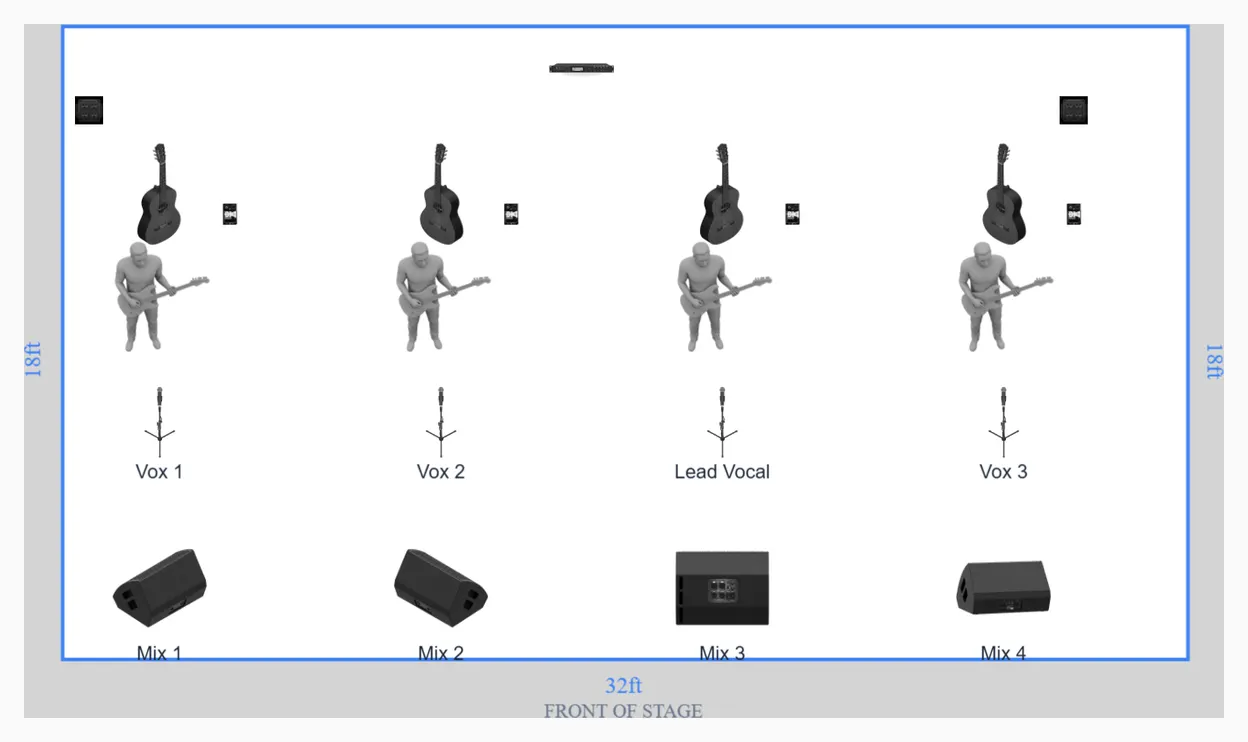
Eight feet between players is the entire design
Four singing guitarists is a deceptively demanding plot, and this template solves it with spacing rather than with gear. The four positions sit at 4, 12, 20 and 28 feet across a 32 foot stage, which puts exactly 8 feet between neighbours and leaves 4 feet of air at each wing. Everyone stands in a straight line 6 feet upstage of their vocal mic, so nobody is behind anybody and the sightline down the row is clean from either end.
That 8 foot gap is doing measurable work. The three to one rule says adjacent open mics should be at least three times as far from each other as they are from their source. Sing 6 inches off the grille and the minimum spacing is 18 inches. At 8 feet you are 16 times the source distance away, which puts your neighbour's voice roughly 24 dB down in your channel. That is the difference between four separate vocal channels and one four channel mush that cannot be EQd apart.
Four DIs, four vocals, eight channels, four auxes
Every guitar on this plot goes through its own mono DI, placed at the player's feet rather than pooled at the wing. Four boxes, four lines, four preamps. Do not let a venue talk you into a single stereo box split across two players, because the moment one guitar needs 4 dB more than the other you have no way to give it.
Each of the four acoustic guitars is a pickup feed, not a mic. On a stage this wide with four wedges running, an instrument mic on an acoustic body is a feedback path you do not need, and the pickup keeps the channel clean enough to compress. The four vocal mics on tripod booms sit in a line 2 and a half feet from the downstage edge.
Eight channels is a modest count, but the aux count is not. Four independent wedge mixes on a small analogue desk eats most of the sends, and it is the number to lead with in your advance rather than the channel count. Write it as "8 inputs, 4 monitor mixes" and put it at the top of your input list. The channel ordering the engineer will expect is instruments first, vocals last, which is covered in the live sound channel order guide.
The stagebox sits upstage centre for a reason
The rack unit at upstage centre is not decoration. On a 32 foot stage, a stagebox parked at one wing means the far player's DI needs a 30 foot run plus slack, and you have doubled your cable inventory for no benefit. Centred, every line is 16 feet or less.
Power is split deliberately: a quad box at each wing rather than one drop daisy chained across the deck. Two players share each drop, nothing crosses centre stage, and a preamp pedal dying at position four does not mean somebody walks through the vocal line during a song. If the venue runs a digital snake rather than an analogue multicore, the practical differences are in the stage boxes and subsnakes guide.
Blend gets built in the wedges, not at front of house
Four part harmony is the reason this template gives every position its own wedge instead of two shared boxes. Harmony singers tune against the part next to them, not against themselves, and each of the four needs a different neighbour loud in their ears. Give all four the same mix and the outer voices drift, because they are hearing an average of the group rather than the line they are stacked against.
Ask for it in those terms at soundcheck. "More of position two and three" is a request an engineer can execute in about eight seconds. "More vocals" is not.
The gain problem four quiet people create
Four acoustic guitars and four voices with no drummer produces maybe 85 dBA on stage. That sounds like an easy night and it is not. Quiet sources need high preamp gain, typically 45 to 55 dB on a vocal channel against 20 dB on a snare, and all of that gain is applied to whatever your wedge is putting back into the capsule. Eight open channels at high gain on one stage is genuinely tighter than a loud rock band with four.
Two habits fix most of it. Sing close, because 2 inches instead of 6 buys you about 10 dB of source level. And accept less guitar in your own wedge than feels right, since at 8 foot spacing you can hear the acoustic bodies around you without help.
Scaling it down
- 28 foot stage. Tighten to 6 foot spacing before you drop a wedge. You lose about 8 dB of mic rejection and it is still workable.
- Under 24 feet. Pair the wedges instead, two players per box, and stagger the row so the outer two stand a foot upstage.
- One player does not sing. Seven channels, and that position gets the quietest wedge on stage.
- Percussion or a cajon. A ninth channel and a real change in the gain picture. Add it to the plot before you arrive.