Orchestral
Concert Band with Vocalists Stage Plot Template Guide
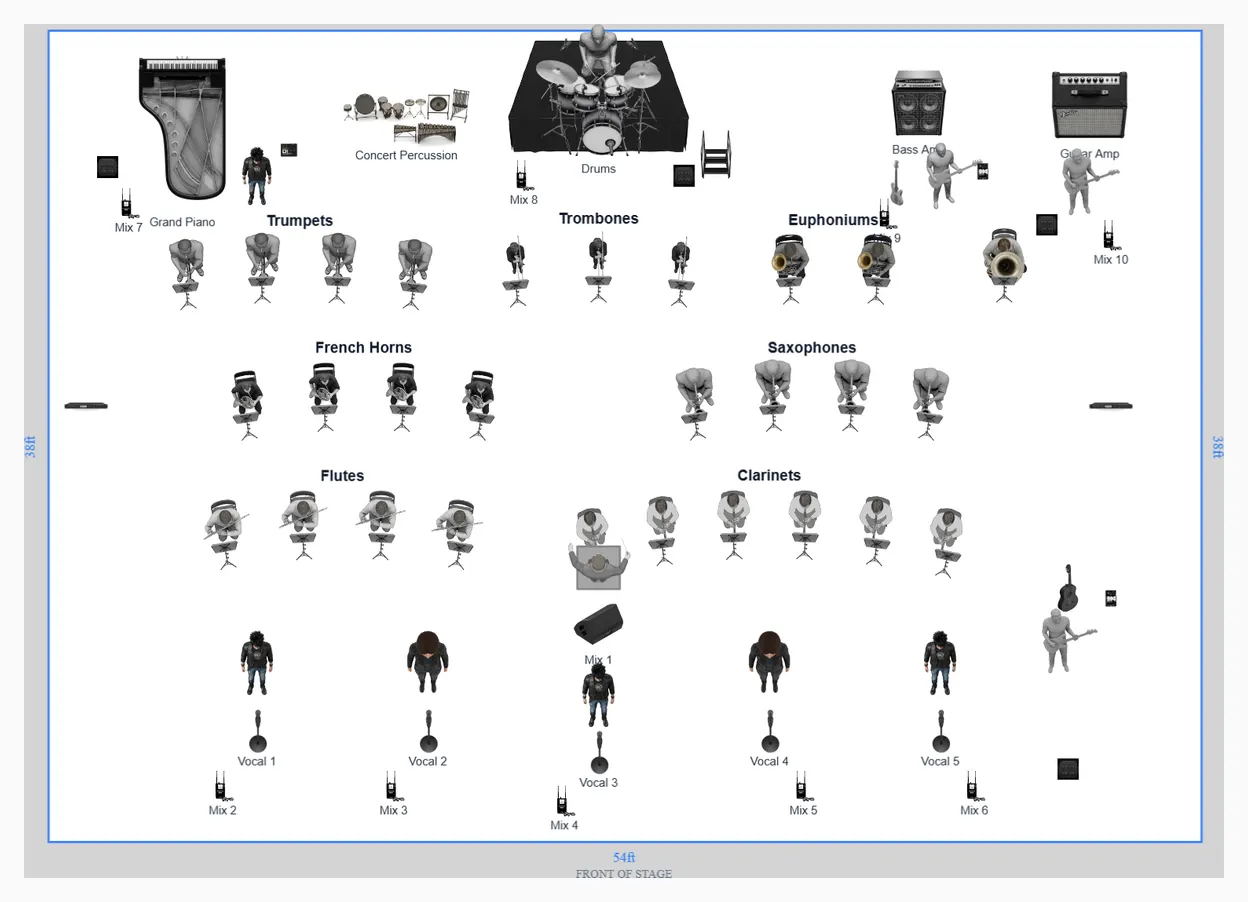
A concert band stage plot with editable curved wind and brass rows, rhythm section, five vocalists, 49 inputs, ten monitor mixes, power, DIs and stageboxes.
Fourteen radio links before you plug in a cable
This is the biggest plot in the collection, 54 by 38 feet with sixty objects on it, and the hardest part of the day has nothing to do with microphone technique. Five wireless handhelds sit across the downstage line, and nine in ear packs sit behind and around them, five for the vocalists and four more for piano, drums, bass and guitar. That is fourteen coordinated frequencies on one stage, and the failure mode is not a bad mix, it is a burst of noise in somebody's ear during a ballad.
Coordinate all fourteen as a single set, not one at a time. Frequencies that are individually clean can still produce intermodulation products that land on each other once they are transmitting together. Run the coordination in software, keep the handheld block and the IEM block in separate frequency ranges, and hold two spare frequencies per block that are already coordinated and ready to select from the front of the console.
Physically, keep the mic receive antennas and the IEM transmit antennas at least ten feet apart and never on the same combiner. The plot puts a power drop downstage at stage right near the vocal positions, which is the natural home for the IEM rack, and it is worth confirming that the venue is not running its own wireless in the same band on the same night. Scan at the venue, on the day, at show time. Whitespace at 10am is not whitespace at 8pm.
The winds have stands and not one microphone
Eight wind and brass positions sit in three arcs across the middle of the stage, trumpet and trombone and euphonium and tuba at 11 feet, horn and sax at 17 feet, flute and clarinet at 23 feet, each with its own stand. None of them carries an input channel on this plot.
That is a deliberate position, not an oversight. A concert band at tutti already produces more than enough level for any room it fits in, and the five handhelds downstage are picking up the band whether you want them to or not. Adding twenty eight wind spots to a stage with five open vocal mics gives you a large number of channels that mostly reproduce what the audience already hears, plus a significant reduction in how loud those vocals can go before the system rings.
Where wind spots are genuinely justified is soloist features, a very dry hall, or an outdoor date with no reflective surfaces at all. In those cases add spots to the featured chairs only, ride them for the solo, and mute them the rest of the time. Everything you do add belongs on the input list in seating order, and the live sound channel order guide covers the numbering convention engineers expect to receive.
A rock rhythm section living inside a concert band
Upstage, the plot carries a fully miked five piece kit on a riser at centre, concert percussion beside it, a grand piano at stage left, a bass rig at 42 feet across and a guitar amp at 50 feet. That is an electric rhythm section sitting eight feet upstage of an acoustic wind band.
The DIs on the plot tell you how this is meant to run. The piano goes out on a stereo DI, the bass on a mono DI beside the player, and the featured acoustic guitar on its own mono DI downstage at stage right. Keep the piano stereo all the way to the console rather than summing it at the box. The stereo inputs guide covers why that pair is worth two channels rather than one.
Amp volume is the thing to negotiate in advance. The guitar and bass cabinets are pointed straight into the back of the wind rows. Get both players onto ears, turn the cabinets down until they are a stage reference rather than a sound source, and take the tone from the DI or from a close mic you control.
Nine belt packs and exactly one wedge
The only floor monitor on the entire plot is the conductor wedge, sitting under three feet downstage of the podium at centre. Because the conductor is facing upstage into the band, that wedge fires away from all five handhelds, which is precisely why it is the one wedge that survives on a stage like this. Put vocals and a little rhythm section in it and nothing else.
Everyone else is in ears. Ten mixes total is realistic: five vocalists, four rhythm section players and the conductor. Resist the urge to build one vocal mix and copy it five times. Five singers standing in a line all need a different amount of themselves.
Where the copper lands
Two rack stageboxes sit at 3 and 51 feet across, both at 18 feet upstage, level with the middle wind row. That is roughly 48 feet apart and it puts a box within reasonable reach of every source: piano and percussion to stage left, bass, guitar, the acoustic DI and the vocal line to stage right.
Four quad power drops cover the piano, the drum riser, the backline corner and the downstage vocal position. Confirm all four with the venue in writing, along with stand light power for the wind rows, which is not an audio item and will absolutely delay your doors if nobody planned it. Send the whole thing ahead using the advance email template rather than attaching a PDF with no covering note.