Electronic
Electronic Live Duo Stage Plot Template for Live Sets
An electronic live duo stage plot template with two synth stations and a stereo groovebox mapped out, so you can advance any club or festival set in minutes.
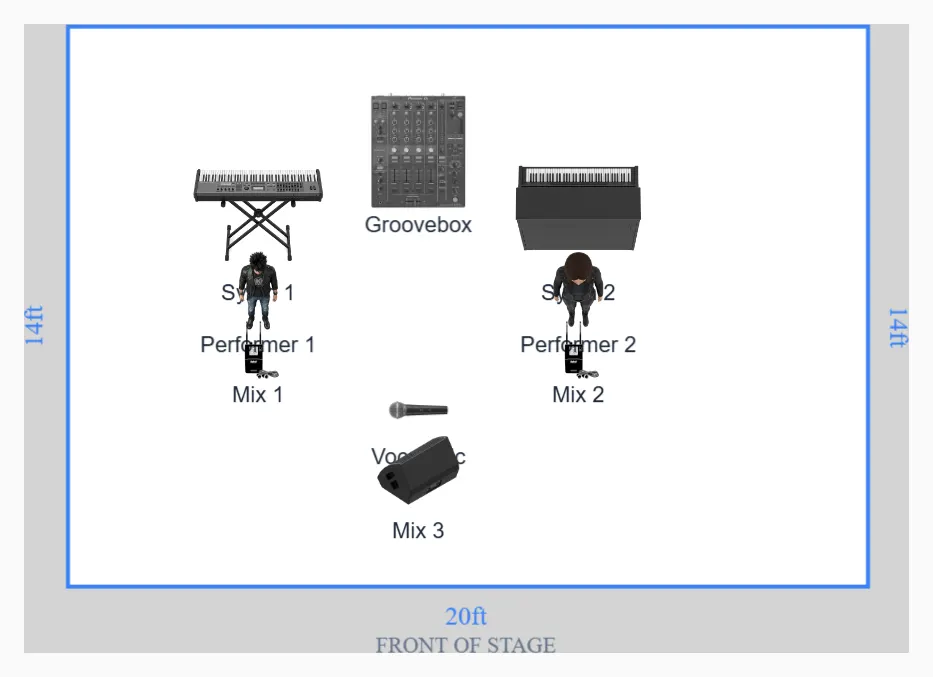
Three sound sources, nine objects, and a lot of cable
An electronic duo looks like the simplest act on the bill until somebody counts the lines. This plot puts synth one at 6 feet across and 5 feet back with its player behind it at 6 by 7, synth two mirrored at 14 by 5, and the groovebox centre and upstage at 10 by 3.5 where both players can reach it. A wireless handheld sits downstage centre at 10 by 10.
Nine objects on a 20 by 14 stage, and somewhere between four and seven audio lines coming off it depending on how you answer the next question.
Decide stereo or mono per box, never for the whole rig
This is the choice that sets your channel count, and defaulting to stereo everything burns lines that a festival changeover cannot spare.
- Synth one and synth two. If the patches use stereo chorus, ping pong delay or a wide pad, take a pair each. If the parts are mono basses and leads, take one line and keep the channel. Be honest about which.
- Groovebox. Almost always stereo, because it is carrying the drums and the loops and any width in the production lives here.
- Vocal. One channel, mono, obviously.
Say the number in the advance and say which pairs are linked, because a stereo pair that arrives unlabelled gets patched as two mono channels panned centre, which throws away exactly the thing you built. The stereo keyboard DI guide covers how to label and hand off a pair so it survives the patch.
One more line item: say whether your outputs are quarter inch or balanced XLR. Quarter inch means the venue supplies the boxes, and a duo asking for three stereo DIs at 6pm on a festival day is asking for something the crew may not have spare. If your boxes are active and you plan to use house DIs, confirm the desk is sending phantom power on those inputs and that nobody switches it off while patching around you.
The clock lives in one box and everything else follows it
Two synths and a groovebox only sound like one act if they agree on tempo. Decide before the tour which device is master, and put it on the plot as a production note so it is not a conversation on stage.
If you run MIDI clock through a USB hub, that hub is now a single point of failure for the entire show. Give it its own power rather than bus powering a chain off a laptop, and carry a spare cable for every link. A dropped clock does not sound like a technical fault to an audience. It sounds like the band fell apart.
When a box dies at minute twenty
Plan the failure in advance, because on this rig nothing else is making noise.
- Groovebox dies. The show stops unless one synth can hold a bass and a pulse alone. Rehearse that once and you will never need it.
- A synth dies. The other player covers. Know which songs allow it.
- Laptop dies. If a laptop is in the chain it is the least reliable thing on stage. Disable sleep, disable updates, disable wifi, run on mains, and carry a second machine with the set loaded if the fee justifies it.
- A DI dies. Carry two spares. They cost less than a refunded booking.
Two ear mixes and one wedge is a hybrid, so say so
Both players are on in ear packs at 6 by 8.5 and 14 by 8.5, and there is a single wedge downstage centre at 10 by 11.5 under the vocal mic. Three monitor mixes on a two person act, and it is worth understanding why.
The ears carry the clock reference, the parts, and whatever cue material the duo runs. That mix has to be tight and consistent room to room, because a performer locked to a grid cannot afford a monitor that changes character every night. The wedge exists so whoever steps out to sing has something in the room, and so a guest vocalist who is not rigged can work.
Ask for that wedge vocal heavy and low end light. It sits about 18 inches from a handheld and it is the only feedback path on the entire stage.
Power draws more than a footprint this size suggests
Two synth stations, a groovebox, two IEM transmitters, a wireless receiver and a couple of laptop supplies is realistically 6 to 10 outlets. Ask for two 15 amp drops on separate circuits, one per station, and draw them on the plot. A single drop daisy chained 20 feet across the stage is both a trip hazard and the reason your rig hums.
Write all of it down once. A duo that arrives with a channel list, a power ask and a clock note is easier to advance than most five piece bands, and the tech rider guide covers what else belongs in that document before you send it.