Rock
Four Piece Power Rock Band Stage Plot Template Guide
A four-piece power-rock stage plot with two guitar amps, bass DI and amp, full drums, three vocals, four monitor mixes and compact power positions throughout.
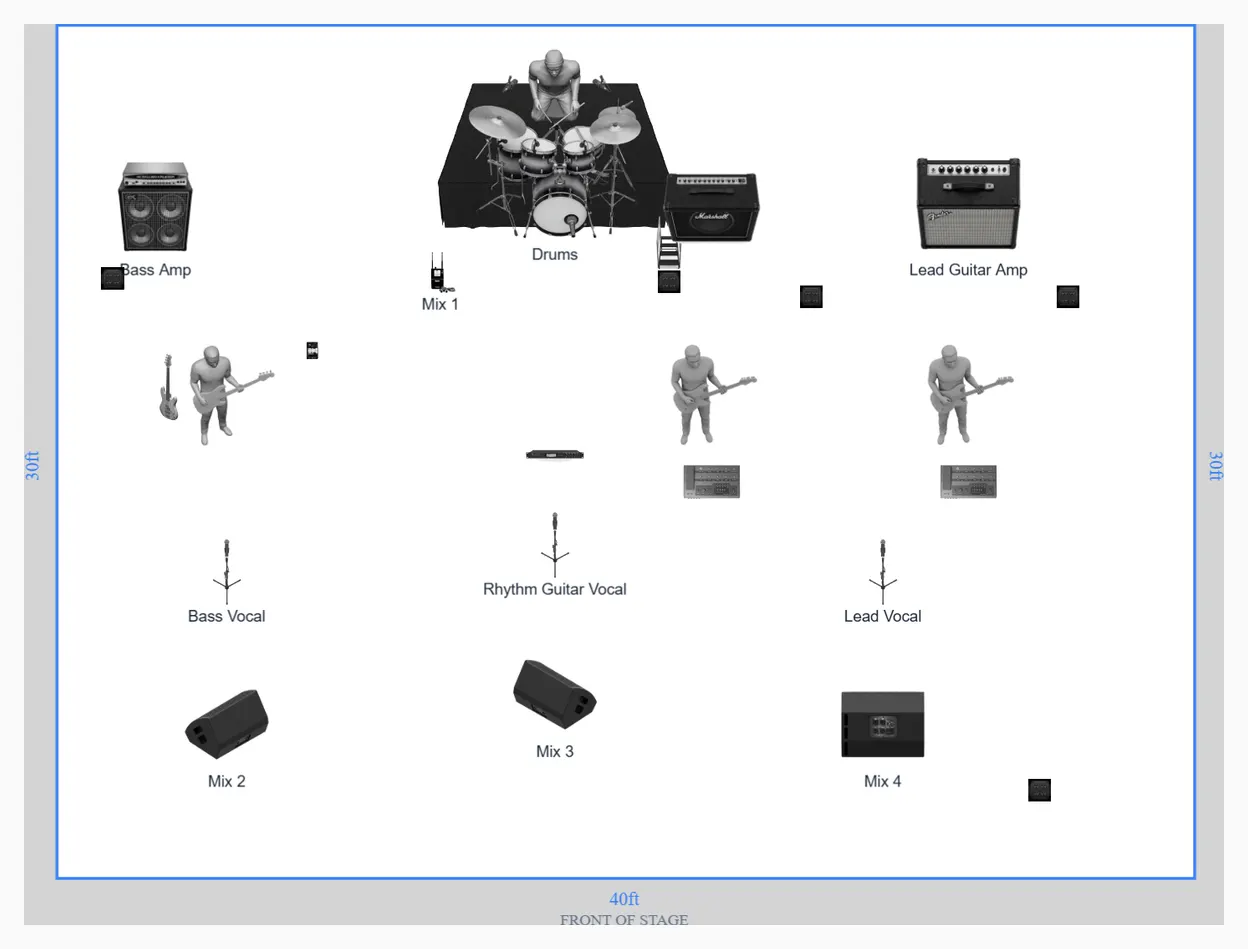
Three amp stacks across a 40 foot back wall
This is the loud version of a four piece, and the plot is drawn that way on purpose. Three amps sit in a row at 5.2 feet from the upstage edge: the bass 4x10 at 6 feet across, a Marshall style guitar stack at 25.5 for the rhythm player, and a Fender style amp at 34.5 for the lead. The five piece kit is centre on a riser between them. Add the wash coming off a drum kit that is already being played hard and you have a stage that produces a complete, fairly loud rock mix before the PA does anything at all.
That is the central problem this template is for. Front of house is not building your sound from scratch. They are adding to a mix that already exists in the room, and everything they can control lives on top of something they cannot. Understanding that changes what you ask for.
Backline volume against gain before feedback
Three amps and three open vocal mics on the same deck is a feedback budget, not a volume setting. Every dB of guitar arriving at a vocal capsule is a dB the engineer has to give up in the wedges. The three vocal mics sit at 16.5 to 17.4 feet downstage, which is roughly 11 to 12 feet in front of the amp line. That is decent separation and it is the reason the plot puts the players out that far instead of tucked in beside their rigs.
The other lever is mic technique on the cabs. An amp mic parked dead centre on the cone at zero distance gives the brightest, most aggressive capture and also the most spill. Angling it 30 degrees off axis, or sliding it toward the edge of the speaker, softens the top end and rejects a useful amount of what is arriving from the drum riser six feet away. If your engineer suggests it, they are not dulling your tone, they are buying headroom. The general logic of choosing and placing mics on a loud stage is in the live mic selection guide.
Both guitarists have a pedalboard drawn at their feet, and the bass runs through a mono DI at 11.5 feet in so the engineer has a clean low end that is not just a mic in front of a 4x10.
Five power drops, and why they are on the plot
There are five AC quads drawn: bass, drums, both guitar positions and one downstage for vocals. Pedalboards are where power planning quietly fails. A board with a digital delay, a modulation unit and a tuner draws more than a daisy chain off the amp's convenience outlet should be carrying, and a shared run with a lighting circuit is how you end up with a buzz that nobody can find at 7:30pm. Drawing the drops means the venue runs them before you arrive rather than while you are trying to line check.
Ask for guitar power on the same circuit as the audio ground where possible, and keep the vocal drop away from the dimmer racks. That coordination is part of the same conversation as the patch plan, and the stagebox rack drawn at centre, 13.5 feet in, is what makes it cheap: every line on this stage lands within about 15 feet of one point.
A riser and four steps is time you have to budget
The drum riser with four step stairs at stage right is 20 to 30 minutes of build with a crew that has done it, and it changes two things. First, the kit gets 12 to 24 inches of height, which helps the drummer see over the amp line and helps the audience see the drummer. Second, the kick is no longer coupled to the deck, so it loses some of the boom that a floor mounted kit picks up. That is usually an improvement, and it is worth knowing before you blame the mic.
Confirm the riser height in the advance. An 8 by 8 foot riser holds a five piece kit and a stool comfortably. A 6 by 6 does not, once the hardware is spread.
Three wedges, one IEM feed, and honest channel math
The drummer is on in ear monitors and the three front line players each get a floor wedge. That is four monitor sends, which is the number most club and mid size consoles have before you start sharing. Do not assume a fifth exists.
Count the inputs: 8 to 9 for a fully miked five piece kit, 1 to 2 for bass depending on whether you take the DI alone or DI plus amp mic, 2 guitar amps, and 3 vocals. That is 14 to 16 channels, plus a spare for talkback. Send that number in writing rather than the word "standard", and give the engineer your set order too, because a loud stage rewards a structured soundcheck far more than a quiet one does.