Rock
Electric Guitar Duo Stage Plot with Two Vocal Positions
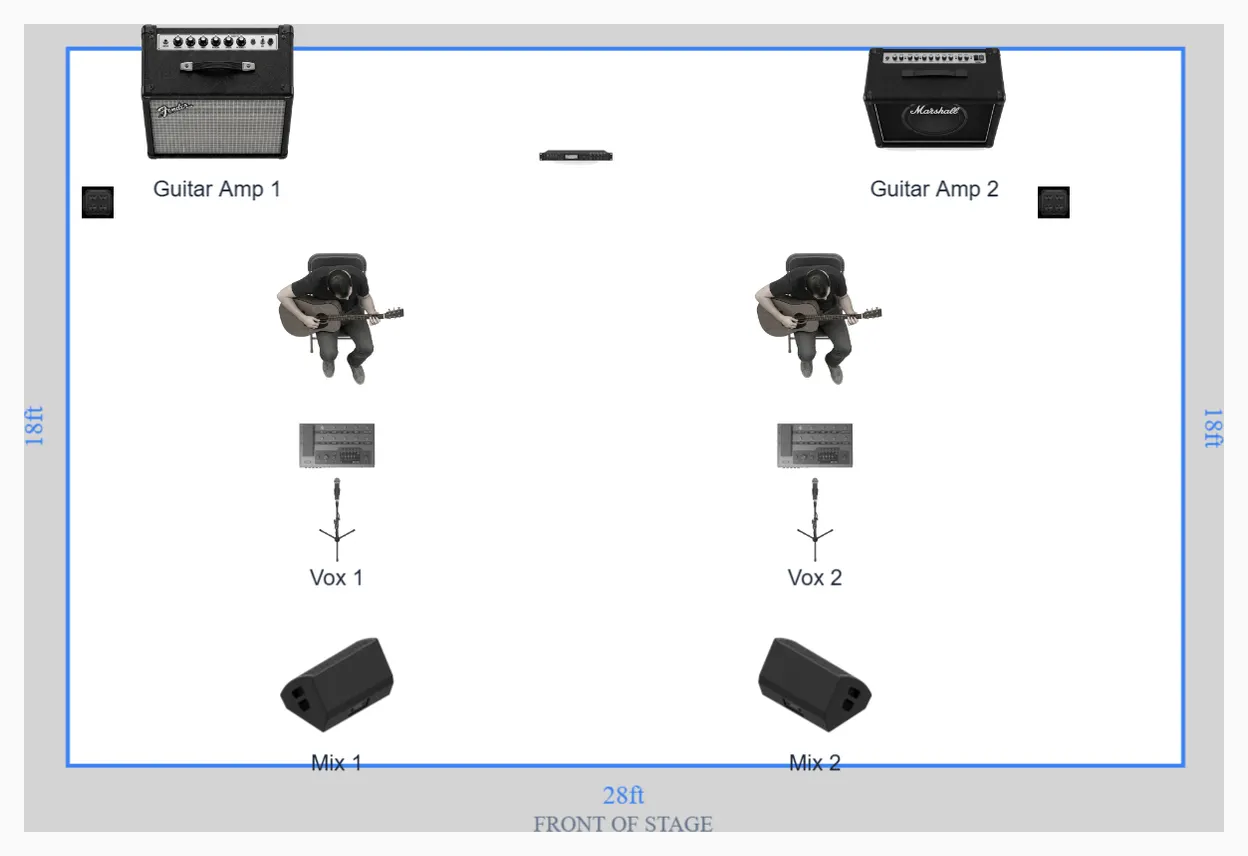
A two-guitar stage plot with separately mic’d amps, two vocal positions, independent wedges, compact power, and a centre patch position for quick advances.
Two guitars, and no rhythm section to hide behind
There is no kick drum on this plot and no bass rig. Whatever low end the audience hears comes out of two guitar cabinets and the PA, which changes almost every decision an engineer would normally make on autopilot. A high pass filter set to the usual 100 Hz on a guitar channel is fine in a five piece band and wrong here, because you have just removed the only weight in the show. Ask for the guitars to be filtered gently, somewhere around 70 to 80 Hz, and let the amps do the job the bass player is not there to do.
The layout is a 28 by 18 foot stage with two seated players. A Fender style combo sits at x5 y3.2 and a Marshall style rig sits at x23 y3.2, with a guitarist at x8 and another at x20, both at y8.
Eighteen feet of depth for two people is an amp distance decision
Two performers do not need 18 feet. The amps do. Each cabinet sits nearly five feet upstage of its player, which is the distance that lets a seated guitarist hear their own rig as a sound in the room rather than as a blast at ankle height. Move the amp up against the player and you get a rig that seems loud on stage and disappears three rows out, so the player turns up, and now front of house is fighting a cabinet that is too loud everywhere except where it needs to be.
Eighteen feet between the two cabinets does the other half of the work. That much separation gives each close mic a genuinely dominant source, so the engineer can pan the two guitars apart and have it actually mean something. On a stage narrower than 20 feet, expect the two channels to start sounding like one wide mono guitar and plan your panning accordingly. Which cabinet is which side matters here, so name them by stage left and stage right rather than by player name.
Seated players change every stand height on the page
Both vocal positions are tripod boom stands at y12.4, and both need to be set for a seated singer. A capsule at standing height, roughly 60 inches, is six to eight inches too high for a seated player and forces them to lift their chin, which changes their tone and their pitch. Set the booms at around 46 to 50 inches and note "seated" on the plot.
Angle the booms so the null of each cardioid capsule faces the nearer cabinet. That one adjustment is worth more headroom than any EQ move the engineer can make afterwards.
Two mixes, and they are not copies of each other
Wedges sit at x8 y16 and x20 y16, one per player, right at the front edge. Two mixes for two people sounds like a luxury and is actually the minimum, because in a duo the two players are doing different jobs at different moments and neither one has a drummer to lock to. Ask for vocals first and the other person's guitar second in each mix. Your own amp is five feet behind you and already in the room.
Resist the urge to put your own guitar in your own wedge. That is the request that turns a quiet stage into a loud one, and it is unnecessary at this amp distance. If you cannot hear yourself, the fix is to turn the amp up two notches, not to add it to a monitor. A short conversation about that at the start of soundcheck saves a long one later, and the working with sound engineers guide covers how to have it without sounding difficult.
Pedalboard power, and the hum you will otherwise spend an hour chasing
Two digital FX boards sit at y10.8 in front of the players, with quad AC drops at x2 and x26. Put each board on the same drop as its own amp. Two boards on two circuits with two amps crossed between them is the classic way to create a ground loop on a stage this simple.
Digital boards also draw more current than an old analogue chain and often need an isolated supply rather than a daisy chain. If any part of your rig expects the console to feed it, say so, because a preamp waiting on phantom power that never arrives looks exactly like a dead cable at line check.
- Acoustic instead of one electric. That is a DI, not a mic, and it needs its own line on the plot.
- Backing tracks. A stereo pair, plus a click that goes nowhere near the house.
- Restaurant or patio gig. Drop to one wedge and one power drop, keep the amp distance.