Rock
Three Guitar Trio Stage Plot for Club and Festival Shows
A three-guitar club and festival stage plot with two mic’d electric amps, one acoustic DI, three vocal positions, individual wedges, and compact power.
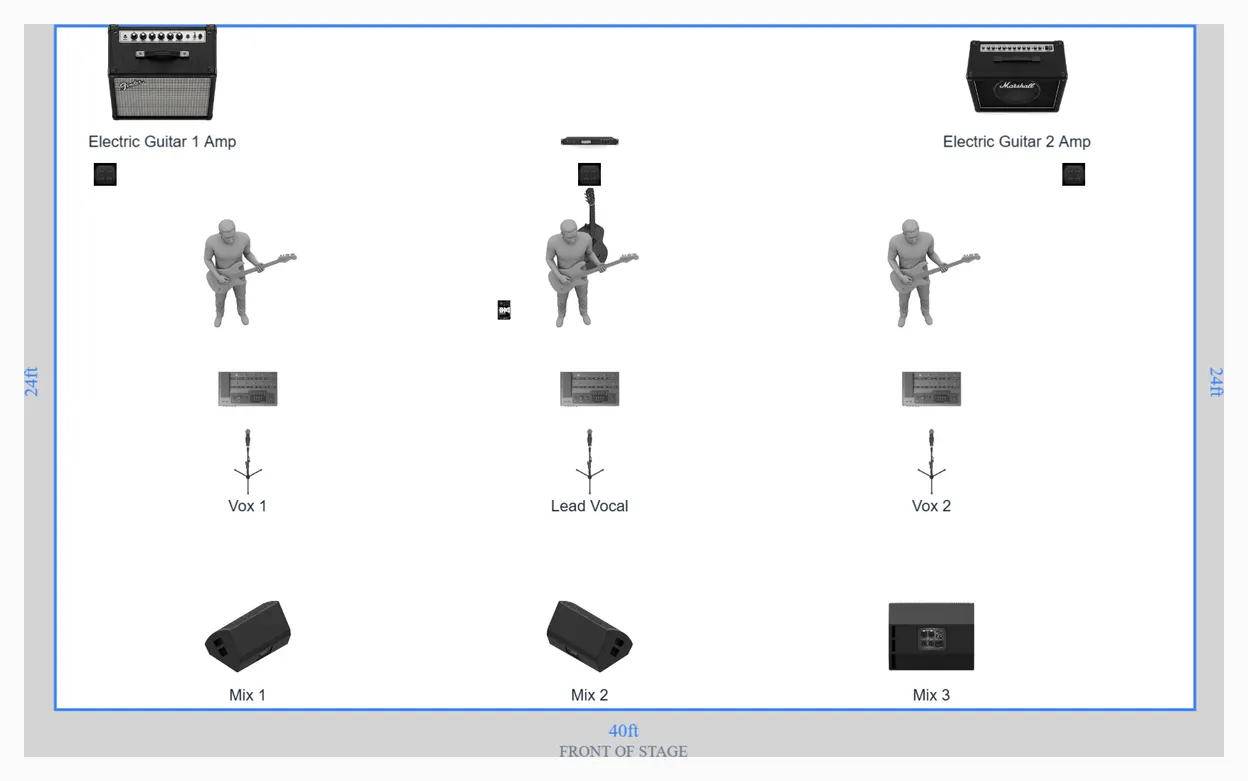
Three guitars, one frequency range
Three guitar players is an arrangement problem before it is an audio problem, and pretending otherwise is why trios like this often sound smaller live than they do in rehearsal. All three instruments occupy roughly the same band of the spectrum, somewhere between 80 Hz and 5 kHz, and no console on earth can carve three overlapping guitars into distinct parts if all three are playing full chords in the same octave. The engineer can pan them and can EQ them. They cannot arrange them.
So the useful version of this page is partly about mic technique and partly about what you play. The plot itself is a 40 by 24 foot stage with three players at y9.5, spread across x8, x20 and x32.
Thirty feet between the two electric amps
The Fender style amp sits at x5 y3.5 and the Marshall style amp sits at x35 y3.5. Thirty feet of separation is a lot, and on this plot it is the main tool you have. Each close mic gets a source that is 30 feet away from its nearest competitor, which means the two electric channels are genuinely independent and can be panned hard without turning into mush in the middle.
Use the separation properly. Angle each cabinet slightly inward so the players can hear each other, and place the close mics off centre on the cone rather than dead on the dust cap. Off axis takes 3 to 4 dB out of the presence region on each guitar, and with two electrics that is the difference between a stage that sounds thick and one that sounds harsh. If both players run similar amp settings, ask one to roll off some 2 kHz at the amp rather than asking the engineer to fix it downstream.
The acoustic is the fragile one
The acoustic guitar at x20 runs through a mono DI at x17, and it is the only instrument on this stage without a cabinet backing it up. It also sits directly between two electric rigs. That combination means the acoustic loses every fight it enters unless you protect it.
Three things help. Run the DI, not a microphone, because an open mic on an acoustic ten feet from a Marshall is a feedback event waiting to happen. Give the acoustic its own EQ pass early in soundcheck while the electrics are silent, so the engineer knows what it is supposed to sound like before it gets buried. And accept a small notch around 200 to 250 Hz on both electrics, which opens a gap where the acoustic body resonance lives. If the difference between a DI and a pickup output is not obvious to you, the DI boxes guide is worth ten minutes.
Three wedges, three completely different mixes
Wedges sit at x8, x20 and x32, all at y20.5, one per player. The temptation on a stage with no drums and no bass is to build three copies of the same mix. Do not.
- Electric 1 and 2. Vocals, the acoustic, and none of their own amp. Their cabinet is six feet behind them and already loud.
- Acoustic. Their own guitar, their own vocal, and a little of each electric. This is the only player who genuinely needs themselves in a wedge, because they have no amp in the room.
- All three. Whoever is singing lead on a given song needs that vocal up. With three boom mounted vocal mics at y15.2 and three open wedges, feedback risk is real, so aim every wedge off the back of its capsule before anyone asks for more level.
Build these one at a time and in the same order every night. The soundcheck guide has a workable sequence, and the monitor mix guide covers how to describe what you want without just saying "more me".
Arrangement discipline is an audio problem
The single biggest improvement available to a three guitar band is not a mic choice. It is deciding, per song, which guitar owns the low register, which one owns the midrange chords, and which one plays above the vocal. When all three players commit to that, the mix builds itself. When they do not, the engineer ends up choosing for you by muting somebody, and it will not be the guitarist you would have picked.
Voicing helps as much as volume. Capo one part up, drop another to lower voicings, and let the acoustic keep the top end sparkle it is naturally good at. That is a rehearsal decision with an audible payoff at front of house.
Each player gets a pedalboard at y13 and a quad power drop nearby at y6.5, so keep each board on its own rig's circuit and note anything that needs an isolated supply.