Hip-Hop
Hip-Hop DJ and MC Stage Plot Template for Live Shows
A hip-hop DJ and MC stage plot template with a booth, controller and two handheld mics laid out, so you can advance a club or festival set in minutes.
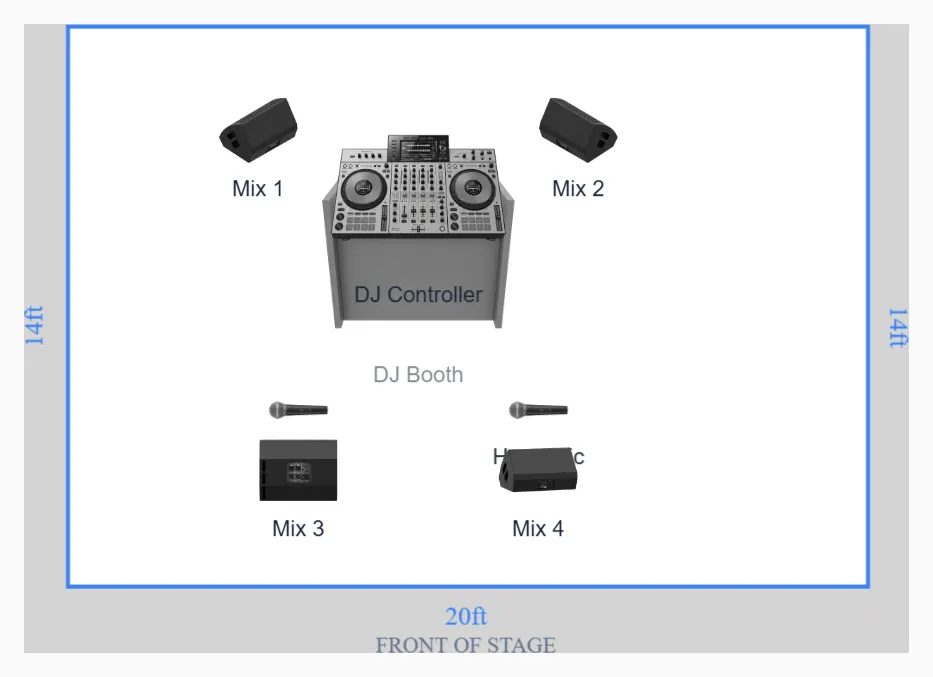
Everything here is fixed except the two things that matter
On this 20 by 14 stage the DJ booth sits dead centre at 10 feet across and 6 feet back, the controller on top of it at 10 by 4.5, and four wedges are placed and aimed. Then there are two wireless handhelds marked at 7 by 10 and 13 by 10, and both of them are going to spend the show somewhere else.
Marking them anyway is the point. Those two positions tell the engineer where the MC and the hype man start: 4 feet downstage of the booth and 6 feet apart. They also tell the engineer that the vocal wedges at 7 and 13 by 11.5 are aimed at people who will be standing in front of them, on top of them, or 10 feet upstage leaning into the booth. Plan for all three.
Two frequencies, and they are not only your business
Two handhelds on a club or festival stage is where wireless coordination stops being optional. Put real numbers in the advance.
- Say the band, not the brand. Two channels, 606 to 630 MHz, is useful information. Two Shures is not.
- Ask what else is on the stage. Four acts, an IEM rack and a comms system is a crowded spectrum, and the coordinator needs your numbers days ahead, not at line check.
- Bring fresh batteries and a spare mic. Two mics and no spare on a stage where both get dropped is a bet you lose eventually.
- Label both bodies. MC and HYPE, taped on. Nobody at the desk can tell them apart by sound.
Handing an engineer that list before the day is most of what working well with a sound engineer actually consists of.
Gain before feedback when a mic walks into the booth wedge
The booth wedges sit at 6 and 14 feet across, 3 feet back, and they are loud. That is their job. The problem is that an MC on this act does not stay downstage. They come up to the booth, lean over the controller, and hold a live capsule over a box running at DJ level, and the vocal channel starts ringing somewhere around 2 kHz.
The fixes are boring and effective. Use tight cardioid or supercardioid capsules rather than anything with a wide pattern. Ring out both vocal channels during check with somebody standing at the booth, not at the downstage mark. Notch narrow rather than pulling broad EQ, because a hip hop vocal needs its presence range intact to cut over a track that already occupies the same space. Expect to run less mic gain than a band vocal would take, and make up the difference with a compressor doing real work rather than a hotter preamp.
A vocal chain built to survive a mastered track
The vocal here is competing against a finished record, not a live band with gaps in it. That changes the treatment.
Ask for a high pass around 100 Hz, firm compression at 4:1 to 6:1 with 6 to 10 dB of gain reduction on peaks, and a de esser if the MC works close. Ask for a short slap or an eighth note delay on a fader rather than a long reverb, because reverb over a dense track just turns everything to mush. Both mics get the same chain so the hype man does not sound like a different show.
Write that in the advance. An engineer who reads two handhelds and nothing else will set them up like band vocals, and you will spend two songs fixing it.
Mute discipline belongs on the plot, not in the moment
Two live handhelds on a stage with four wedges is the loudest possible way to lose a show. Between tracks both mics need to be down unless somebody is actually talking, and one named person has to own that. If the engineer is riding them, say so. If the MC works the switch on the body, say that instead, and check it before doors, because that is the switch most often taped over.
The related habit is making the plot itself say the mics are wireless, handheld, and that there are two. That one line prevents a surprising share of the common plot mistakes that cost time at load in.
Four wedges doing two completely different jobs
The two boxes flanking the booth are the DJ's mix. The two vocal wedges at 11.5 feet back are not. They should not carry the same content and they should not share an aux.
The DJ wants program with the low end intact. The MC wants their own voice plus enough of the track to catch the beat, and considerably less bass, because bass in a vocal wedge is what most often triggers the ring in the first place. Two sends is the minimum on this plot. Three or four is better if the desk has them, since the MC and the hype man rarely want the same thing.
If this act tours enough to invest, moving both vocalists to in ears removes the feedback ceiling entirely and takes two open mics off the wedges. The trade offs are laid out in the guide on wedges versus in ear monitors.