Latin
Latin Rumba Band Stage Plot Template for Live Events
A Latin-rumba stage plot with drums, hand percussion, bass and three direct-string instruments, three vocals, 16 inputs, six mixes, power and DIs throughout.
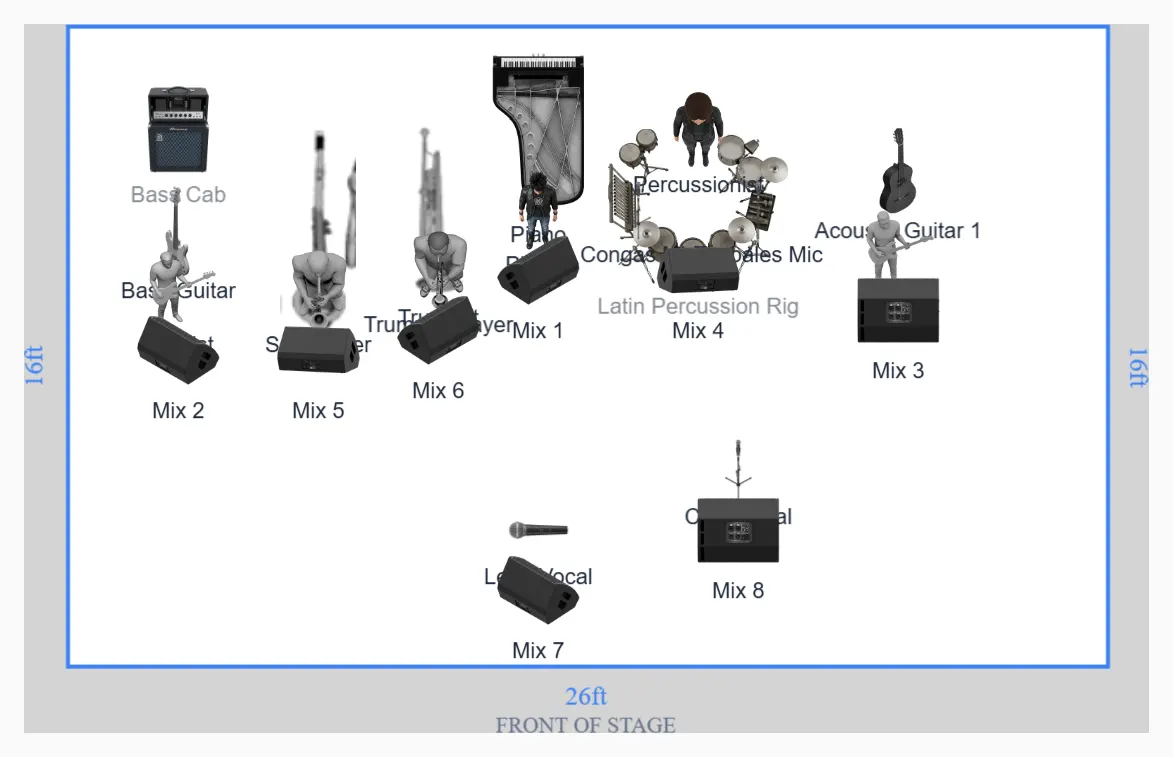
Two drummers, eight feet apart
The upstage line on this 40 by 30 foot plot carries a four piece kit at x24 and a hand percussion rig in a semicircle at x16. Both players are keeping time. Both are playing patterns the audience needs to hear. And they are eight feet apart, which is close enough that every open mic on one of them is also a distant mic on the other.
Fighting that with EQ is a losing game. Accept it and plan around it instead. Keep the percussion mics tight and close, an inch or two off the heads and angled away from the kit, so the direct sound wins by enough margin that the bleed reads as room rather than as a second snare. Gate the kit toms hard, leave the percussion channels ungated, because a gate on a conga that is also hearing a kick drum will chatter through every quiet passage. And decide, before the gig, whether the kit or the rig owns the backbeat in each arrangement. When both players cover it, no amount of console work makes the pocket sound like one thing.
Four plucked instruments, four DI boxes, four problems
The middle line at y11 is the unusual part of this band: bass at x30.5, acoustic guitar at x20, banjo at x9, and laúd at x37. Every one of them runs through a mono DI placed a couple of feet upstage of the player. Four instruments, four boxes, and they do not want the same box.
- Bass. The one that behaves. Active or passive changes whether the DI needs phantom, so say which in the advance.
- Acoustic guitar. Almost always an undersaddle piezo, which is a very high impedance source. A cheap transformer DI loads it down and the guitar arrives thin and quacky. Ask for an active box with a 1 megohm or higher input.
- Banjo. The loudest transient on the plot and the one most likely to clip a preamp before anybody notices. Pad the input, then set gain against the loudest thing the player does rather than a comfortable strum.
- Laúd. Quiet, bright, twelve strings in six courses. If the player's pickup is weak, a small condenser on a short stand beats a DI, and that is a microphone stand and a channel change worth deciding in advance rather than discovering at line check.
If any of that is unfamiliar, what a DI box actually does is the background reading, and it is worth doing before you argue about tone with the house.
The drummer is the only one on in ears
Six mixes on this plot, and only one of them is private. There is a single IEM at x27.5 beside the kit. Everyone else is on wedges: three across the downstage vocal line, one for bass at x31.5, one for guitar at x20.
That hybrid is the right default rather than a compromise. The drummer is the player most likely to be on a click and the one who benefits most from a sealed mix, and pulling the drum wedge off the stage removes the loudest monitor from the middle of an already busy deck. Everyone else keeps the wedge they are used to.
The three vocal wedges sit at y22.5 and y23.5, which puts them at the very front lip in front of three tripod boom mics. That geometry is fine as long as the wedges are aimed at ears and not at capsules. Write down what each of those three mixes needs before soundcheck rather than describing it out loud over a loud stage. The monitor mix request template exists for exactly that.
Where the power and the patch actually live
Three quad AC drops are marked: one by the kit at x28.5, one at the percussion rig at x13.5, and one at x35 y24.8. That third one is the one to look at twice. It sits at the downstage stage right corner, which means a cable run across the front of the stage in the audience's sightline if anything at the vocal line needs power.
The stagebox rack sits at x24 y15, dead centre of the stage. That keeps every DI run under ten feet, which is genuinely good for the four passive-ish string sources, and it puts a rack in the middle of a stage that people cross during the set. Confirm it can live there, or move it upstage and accept longer runs. Either answer is defensible. Not deciding is not. The stage patching guide covers how box position changes the rest of the run.
Total channel count reads about 16 to 19: five to seven for the kit, three to four for the hand percussion, four direct instruments, three vocals.