Orchestral
Symphony Orchestra Stage Plot Template with Sections
Arrange a symphony orchestra stage plot with strings, woodwinds, brass, timpani, orchestral percussion, conductor, risers, safe stairs and two stageboxes.
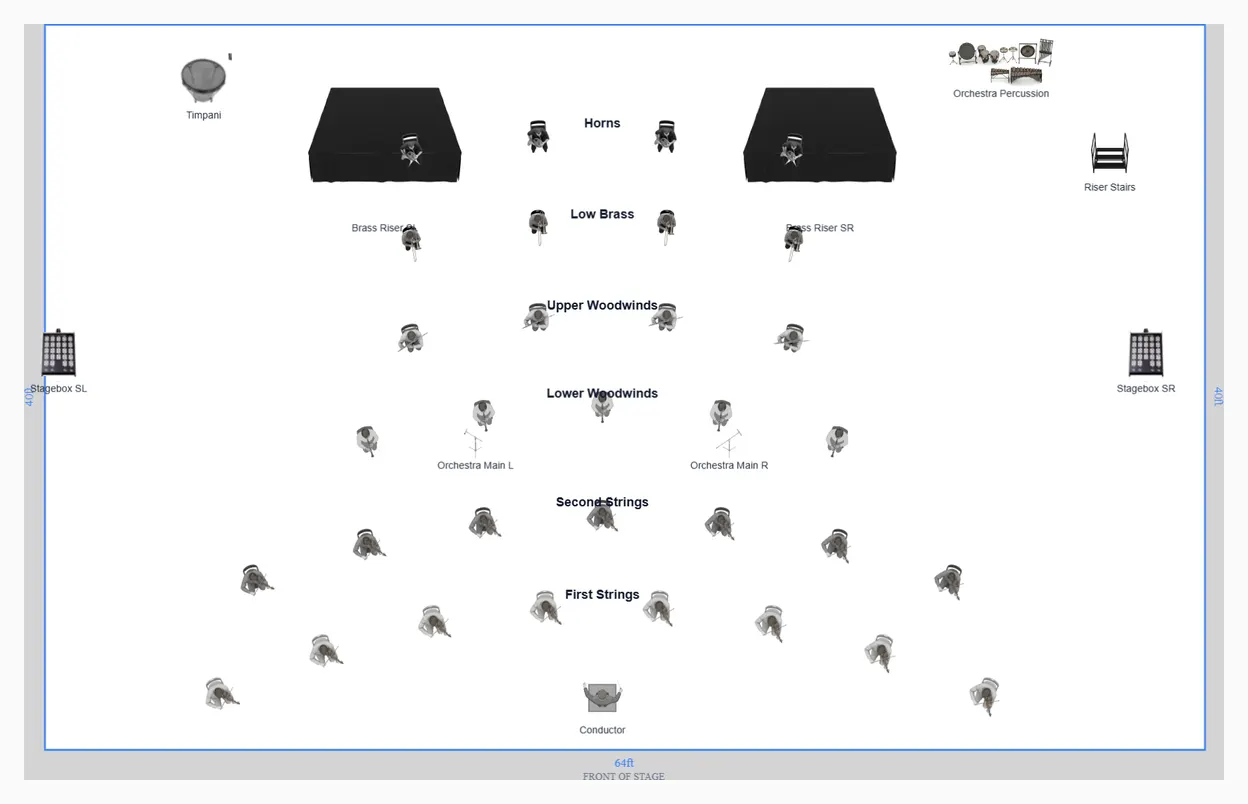
Sixty feet of copper before you hang a single microphone
A symphony plot looks like a microphone problem and is actually a cable problem. This template runs 64 feet wide, and it places a 32 channel stagebox at each wing, two feet in from either edge and 20 feet upstage. Those two boxes are 60 feet apart. Every decision about where a source lives on this stage is also a decision about which box it lands in and how much cable crosses a deck that 60 to 80 musicians are about to walk across.
Start the advance there. Ask the venue which wing the amp room, the machine room or the truck parking sits on, because that determines which of the two boxes is the short run and which one is going to need a fibre or a Cat run around the back wall. On a digital network, the two boxes are usually a primary and a secondary node on the same loop, and a loop that goes down one wing, across the back, and up the other wing is far more robust than a spur. The reasoning behind that topology is in the stagebox and split guide.
Two boxes, four named inputs, and why that is not a mistake
The plot carries a very small named input list: a main pair left and right over the centre of the orchestra, plus the timpani and the orchestral percussion section. Everything else on the plot is a player, a chair or a riser with no channel attached.
Sixty four channels of stagebox for four inputs sounds absurd until you look at what actually happens on a symphonic date. A broadcast or recording truck wants a split. The hall wants a house feed. A soloist, a chorus or an amplified guest artist appears in the second half and arrives with eight more inputs of their own. Spot mics get added movement by movement once the conductor hears the balance in the room. Boxes at both wings mean none of that requires a new cable run at 4pm on show day. Write the four core channels and the split destinations into a document before you arrive, and the input list guide gives a format engineers already recognise.
One pair over 40 feet of depth
The main pair sits 14 feet apart at 25 feet upstage, which puts it between the clarinet row and the violas. From there the seated violinists at 34 feet are about 11 feet away, the brass on risers at 8 feet are about 18 feet away, and the percussion in the stage right upstage corner is roughly 26 feet away. That last number is the one worth staring at. Percussion is more than twice as far from the pair as the front strings, which is around 7 dB of level lost to distance alone before you account for the pair's off axis response at that angle.
This is exactly why the percussion and timpani carry their own channels while the strings and winds do not. It is not that percussion needs reinforcement in a good hall. It is that the corners of a 64 by 40 foot stage are geometrically outside the pair's useful coverage, and if the score puts a critical cymbal roll or a timpani entry there, the pair alone will under represent it. Blend those two spots underneath the pair, low, and delay them to the pair if the desk supports it.
Brass risers and the entrance nobody planned
Two brass risers sit upstage at 20 and 44 feet across, with the seated horns in front of them on the centre line and one set of three step stairs at the far stage right edge. One set of stairs for two risers is workable but tight. If your brass section changes size between pieces, add a second run at stage left rather than sending eight players around the back of the percussion in the dark.
Riser height is worth confirming in writing. An 8 inch riser and a 16 inch riser put the brass bells at meaningfully different heights relative to the main pair, and on a stage this deep that changes how much brass arrives in a mic that is 18 feet away. Confirm it with the venue, then confirm your patch order against the stage patching guide so that whichever box a source lands in, the channel numbering still reads left to right the way an engineer expects.