World
Steel Pan Ensemble Stage Plot Template with Risers
Lay out a steel pan ensemble with two full-width pan rows, bass pans, rhythm percussion, shared vocals, risers, safe stairs, a stagebox and monitor zones.
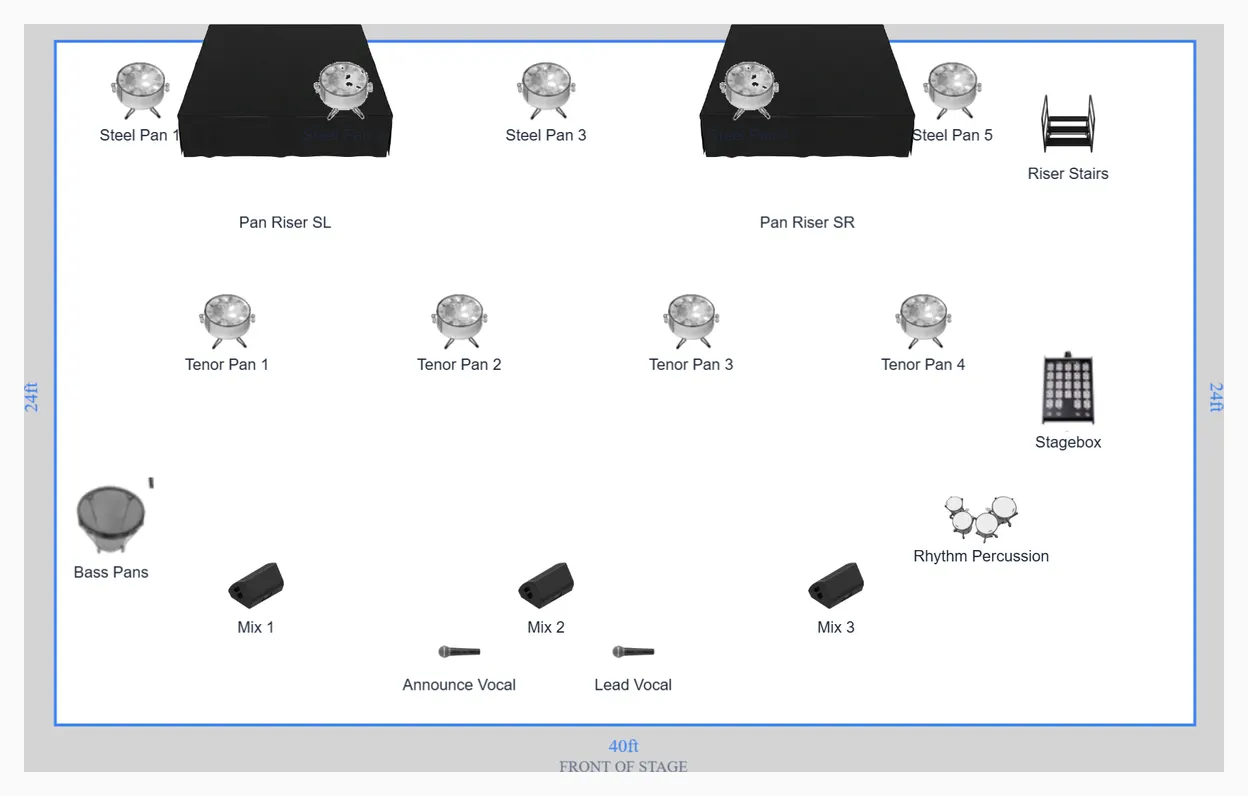
Nothing on this stage plugs in
Look at what is missing from this 40 by 24 foot plot. No amplifiers. No DI boxes. No drum kit. No keyboard, no playback rig, no instrument on the deck that produces an electrical signal of any kind. The only thing on the drawing that needs mains power is the 32 channel stagebox at x38, and the only inputs on the entire plot are microphones pointed at acoustic instruments.
That makes the advance conversation short and the microphone plan the whole job. It also means one thing nobody expects: on a stage this size with this many players, your input count is genuinely low. Ten to sixteen channels covers a full ensemble, which leaves an enormous amount of room in a 32 channel box. Use that room. Nobody ever regretted taking four area mics instead of two.
Area mics beat close mics on a pan row
The two pan risers sit at x11 and x29, both five feet off the upstage edge, which spreads the front pans across roughly thirty feet of width. Close mic every pan on those risers and you will be patching twelve channels of instruments that were already loud enough to be heard from the parking lot.
A tenor pan played properly puts out well over 100 dB at a metre. You do not need proximity, you need coverage. Two small diaphragm condensers per riser, three to four feet above the playing surface and spaced to cover the row, gives you four channels total and a natural blend the players have already balanced themselves. Gain will sit surprisingly low, which is a good sign. If a specific voice needs to come forward for a feature, add one spot mic for that pan rather than rebuilding the whole approach around soloists.
The other advantage is practical. Four stands on risers is a two minute set change. Twelve stands, with twelve cables dressed around players who move between pans, is not.
Bass pans and the engine room are separate problems
Two positions handle the low end and the drive, and they sit at opposite downstage corners. The bass pans are at x5, the rhythm percussion at x35.
Bass pans are six drums arranged in an arc around one player, with fundamentals between roughly 60 and 120 Hz. One microphone at the centre of the arc, a foot or two back from the rims, covers all six reasonably. Two mics covering three drums each is better outdoors, where a single mic also hears the whole field.
The engine room is the opposite problem. Irons, brake drums, congas, scratcher. Loud, metallic and violently transient. Condensers there will run out of headroom and sound harsh. Use dynamics, and budget two to four channels rather than one, because the iron and the congas want completely different treatment and you cannot separate them after the fact.
One set of stairs for the whole ensemble
There is a single three step unit at x38, stage right, serving both risers. For a twenty piece ensemble entering and exiting together, that is one door for a crowd, and it is the thing most likely to make the changeover run long.
Ask the venue for a second set of stairs at stage left. It costs nothing, it halves the load in and load out time, and on a wet outdoor deck it is a genuine safety item. While you are at it, confirm the riser height. Pan stands are tall and the players stand at them, so a 24 inch riser puts heads eight feet off the deck and into whatever is flown above.
Sun, wind, and steel that goes out of tune
Most steel pan work is outdoors, and the outdoor version of this plot is a different document.
- Heat and sun. A tuned steel pan drifts as its temperature changes, and direct sun on a chrome playing surface is brutal for both tuning and the player's eyes. A canopy over the risers is a production requirement, not a nicety. Ask for it in writing.
- Rain. Steel instruments and open condensers do not share an opinion about weather. Have a call time for covering the pans and a person assigned to it.
- Wind. Condensers pointed up over a riser in an open field pick up wind as low frequency rumble. Foam windscreens plus a high pass filter around 80 Hz on the pan channels, and dynamics as the fallback if the site is genuinely exposed.
- Shared bills. On a festival slot, assume the risers are not happening and have a flat version of this layout ready. The festival stage plot guide explains what changes when you are third on a rolling changeover.
Two wireless handhelds sit at x17 and x23 for announcements and lead vocal. Those two channels are how the audience learns what they are listening to, so do not let them be an afterthought at soundcheck.
Send the whole thing early. Use the advance email template to frame it, and run the stage plot checklist before you export the PDF.