Orchestral
Live Band with Chamber Orchestra Stage Plot Template
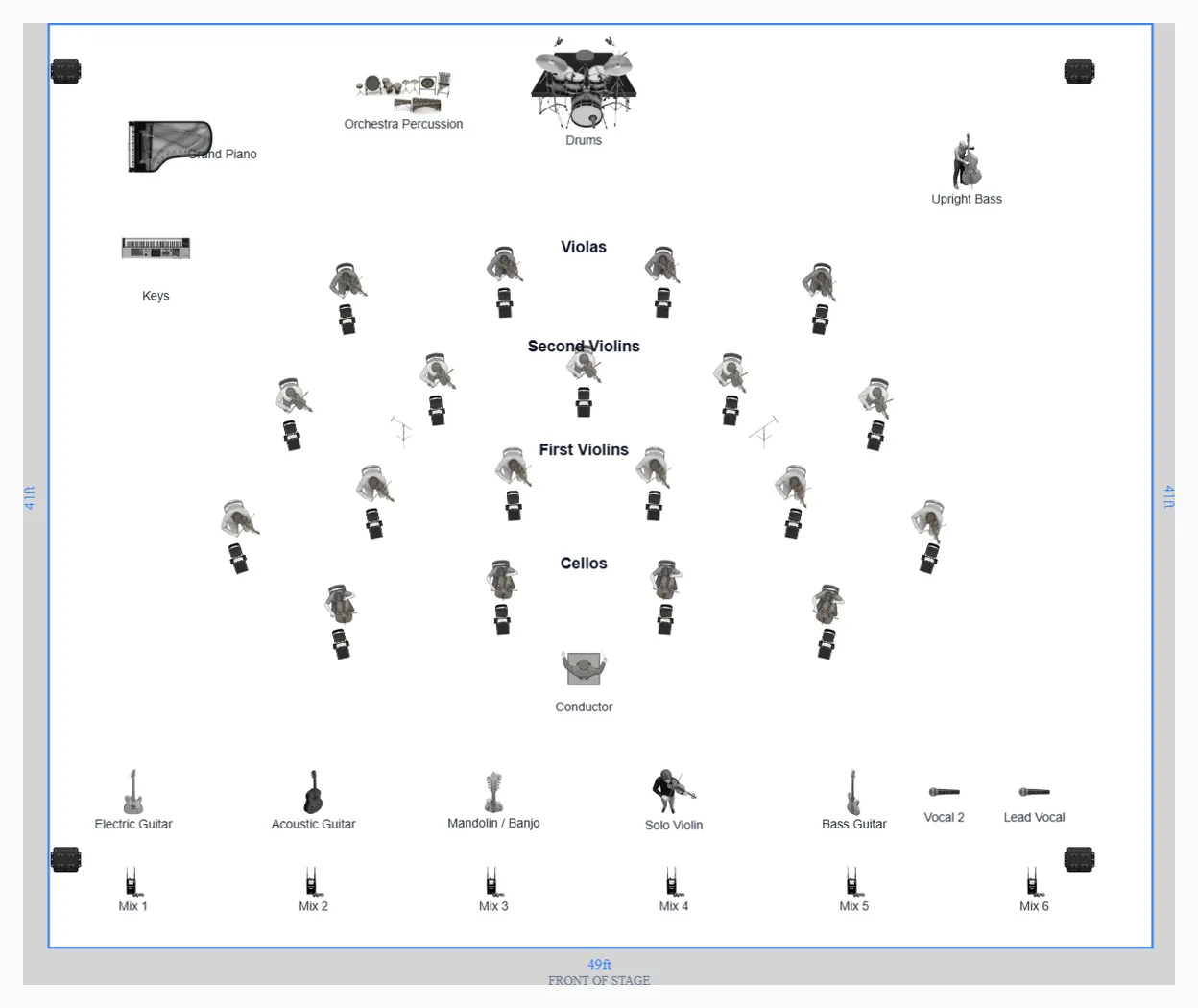
Plan a band with chamber orchestra using a deep stage, amplified rhythm section, close-miked curved strings, conductor, featured front line and six IEMs.
Two ensembles that want opposite things from one deck
A string section needs a quiet stage. A rhythm section does not provide one. Every other decision on this 49 by 41 foot plot exists to manage that conflict, and if you only skim one section of this page, make it this one.
The layout sandwiches the strings. A five piece kit on a riser sits 3 and a half feet from the upstage edge, with a grand piano, a stereo keyboard rig, orchestra percussion and an upright bass filling out that upstage band. Four string desks run up the centre line at 11 and a half, 16, 20 and a half, and 25 and a half feet. The conductor stands at 29 and a half feet, and the featured front line of guitars, solo violin, bass and two wireless vocals runs across the downstage edge at 35 feet.
Eight feet between the kit and the viola desk
That is the number. The seated violist is 8 feet downstage of a fully miked drum kit, with nothing between them. The orchestra main pair hangs at 19 feet, which puts it roughly 17 feet from the kit and about 7 feet from the nearest string player.
Seventeen feet is not far enough. A rock drummer at a normal playing level will be clearly present in an open pair 17 feet away, and no amount of EQ separates a snare from a viola once they are on the same channel. Three things make this workable, and you need all three.
- Drum shield or a low riser surround. Even a half height shield upstage of the kit buys several dB in the string pair.
- The drummer plays the arrangement, not the room. In orchestral repertoire that usually means rods or lighter sticks under the string features and full sticks only where the strings are tacet.
- The pair runs tighter than you would like. Cardioid, aimed down at the second row, not out at the section. You lose some hall. You keep the strings.
If the room and the budget allow, add close mics to the string desks and use the pair only as a blend. That is a genuinely different show and it belongs in the technical rider rather than in a conversation on the day.
Nothing on this stage is amplified by an amplifier
Look at the downstage line: an electric guitar, an acoustic guitar, a mandolin, a solo violin and an electric bass. There is not a single backline cabinet on this plot. That is not an omission, it is the whole reason the two ensembles can share a deck. Every electric instrument here runs direct, into a modeller, a preamp or a DI, and the players hear themselves in ears rather than off a speaker pointed at the strings.
The stereo keyboard rig deserves a specific note. It arrives as two channels, not one, and summing it to mono at the box throws away the width the arrangements were probably written around. Confirm it as a stereo pair in the advance, and check the stereo keyboard DI guide for how to get both sides to the stage without a ground loop.
There are also two bass sources on this plot: an upright at 42 feet across upstage, and an electric on the downstage line. Say clearly whether that is one player doubling or two players, because it changes whether those two channels can ever be open at the same time.
The conductor is facing away from half the show
The podium sits at 29 and a half feet, facing upstage into the strings. The front line at 35 feet is behind the conductor's back. Those five players cannot see a downbeat, which means the band is taking time from the drummer while the strings are taking time from the stick, and those two clocks will drift on any rubato passage.
Fix it in the plot rather than in rehearsal. Either put a small video monitor at the upstage edge showing the conductor, or angle the podium so the conductor works three quarter turned and the front line can catch a cue in peripheral vision. Flag whichever you choose as a production line item, because a confidence monitor needs a camera, a run and a power drop that nobody budgeted.
Four power drops, no wedges anywhere
Power lands at all four corners: two quad drops upstage at 2 and 47 feet across, and two more downstage in the same positions. That splits band power from orchestra power, which is worth keeping when you add stand lights to the four string desks.
What the plot does not carry is a single floor wedge. That is the right call and it forces a decision: the band runs in ears, full stop. A wedge at the downstage line points its energy straight up the centre aisle at the string pair 16 feet away. If someone on the front line insists on a wedge, put it hard at the outside edge, aimed across the stage rather than up it, and read wedges versus in ear monitors before you agree to more than one.