Country
Country Five Piece Stage Plot Template for Live Gigs
A country five piece stage plot template with drums, bass, guitar, steel guitar and a lead vocal, plus a wedge per player, ready for your next club or fair gig.
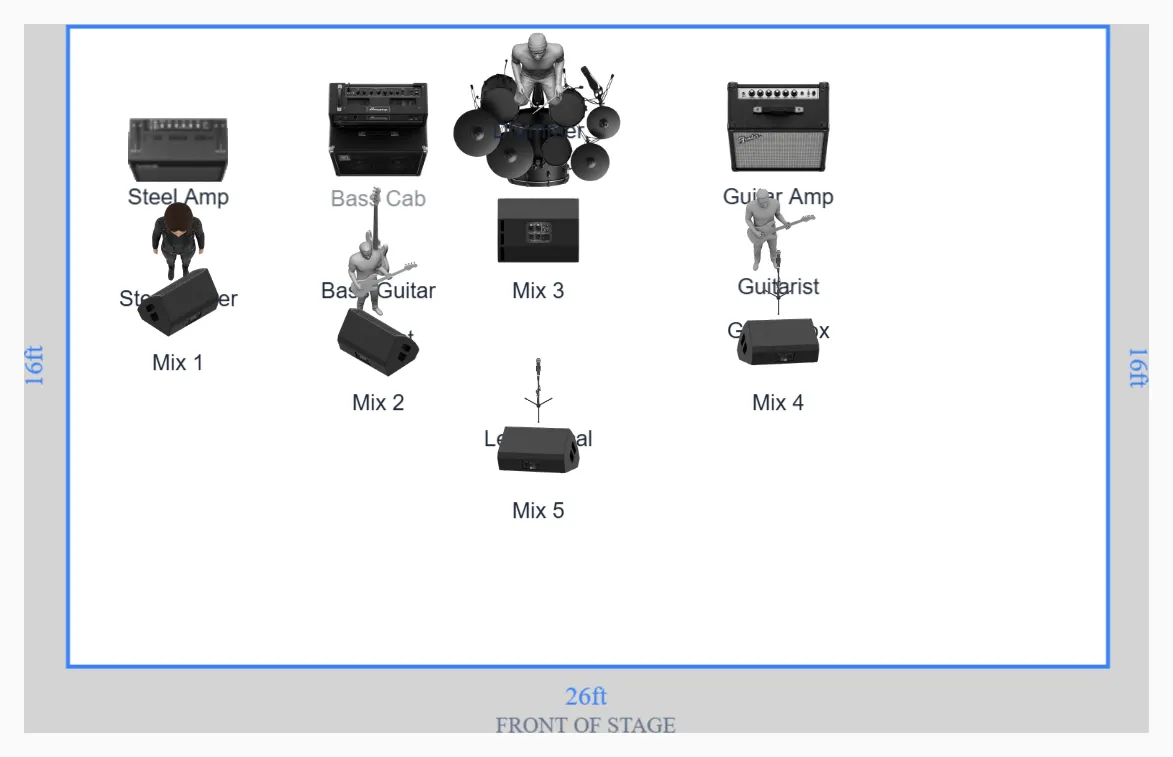
Two amps fifteen feet apart, fighting over the same octave
The pedal steel is what makes this plot different from every other five piece on the site, and the layout is built around keeping it away from the electric guitar. The steel amp sits far stage left at 4 feet across, and the guitar amp sits at 19 feet, with the Ampeg bass rig at 9 feet and the four piece kit at centre between them on a 26 by 16 foot deck.
Fifteen feet of separation is not about bleed. Two mic'd combos that far apart barely hear each other. It is about the mix, and about the players. A pedal steel and a Telecaster occupy almost exactly the same band, roughly 200 Hz to 5 kHz, with the same clean amp voicing and often the same reverb. The difference is sustain: the steel holds a note where the guitar decays, so in a busy chorus the steel disappears under a guitar that is objectively quieter. Putting them at opposite ends of the stage means each player hears their own amp and the other one from across the room, which is the only reliable way for two people to stop stepping on each other without an engineer refereeing.
The volume pedal is a compressor you cannot see
Every pedal steel player works a volume pedal continuously, which means the instrument arrives at the console with its dynamics already shaped, and shaped in a way that fools gain staging.
The practical number is that a steel's average level during swells sits 10 to 15 dB below its peak on a hard pedal down attack. Set the preamp on a swell and the peaks clip. Set it on the peak and the swells vanish. The only fix is procedural: at line check, ask the steel player to play the loudest thing they do in the set, then the quietest, and let the engineer set gain from the top with a limiter rather than from the middle.
Micing it is also not the same as micing the guitar amp. A steel amp is usually run cleaner, brighter and with more headroom than a guitar combo, and an SM57 jammed on the dust cap will give you an ice pick. Move the mic toward the cone edge, 2 to 4 inches back and off axis, or use a ribbon if the venue has one. Note your preference on the plot rather than hoping.
Two vocals, five wedges, and a singer holding nothing
The guitarist's vocal mic sits at their position at 19 feet across, and the lead vocal is at centre, 9 and a half feet from the back wall, well downstage of the whole band. That downstage position is the point: the lead singer is the only person on this stage not tied to an instrument, and the plot should show them out in front where they actually work.
Five wedges, one per player, with the lead vocal wedge furthest downstage at 11 feet from the back wall. That box sits a foot and a half in front of the vocal mic pointing back at it, which is the standard placement and also the highest feedback risk on the plot. Aim it at the singer's ears and deliberately off the capsule's axis. A cardioid rejects 15 to 20 dB directly behind it, and that rejection is the entire difference between a usable vocal wedge and one that rings at the first loud chorus.
The drum wedge is the other one worth noting. It sits downstage of the kit at centre, firing back upstage at the drummer, which keeps its rear toward the lead vocal mic 4 feet in front of it.
Where the steel and the guitar actually collide
In the wedges, not in the room. The guitarist will ask for more of themselves because the steel is filling the space they were hearing. The steel player will ask for the same thing for the same reason. Granting both requests ends with both wedges 6 dB louder and nothing solved.
The real fix is to take the other instrument out of each mix rather than adding your own. The guitarist needs kick, snare, bass and the lead vocal, plus enough of their own amp to phrase against. Steel in that mix is optional and usually counterproductive. Ask for it as a subtraction and the engineer will thank you.
What the venue needs a week out
Thirteen or fourteen channels depending on how the kit is mic'd, five monitor mixes, three amps needing power at three different points across a 26 foot stage. That is a real technical package for a bar gig and it belongs in writing. Build it from the technical rider template and send it with the plot, because five wedges and three power drops is the part a venue will discover too late otherwise.
If you are on a fair, festival or multi band bill, expect the backline conversation to change entirely, and read the shared backline guide before you agree to use a house rig. A steel player borrowing an unfamiliar amp is the one substitution on this stage that genuinely does not work. Confirm your input assignments in advance as well, since a clear patch plan is what keeps a 20 minute changeover from eating your set.