Rock
Five Piece Rock Band Stage Plot Template for Club Shows
A five piece rock band stage plot template with two guitar amps, DI bass, a full kit and three vocal mics, ready to advance a bigger club or theater gig fast.
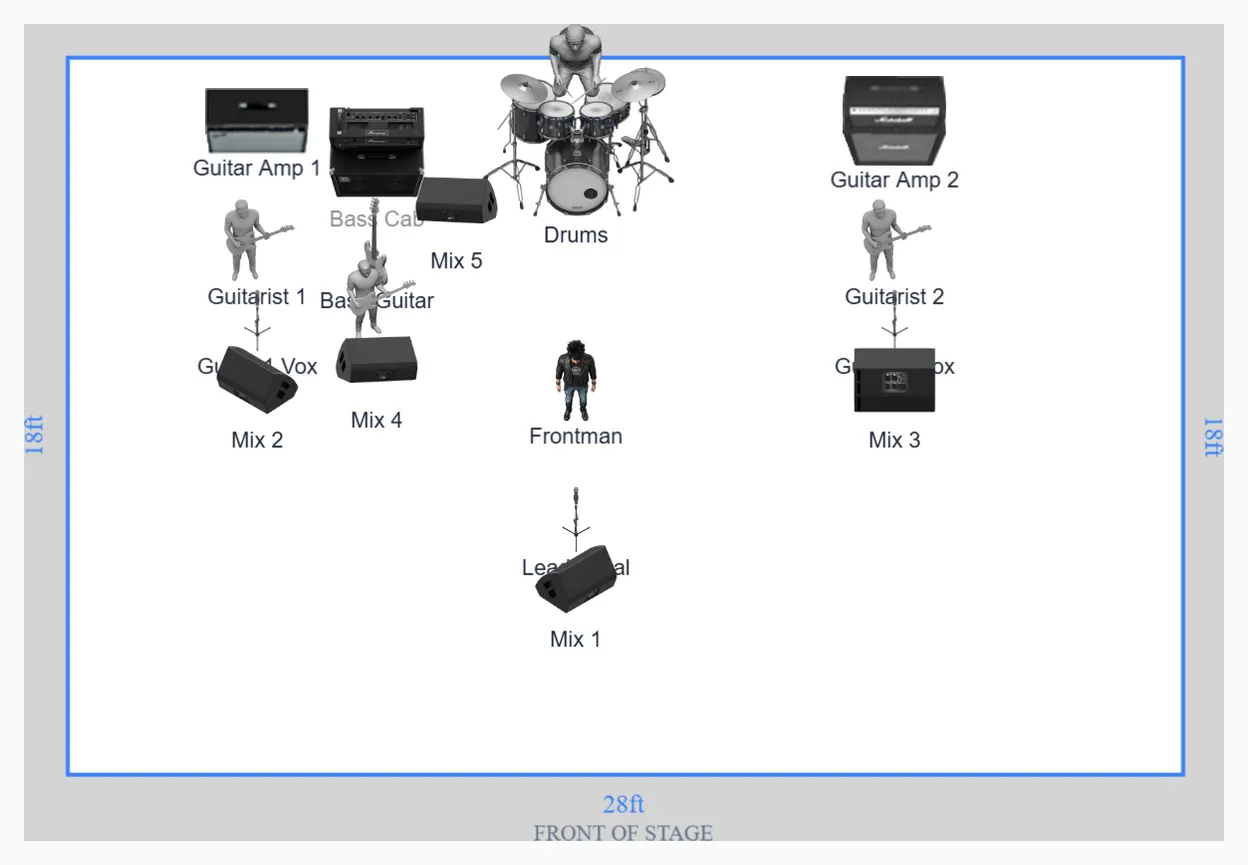
Five wedges is a bigger ask than five people
This plot draws a wedge for every performer: one at each guitar position, one for the bassist, one for the drummer, and one downstage centre for the frontman. Five wedges means five aux sends, and that is the number that quietly decides whether your show goes well.
Plenty of working club consoles give you four monitor sends before you start sharing, and on a busy multi band night you may be offered fewer than that regardless of what the desk can do. So ask the question in the advance, in those words: how many discrete monitor mixes do I have. If the answer is four, decide in advance which two players share, and make it the two guitarists rather than the frontman or the drummer. If the answer is five, you have what the plot shows and you can build it properly. Either way you have decided it at your kitchen table instead of at 6:40pm with a room filling up. A written monitor request turns that from a negotiation into a handover.
Two guitar amps sixteen feet apart, and a crowded stage left
The stage is 28 by 18 feet, which sounds generous until you place three cabinets and a kit along an upstage wall that is only 28 feet long. The Fender style amp is at 6 feet across, the Marshall style stack at 22, and the five piece kit is centre at 14. Sixteen feet between the two guitar cabs is workable separation.
The tight spot is stage left. The Ampeg bass cab sits at 9 feet across, roughly three feet from the first guitar amp, with the bassist directly in front of it. Guitar one and the bass rig are effectively sharing a corner, which means the guitar mic is hearing low end it does not want and the bassist is standing inside a guitar cab's throw all night. If you can move anything on this plot, slide the bass rig a foot or two toward centre and angle the guitar cab away from it. That costs nothing and it is worth more than any EQ move an engineer can make afterwards.
The bass cab is marked backline only. The channel comes off the bass guitar through a DI, which keeps a clean low end that is not being coloured by the corner it is standing in.
Three singers doing three different jobs
The frontman works centre with no instrument, on a vocal mic 12 feet downstage, and both guitarists have their own mics at 7 feet in. Those are not three copies of the same channel. The lead vocal needs to sit on top of a loud band all night and will be worked hard. The two guitar vocals are intermittent, sit lower in the mix, and spend most of the show as open mics collecting guitar cab.
Say that in the advance, because it changes what the engineer does. Backing mics that are only live in choruses can be gated or ridden, which recovers real headroom on a stage with two cabs. It also changes mic choice: the lead deserves whatever the venue's best handheld is, and the backing pair can be standard dynamics.
A frontman with no instrument also moves. Ask for a long enough cable run or a wireless channel, and expect them to work in front of the wedge line at some point in the set, which is a feedback risk the engineer would rather hear about in writing than discover in the second song.
Sixteen to eighteen channels, in an order that helps
Count it: 8 to 9 for a miked five piece kit, 1 for the bass DI, 2 guitar cabs, 3 vocals. That is 14 to 15 inputs before you add a talkback or a spare, so budget 16 to 18. That fits a 24 channel club desk with room, and it fills a 16 channel desk exactly, which is why the number is worth stating rather than assuming.
List those inputs in the order an engineer patches them rather than the order they occurred to you. Kick, snare, toms, overheads, bass, guitars, vocals is the convention, and the reasoning behind it is in the channel order guide. If you have never written the document that goes with the drawing, the input list template is the fastest way to get one that does not need rewriting on site.
- Drummer moves to ears. That frees an aux for the frontman and takes the loudest wedge off a crowded stage.
- Keys player added. That is a stereo pair and a sixth mix, and the 28 foot width will not absorb it without moving a guitar rig.