Rock
Three Piece Rock Band Stage Plot with Guitar Bass Drums
A three-piece rock plot with five-piece drums, bass DI, mic’d guitar amp, lead and backing vocals, personal monitor mixes, and compact stage infrastructure.
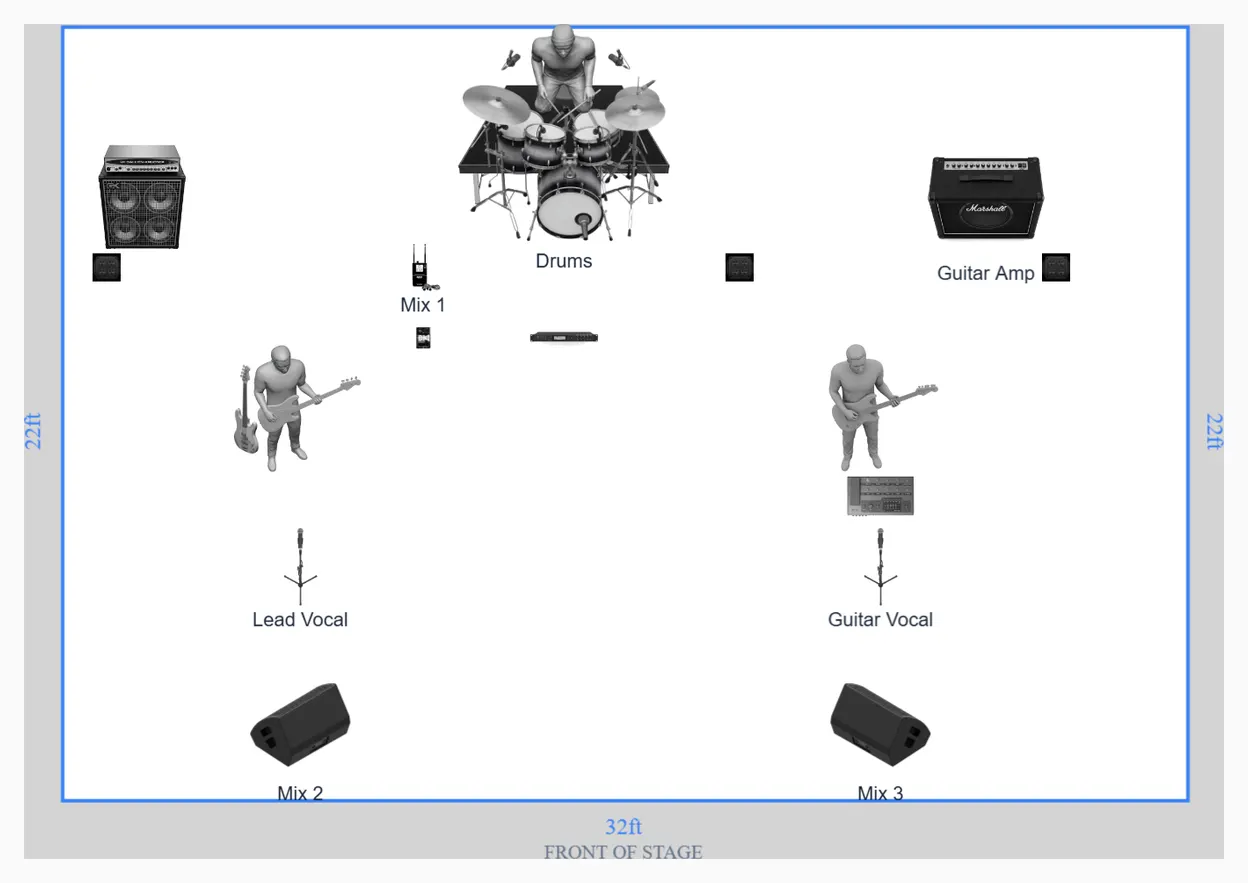
A three piece that shows up with infrastructure
Most trio plots are drawn as if three people means three lines and a handshake. This one is not. It has a riser, a stagebox, a DI, three power drops and an in ear feed for the drummer, on a 32 by 22 foot stage. That is a production document for a band that is playing 300 to 800 capacity rooms and support slots, where the crew you are working with has 45 minutes for your changeover and no patience for improvisation.
Three people spread across 32 feet is a lot of stage per player. The five piece kit sits centre at 16 feet across on a stage riser, the bassist works stage left at 8.5 feet in, and the guitarist works stage right at 25. That is roughly 17 feet between the two of them, which is comfortable to move in and far enough that neither one is hearing the other acoustically with any accuracy. On a trio, that matters more than it does in a bigger band, because there is no third instrument gluing the two of you together.
Twenty four feet between the two cabs
The bass 4x10 is at 4 feet across and the guitar stack is at 28, both at 5 feet deep. Twenty four feet of separation between the two loudest cabinets on stage is the single biggest gift this layout gives front of house. Guitar spill into the bass mic position and vice versa drops off substantially at that distance, and the two vocal mics downstage at 15.5 feet sit roughly ten feet in front of both cabs rather than beside either one.
Spend that separation rather than wasting it. Because the cabs are far apart and far from the mics, the engineer can mic each one closer and hotter than they could on a small stage, which usually means a better capture. Point each amp slightly inward toward the kit instead of straight out at the audience, and the first four rows stop getting hit by raw guitar that front of house cannot pull back. The bass runs through a mono DI at 12 feet in, so the cab exists for the player and the DI exists for the mix.
One stagebox at centre, and what that saves
The stagebox rack sits at 16 feet across, 9 feet deep, which is dead centre and just downstage of the riser. Every input on this plot lands within about 14 feet of it. That is the difference between a patch that takes 10 minutes and one that takes 35, and it is why the box is drawn on the plot at all rather than left as the venue's problem. If your band tours with its own splitter or subsnake, the placement conventions and what to tell the house engineer are covered in the stage box and subsnake guide.
Three AC quads sit at 7 feet deep, one behind each cab and one by the riser. The guitarist's pedalboard at 13.5 feet in gets its own reach from the stage right drop, which is the whole reason the drop is there. A board running digital delay and a tuner off a daisy chain from the amp is the most common source of a hum nobody can locate at line check.
Ears for the drummer, wedges for the front line
The drummer is on in ear monitors and the bassist and guitarist each have a floor wedge at 20 feet downstage. That split is the right call for a trio, and not just for volume. A drummer on ears can take a click or a track feed without leaking it into every mic on stage, and the two players out front keep the physical feel of a wedge, which most rock guitarists play better against than they do against a sealed mix.
Both wedges have to carry a vocal over a loud cab. Ask for vocal first, the other person's instrument second, and your own last. Guitarists reliably request their own guitar in a wedge when they are already standing ten feet from a stack that is doing the job.
Fourteen channels for three people
Counted honestly: 8 to 9 for a fully miked five piece kit, 1 to 2 for bass depending on whether you add an amp mic to the DI, 1 guitar cab, 2 vocals. That is 12 to 14 inputs, 3 monitor mixes, 3 power drops. The kit is the majority of your channel count, which is normal for a trio and worth planning properly with the drum mic guide rather than accepting whatever four mics the venue has spare.
Because this plot carries a riser, an IEM feed and named power positions, it has crossed the line from a drawing into a rider. Put it inside a real one using the tech rider guide and send both together.