Rock
Tribute Band Stage Plot with Drums Keys and Two Guitars
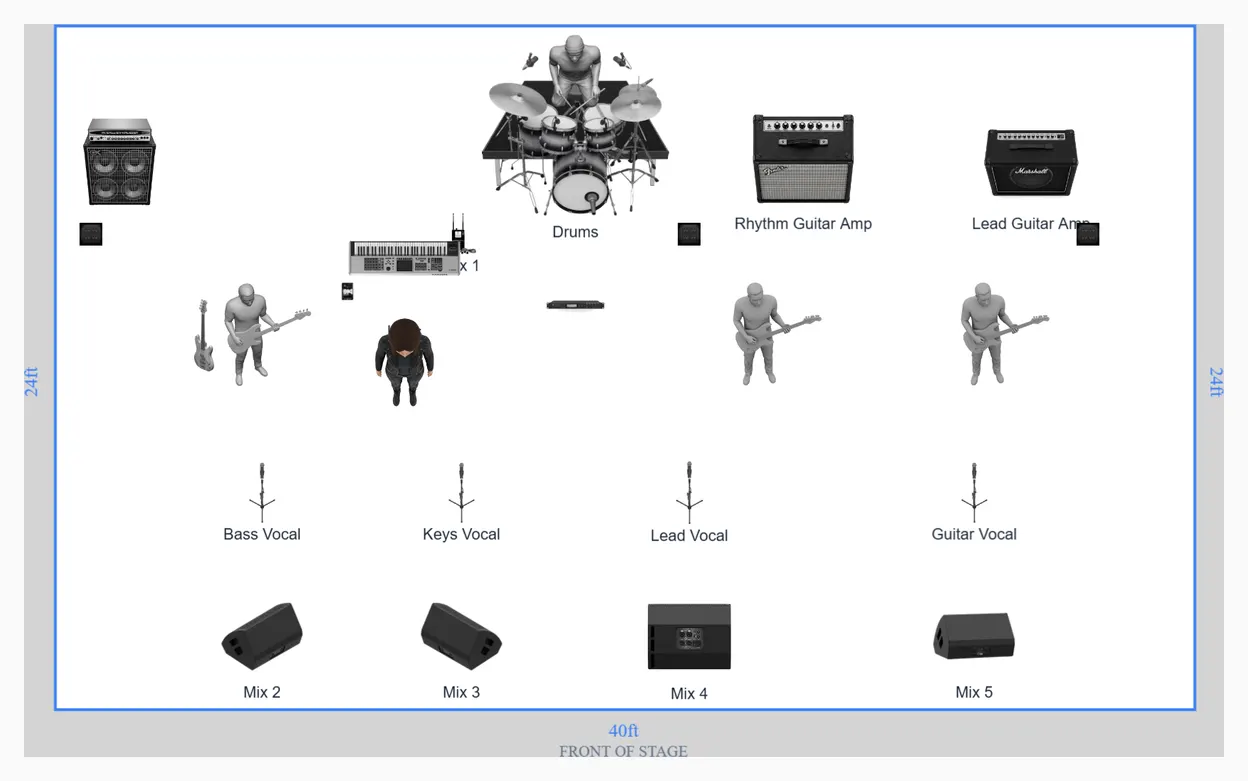
A five-piece tribute-band plot for touring shows with drums, bass DI, stereo keys, two mic’d guitar amps, four vocals, five monitor mixes, and compact patching.
The same show, forty nights, forty different engineers
A tribute act has a problem no original band has. The audience already knows exactly what the songs are supposed to sound like, and they will notice if tonight's version does not match the record they have owned for thirty years. You cannot fix that with a good soundcheck. You fix it by making your input list so rigid that every engineer on the run builds the same mix from the same starting point.
That is what this plot is for. Everything on it is fixed, named and in the same place every night, across a 40 by 24 foot stage.
A fixed patch is the actual product
Twenty six placements, and the channel count barely moves show to show. The micd five piece kit sits on a riser at x20, the bass runs through a mono DI at x12, keys are a stereo pair, two guitar amps are miked, and four vocals sit on booms across the downstage edge at y16.
Number them once and never renumber them. Kick, snare, toms, overheads, bass DI, guitar stage right, guitar further stage right, keys left, keys right, then vocals bass, keys, lead, guitar in that stage order. Send that list ahead of every date as a PDF with the plot, and ask for the console scene to be saved and named after your band. On a digital desk that turns a 40 minute build into a 10 minute check, and it means the fifth show of the week starts where the fourth one finished. The mechanics of asking for it are in the stage patching guide, and the wording that gets a useful reply is in the advance email template.
Two amps, eight feet apart, and neither one is generic
The Fender style rhythm amp is at x28 and the Marshall style lead amp is at x36, both at y4.5. Eight feet of separation on a 40 foot stage is deliberately tight, because these two rigs are supposed to sound like one guitar section, not two soloists in different rooms.
That closeness costs you isolation, so the mic choice matters more than usual. Put both close mics off centre on the cone, and angle the two cabinets away from each other by 20 degrees or so. If you want the clean rhythm part to stay clean under a saturated lead, the separation has to come from cabinet aim and mic position, not from the engineer trying to gate two channels that hear each other.
Signature tone is the whole job here, so resist the urge to let a house engineer "improve" the guitar sound. Ask for flat, then adjust from your amp. An engineer who has never heard the record will EQ toward what they think a guitar should sound like, and that is exactly the thing your audience will notice.
Stereo keys are two channels, and people keep forgetting the second one
The stereo keyboard rig at x14 is not one input. It is a left and a right, and if only one gets patched you lose half the patches on the board, usually the ones with the wide chorus that made the original sound the way it did. Label them Keys L and Keys R on the list, ask for them panned hard and linked as a stereo pair, and check both sides during line check by playing something that only appears on one. The reasoning behind running keys as a genuine pair is covered in the stereo inputs guide.
Riser, in ears, and the one player who cannot drift
The drummer gets an IEM feed at x16 y7. Everyone else is on one of four wedges at y21. That split exists because a tribute show usually runs to a setlist with fixed tempos, and the drummer is the only person who needs a click. Sealed ears also protect the one player who has to reproduce specific fills in specific places for three hours.
Riser height is a production item, not an audio one, but it will eat your load in if unconfirmed. Two feet is normal. Three feet changes sightlines and the length of every drum cable you own.
Three power drops and a rack at centre
Power sits at x3, x24 and x38, and the stagebox rack sits centre at x20 y9.5 behind the keys. That is a short cable run to every position on the stage, which is the point. Keep pedalboards and keyboard supplies on the same drop as their own amp where you can. Splitting one player's rig across two circuits is the most reliable way to invent a ground hum that nobody can find with a support act waiting to load in.
- Fly dates. Specify cabinets, not heads, and confirm the DI count.
- Festival slot. No riser, no IEM rack, plan the flat version in advance.
- Extra vocal. Add the channel to the master list, not to that one show.