Country
Six Piece Country Band Stage Plot Template for Touring Shows
A touring country-band stage plot for six players: drums, bass, keys, pedal steel, electric and acoustic guitars, vocals, monitor mixes, and tidy patching.
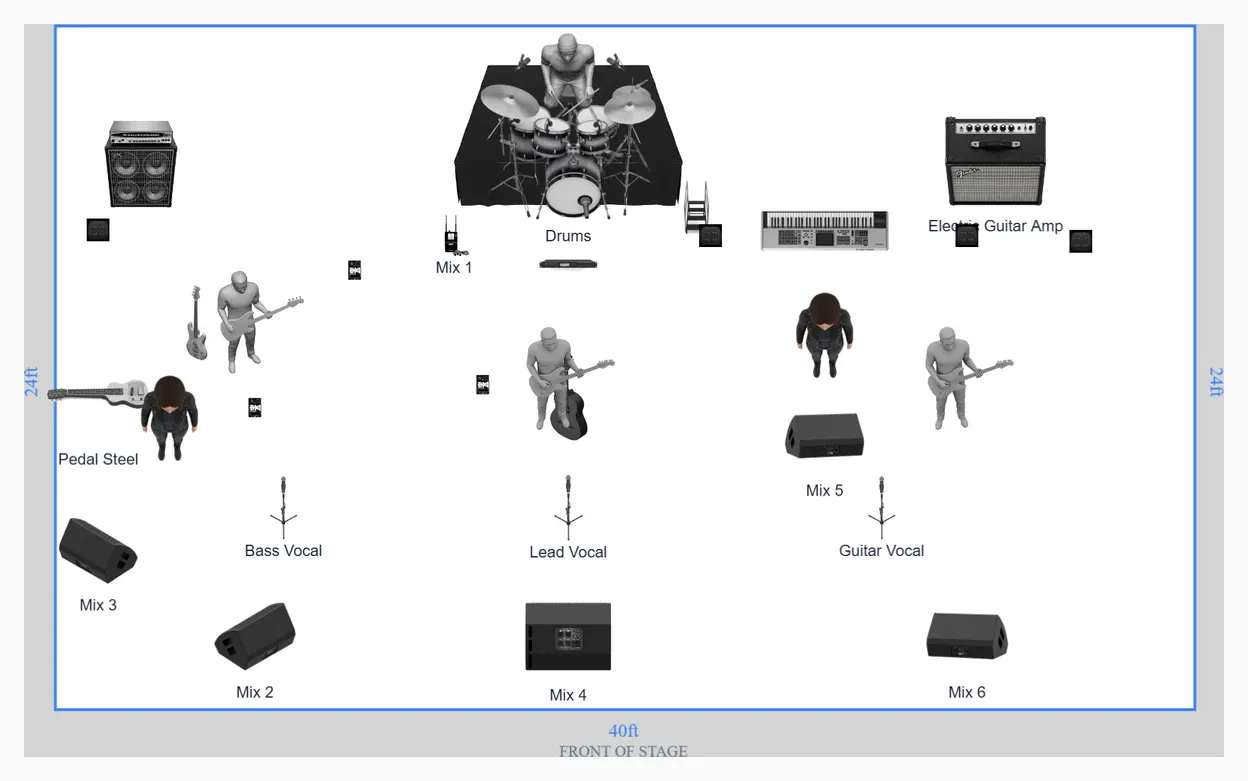
Forty by twenty four feet, and every foot of it is used
This is the largest plot in the country category and nothing on it is decorative. Six players spread across 40 feet, a drum riser centre at 20 by 3.5 with four step stairs coming off the stage right side at 24.5 by 6, a micd five piece kit on top of it, and a rack at 20 by 8 directly downstage of the riser where every line on the stage can converge.
The wide spread is not vanity. Pedal steel at 3.5 feet across and an electric guitar amp at 35 feet is 31 feet of separation, and that is the difference between two instruments in the same frequency range bleeding into each other's mics all night and two that leave each other alone.
Three DI boxes, and the pedal steel is the one to get right
Three mono DI boxes are drawn on this plot: at 12.5 by 8.2 for the bass, 9 by 13 for the steel, and 17 by 12.2 for the acoustic. Drawing them is the point. A plot that says acoustic guitar gets you a mic stand. A plot that shows a DI at a named position gets you a box, a line and a channel already labelled before you walk in.
The bass runs amp and DI together, which is standard: the 4x10 cab at 5 by 4.5 for the stage sound, the DI feeding the house. Say whether you want it pre or post the amp EQ, because that choice belongs to the player and otherwise gets made by default at the patch panel.
The pedal steel is the one that goes wrong. It is a high impedance instrument with enormous sustain and it needs an active DI rather than a passive one to keep the top end and the bloom intact. A passive box on a steel sounds thin and slightly dead, and the player will chase it with the tone control all night instead of saying anything. Ask for active, and ask early.
The volume pedal is a gain staging problem, not a mix problem
A steel player rides a volume pedal continuously. The channel therefore arrives at the desk with 30 or 40 dB of range in ordinary playing, from a swell that starts at silence to a full chord under a chorus.
Compress it lightly if at all, and set the gain to the loudest passages rather than the average, because clipping the top of a swell is far more audible than a quiet intro sitting low. Demonstrate it at check by playing the quietest and the loudest thing in the set back to back. Most engineers will otherwise set steel gain off one mid volume phrase and fight it for the next hour.
The same logic applies to the acoustic guitar at 20 by 12.6, played by the lead singer and switched in and out through the set. Mute it when it is not in hand or it becomes a second vocal mic pointed at the wrong thing.
Four power drops, drawn where they are actually needed
Most plots leave power off entirely and then lose 20 minutes at load in to an extension cord hunt. This one draws four 120 volt quad boxes: 3.5 by 6.8 for the bass rig and the steel, 25 by 7 for the drum riser, 34 by 7 for keys, and 38 by 7.2 for the guitar amp.
Four drops on a six piece is the right number, and the reason is separation rather than capacity. Keys, a steel preamp and a pedalboard supply sharing a circuit with a dimmer rack is a hum no EQ will fix. Ask for audio power on circuits separate from lighting and say it in the advance while it can still be arranged.
One rack, and the patch that runs through it
The stagebox rack at 20 by 8 is where the whole stage converges. Expect 24 to 28 channels once the kit is counted: 7 or 8 on drums, bass amp and DI, steel, stereo keys, electric guitar, acoustic, and three vocals.
Run a sub snake to each wing rather than pulling 20 individual lines 35 feet into the middle. The stage patching guide covers how to split a stage this wide without turning it into a rats nest, and the band input list template gives you a format the house engineer can read in one pass.
Five wedges, one ear mix, and three vocals on booms
The drummer is on in ears at 16 by 7 and everybody else is on wedges: bass at 9 by 21, steel at 3.5 by 18, lead at 20 by 21, keys at 29 by 14, guitar at 34 by 21. Five wedge mixes plus one ear mix is six sends, and on a 40 foot stage that is genuinely six different rooms. The bass player at 9 feet across cannot hear the guitar amp at 35 feet acoustically in any useful way, so their wedge has to supply it rather than just flatter their own instrument.
The three vocal mics sit in a line 16.5 feet back, at 10, 20 and 31 feet across, all on tripod booms. Tripods rather than round bases matter here because every singer also moves to and from an instrument, and a round base is a foot trap in the dark.
Send the monitor asks in writing before the day using the monitor mix request template. Six mixes built from scratch at soundcheck is 40 minutes. Six mixes built from a written starting point is 15, and the difference is the rest of your line check.