Function
12-Piece Wedding Band Stage Plot Template with IEMs
Start with a 12-piece wedding band plot for drums, percussion, bass, guitar, two keys, four horns, three vocals, risers, stagebox and twelve named IEMs.
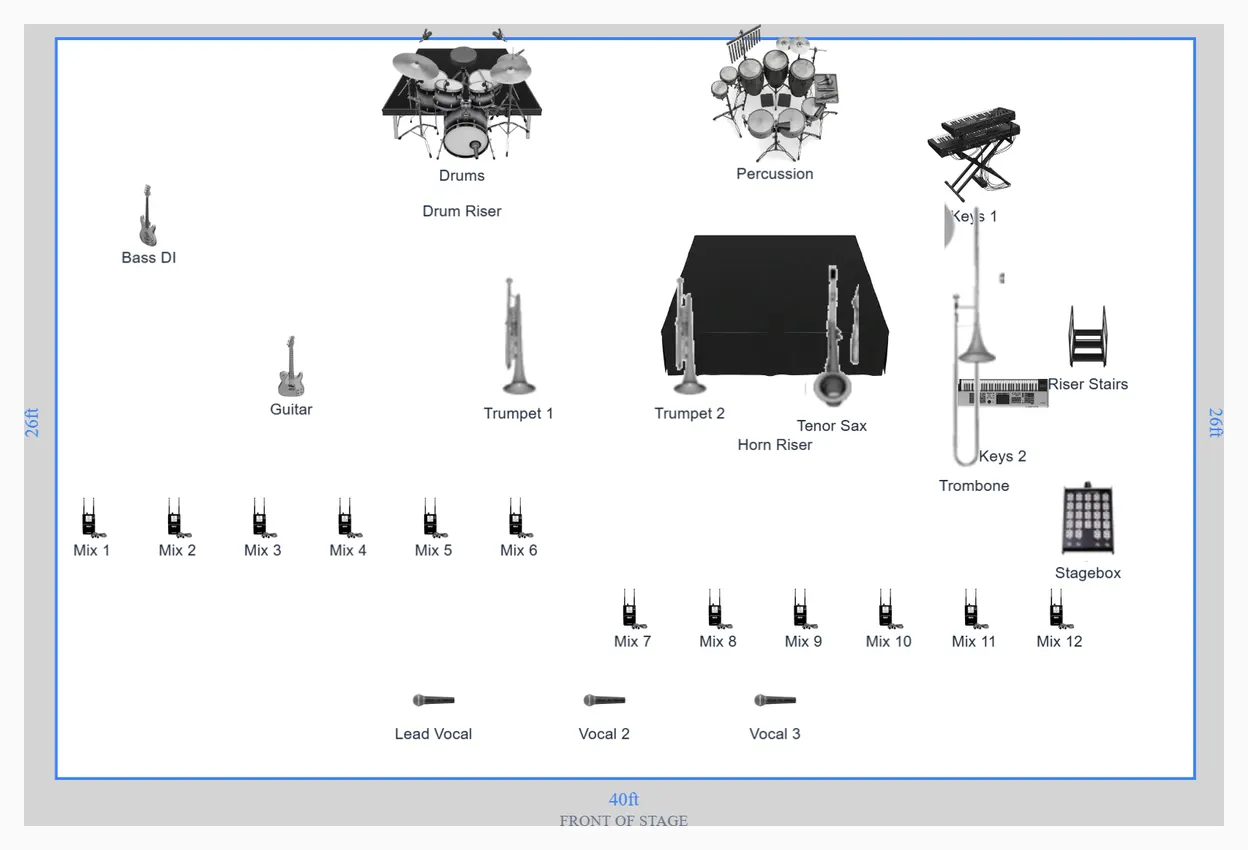
Twelve players and not one floor wedge
Look at the plot and notice what is missing. There are no wedges anywhere on this 40 by 26 foot stage. Not one. Every player on the deck is on ears, and that single decision changes the advance, the changeover, the front of house mix and the argument you are going to have with the venue more than any other line on the page.
The band lives in three bands of depth. The miked five piece kit sits on a riser at the 3 foot line just left of centre with the latin percussion rig beside it at the 27 foot mark. Bass, guitar and two keyboard rigs fill the middle band between 5 and 13 feet deep. The four horns work a straight row across the 11 foot line, with the horn riser under them, and the three wireless handhelds sit at the 23 foot line, three feet off the downstage edge.
What a fully in ear stage buys you
Stage volume is the whole prize. With no wedges open, the only acoustic sources left are the kit, the percussion and whatever the guitar amp does, which means the vocal mics stop hearing the monitor world. Front of house gets 6 to 10 dB more usable gain on the vocals before anything rings, and a room with a 95 dBA cap suddenly has room for a horn section.
The second prize is repeatability. Twelve personal mixes that the players build themselves do not have to be rebuilt in every ballroom. The third is speed. A monitor build that would take 25 minutes with eight wedges takes about five when the mixes recall from the band's own rack. If you are still deciding between the two worlds, the tradeoffs are laid out in the wedges versus in ear monitors guide.
What the band owns and what the venue still owes you
This is the part bands get wrong in the advance. A twelve piece IEM stage is a rig the band brings, not a service the venue provides.
The band arrives with the transmitter rack, the packs, the earpieces, a personal mixing system if the players build their own blends, and, critically, a split. A digital split over a network protocol or a passive analog splitter is what lets the band's monitor world and the venue's front of house console share the same 26 microphones without fighting over gain. Without a split there is exactly one gain structure on stage and it belongs to whoever plugged in first.
The venue still owes you four things: a stage box position at the 38 foot mark stage right where the 32 channel box is drawn, a clean 15 amp circuit for the RF and IEM rack that is not shared with lighting, front of house lines to that box, and an ambience pair or a talkback path so the band can hear the room. Spell all four out in the rider. The technical rider template has the language for it.
Twenty six channels into a 32 channel box
The count runs roughly eight or nine for the kit, three or four for percussion, one bass DI, one guitar, two for the double keyboard rig, two for the stereo keys, four horns and three vocals. That is 25 to 27 before you add a talkback mic, a playback pair and an ambience pair, which is how a 32 channel box goes from generous to full. Decide in the advance whether playback rides on the band's rack or the venue's, because the answer changes who owns the last four inputs. The stage box and split guide covers how the two consoles share those lines.
What an all ears stage costs you
Three real costs, and they all land on the bandleader.
- Nobody hears the room. Sealed ears cut a wedding audience out entirely. You need an ambience pair or the band plays to a wall of silence and pushes tempo all night.
- RF gets crowded. Three wireless vocals plus the IEM transmitters plus the venue's speech mics and the DJ is easily 15 to 20 coordinated frequencies in one ballroom. Trade frequency lists a week out.
- One failure is total. A dead pack mid set is not a quieter mix, it is a player with nothing. Carry spare packs and spare batteries at the riser stairs where somebody can reach them without crossing the stage.
Open the template, mark where your split lands, and export it with the rider.